


Heißer Verkauf

ANWENDUNG

Phone:+86-15215969856 E-Mail: 396838165@qq.com
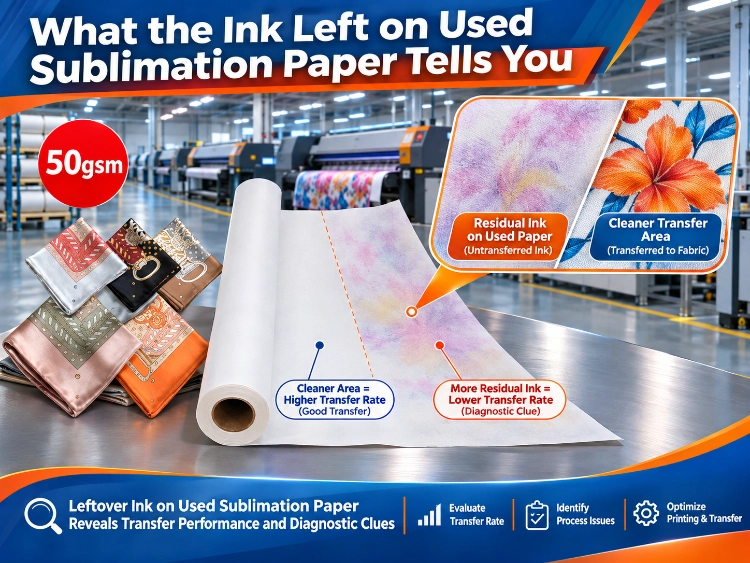
Every transfer produces two results: the fabric, and the spent sheet that comes off it. The fabric gets inspected. The sheet usually goes straight into the bin — although it is the more honest of the two records. The fabric shows that something went wrong somewhere. The used paper shows where, because the dye that should have moved and did not is still sitting on it, printed as a map of the transfer that failed to happen.
Reading that map costs nothing and takes a minute. It also separates faults that look identical on finished cloth. A pale panel can come from a cold zone on the press, from pressure falling away at one side, from a cycle that was short for the whole job, or from damp material — and each of those leaves a different pattern of ink behind on the sheet.
The Reference: What a Clean Sheet Looks Like
Faint and Even Is the Target
In a sound transfer, most of the dye leaves the paper. The spent sheet keeps a ghost of the design — visible, but pale and, above all, even: the same faintness in the centre as at the edges, in the dark areas as in the light ones, adjusted for how much ink each area carried. The grades a line runs every day are rated for exactly this. The 40 and 50gsm papers on the Changfa Digital range carry a transfer rate of 95 to 98%, and the heavy 100gsm grade is rated above 98%, so a well-run sheet should come off the press looking spent, not loaded.
Keep a Known-Good Sheet as the Comparison Standard
A single sheet is hard to judge without a reference, because heavy designs legitimately leave more behind than light ones. The working method is to keep the spent sheet from the first approved piece of a job — same paper, same fabric, same settings — and compare later sheets against it. Deviations from that sheet, not from an imagined ideal, are what carry information.
On a calender line the record is continuous rather than a single sheet. The spent web comes off in one length, so mark the metre where the run starts and read one full design repeat at a time. A leftover pattern that sits in the same place in every repeat belongs to the cycle of the equipment. A pattern that drifts, strengthens or fades along the length belongs to the material or the room. Separating those two behaviours on the web tells the operator whether to stop the line now, or finish the roll and correct the conditions before the next one.
Reading the Deviations
One Dark Zone Points at That Zone of the Press
When one area of the sheet stays dark while the rest releases cleanly, the dye in that area never received the conditions the rest did. The cause sits in the same position on the equipment: a worn or contaminated section of calender blanket, a cold spot on a platen, or pressure falling away locally. The leftover pattern reproduces the press map, which is why it is worth comparing against the checks for keeping fabric alignment and transfer results consistent on heated equipment. A settings change applied to the whole press cannot repair a fault that lives in one zone of it.
Dark Edges With a Clean Centre Point at the Boundaries
If the centre of the sheet is spent and both edges stay dark, the transfer weakened toward the sides. Heated width narrower than the working width, pressure dropping at the edges, and fabric or paper overhanging the evenly heated zone all produce this signature. It appears most often when a line moves to a wider roll without re-proving the full width, and the fabric edges carry the cost as pale borders and rejected panels.
A Sheet That Is Dark Everywhere Indicts the Cycle
Uniform darkness is a different verdict. When the whole sheet holds its colour, no single zone failed; the cycle itself was short for the combination — temperature or time below what that paper and fabric need to complete the transfer — or the paper’s release does not suit the job. This is also the pattern with a direct cost attached, since dye retained on the sheet is dye paid for and thrown away, the subject of the hidden costs of a low transfer rate. The correction is in the cycle and the material pairing, not in local press repairs.
Blotchy Leftovers Point at Moisture
An irregular, cloudy pattern — darker in patches that follow no geometry of the press — usually means the transfer conditions varied across the sheet itself. Uneven moisture in the paper or the fabric is the common cause: damp areas transfer differently from dry ones, and the sheet records the difference. The remedy sits before the press, in keeping paper sealed and dry until use and in letting cold material reach room condition before it runs.
The Paper That Carries the Record
The reading is only as consistent as the paper producing it. A grade whose release varies along the roll writes noise into every sheet and makes zone faults hard to separate from material faults. The 50gsm Jumbo Roll Sublimation Paper is the general production grade Changfa Digital supplies for this work — a three-star ink-load rating with the 95 to 98% transfer rate quoted above — so the spent sheet from a run means the same thing at metre fifty as it does at metre five hundred.
Schlussfolgerung
The used sheet is a transfer report that the line already produces and usually throws away. Faint and even means the cycle, the press and the paper agree. A dark zone locates the fault on the equipment, dark edges mark the boundaries of the heated area, uniform darkness condemns the cycle, and blotches point at moisture. Read against a known-good reference sheet, one minute with the waste tells the operator where to work next.
To have a result read, send the press type, the temperature and time in use, the paper grade and GSM, the fabric, and a description or photograph of what the spent sheet kept. The pattern is usually enough to name the cause family before anyone touches a setting.
Häufig gestellte Fragen
Q1: How much ink should remain on the paper after a good transfer?
A1: A small, even fraction. Papers rated at a 95 to 98% transfer rate should come off the press holding only a faint ghost of the design, uniform across the sheet. More than that — or the right amount in the wrong pattern — is information: heavy designs leave more behind than light ones, so judge the sheet against a known-good sheet from the same job.
Q2: Can the used sheet be run through the press a second time?
A2: It should not be. The coating has already given up its dye unevenly — fully in the areas that transferred, barely in the areas that did not — so a second pass prints that unevenness into the next piece, and residue carried on the sheet can mark the press and the following work. The sheet’s value after pressing is diagnostic, not productive.
Q3: Does a dark spent sheet always mean the fabric came out pale?
A3: Not always, and the two should be read together. A saturated design can leave a strong ghost on the sheet while the fabric has taken all the dye it can hold. The warning sign is a mismatch: a dark sheet under a pale fabric means dye stayed behind that the fabric needed, and the pattern of what stayed shows where it failed to move.


