


Vente chaude
Application
Phone:+86-15215969856 E-Mail: 396838165@qq.com
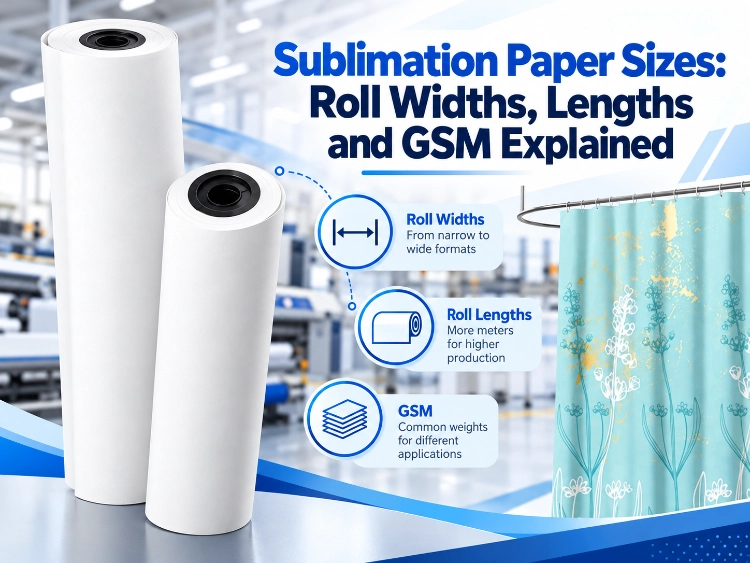
“Send the usual 162.” That is a real order line we get, more or less word for word, a few times a month. The usual 162 what, though? At 162 cm wide this factory slits eleven different papers, from a 30gsm roll a kilometre long down to a 100gsm roll that runs out at 100 m. Same width. Completely different animal on the machine.
Sublimation paper sizes look like a long random table until somebody points at the pattern, and then you cannot unsee it. Weight decides length. Weight decides which widths exist. And the width you can have this week is a shorter list than the width you can have at all. Here is the table the way our slitting room reads it.
One pattern runs through the whole size table
Lighter paper, longer roll — every time
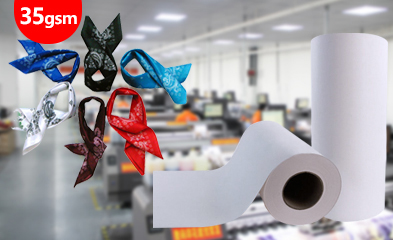
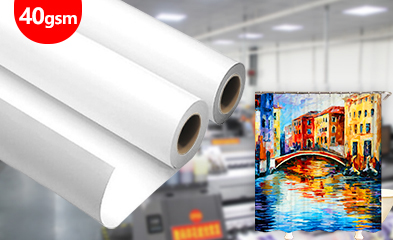
Read the standard lengths down the grades and they climb like a staircase. 100gsm and 90gsm come off the shelf at 100 m. The 70 and 60gsm rolls carry 200 m. The 50gsm jumbo roll sits at 300 m, and from 40gsm down — 40, 35, 31, 30 — the standard roll is 1,000 m. Nothing about that is an accident. A metre of thin paper weighs less and winds tighter, so the roll a man can lift and a shaft can carry simply holds more of it. Even the roll diameters tell the story: the 100gsm roll is a neat 16.5 cm across, the 35gsm roll swells to 25.5 cm and the 40gsm to 28 cm, because there is a kilometre of paper in there. Reading a quoted length in metres, roll weight and cost together is a separate habit, and we covered it in reading roll length properly.
Jumbo lengths stretch the same logic further. The 50gsm grade runs from its 300 m shelf roll out to 3,000 m for factories that load once and print for days. Small rolls exist for the other end of the market — sampling rooms, small presses, shops that would rather change rolls than store them.
Heavy grades own the narrow widths
Widths split the range just as cleanly. The heavy end — 60, 70, 90, 100gsm — starts at 61 cm and climbs through 91.4, 111.8 and 132 cm before it reaches the wide textile widths. Those small sizes feed mug presses, panel work, desktop and entry machines. The light grades do not bother with any of that. From 50gsm down, the width list starts at 132 cm, because nobody runs a kilometre of 35gsm paper through a mug press. Light paper is roll-to-roll textile paper, and its widths — 132, 142, 152, 153, 155, 160, 162, 172, 180, 183, 190 cm — are fabric widths, chosen to sit inside a printer’s working width with the fabric underneath.
The stock list is shorter than the size list
Here is the part that actually decides delivery dates. A grade can exist in fourteen widths and be stocked in four. The heavy grades keep 111.8, 152, 162 and 183 cm on the shelf, with 60gsm adding 160 and 172. The mid and light grades from 50 down to 40gsm stock their full width run. And the three lightest — 30, 31, 35gsm — stock exactly one width: 162 cm. Everything else in their row is slit to order at Changfa numérique. Neither list is a trick. A size being in the table means the slitting room can make it; a size being in stock means a truck can carry it away this week.
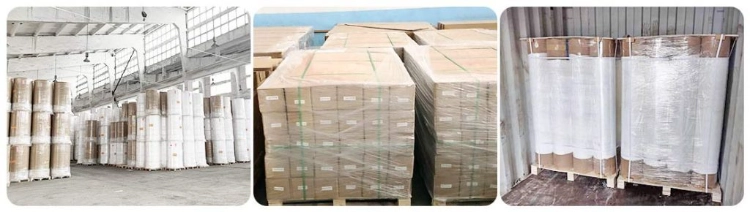
Reading a size line the way the slitting room reads it
Width follows the printer first, the fabric second
Paper width is not chosen, it is inherited. The printer sets the ceiling — most production machines in this trade work at 1.8 or 1.9 m, which is why the paper table tops out at 183 and 190 cm — and the fabric sets the floor, because paper narrower than the fabric leaves unprinted edges that show on the finished piece. Buyers who order paper by the fabric width alone, forgetting the printer’s grip margin, end up trimming good paper off both sides of every roll. A size line that names the printer model settles all of this in one step. Matching width to the job itself — which width for which product — is worked through in matching roll width to projects.
The core is a size too
Every grade in the table ships on a 2 inch or a 3 inch core, and the factory keeps ten slitting machines across the two sizes because both are live orders every week. The core never appears in the buyer’s first email and it is the first thing the slitting room asks, because a roll wound on the wrong core cannot be mounted at all. Put it in the size line: gsm, width, length, core. Four numbers and the order is unambiguous. The core question gets its own article, 2 inch or 3 inch roll core, because the wrong core stops a line before a single metre has printed.
Custom widths are real — and they are a schedule, not a shelf
Rolls can be made from 61 cm out to 320 cm wide, and the 320 figure gets quoted back at us as if it were a stock size. It is a capability, not a shelf item. The standard table ends at 190 cm because that is what production printers swallow. A 260 cm roll for a special line is a planned job — coated, slit and packed against an order — and it prices and schedules like one. The Rouleau de papier de sublimation à séchage rapide 100 g/m² page carries the same table as every other grade, and it is worth reading the row for your grade before asking for a width outside it.
One neighbour deserves a line of its own: the protective tissue paper that runs with the paper on the calender comes at 30gsm, in 160, 162, 180 and 182 cm widths, on 1,000 m rolls. Its sizes shadow the paper sizes on purpose — it has to cover the same fabric.
Conclusion
The size table is a staircase, not a catalogue. Heavier paper comes in shorter rolls and narrower widths; lighter paper comes in kilometre rolls and fabric widths; and the stock list, which is the list that ships fast, is shorter than both. If you send us your printer model and working width, the fabric width, the grade you run and roughly how many metres a month you print, we will hand back the exact size line — gsm, width, length and core — and tell you plainly whether it is a shelf roll or a slit-to-order roll.
Questions fréquentes
Q1: What is the most common sublimation paper roll size in garment factories?
A1: 162 cm wide, because it sits inside a 1.8–1.9 m printer with margin and matches standard fabric widths. The length on that roll depends on the grade: 100 m at 100gsm, 200 m at 60–70gsm, 300 m at 50gsm and 1,000 m at 35gsm and below.
Q2: Can we order a 320 cm wide roll?
A2: Yes, as a custom job. Rolls are made from 61 to 320 cm wide, but the standard size table ends at 190 cm, which covers production printers. A 320 cm roll is coated and slit against your order, so it needs lead time rather than coming off the shelf.
Q3: Why does the same gsm come in more than one length?
A3: Because the same grade serves two kinds of line. The 40gsm grade, for example, leaves here as a 100 m roll for small shops and as a 1,000 m roll for factories, and the 50gsm runs from 300 m out to 3,000 m. The paper is identical; the roll is built around how the buyer’s line loads and stores it.


