


Vente chaude

Phone:+86-15215969856 E-Mail: 396838165@qq.com
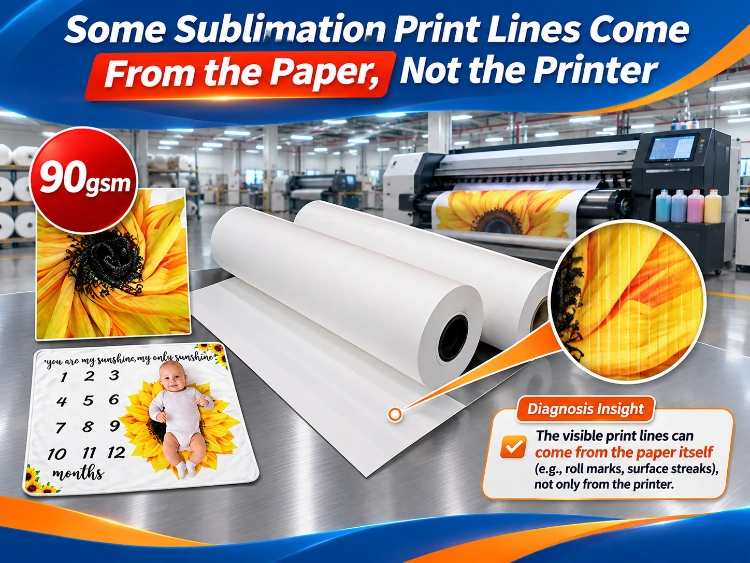
A line in the print sends the line to the printer first, and rightly. Nozzles clog, heads drift out of alignment, feed mechanisms slip, and each of those writes lines into the work. The standard causes and their order of checking are set out in the article on why sublimation printing shows banding or broken lines. But one family of lines survives every item on that checklist. The nozzle pattern is clean, the head has been serviced, the feed is calibrated — and the line is still there, in the same place, print after print. That line is not being made by the printer. It is being carried by the paper.
The Signature of a Paper-Side Line
It Keeps Its Position Across the Web
Measure the line from the edge of the web and write the number down. A coating streak sits at a fixed distance from that edge and holds the position for as long as the roll runs, because it is a lane of the paper itself. Printer banding behaves differently: it repeats across the direction of travel at feed or pass intervals, and it changes when speed, pass count or head condition changes. A line that ignores every one of those variables and keeps its address across the width is announcing where it lives.
It Shows First in Flat Colour
A small density difference along one lane is invisible inside a busy graphic, where the eye has no reference. In a flat tint — a team jersey background, a flag field, a soft-signage panel — the same difference reads as a visible stripe from one end of the piece to the other. This is why paper streaks are so often discovered on the simplest work in the building, and why they can pass unnoticed through photographic jobs on the same roll for days.
It Outlives Every Printer Adjustment
The practical test is exhaustion. When cleaning cycles, alignment, ink supply checks and feed calibration have all been done and documented, and the line has not moved, narrowed or changed its spacing, continuing to service the printer is spending production time on the wrong machine. The evidence has already separated the two suspects; what remains is to prove it formally.
Proving It Before Blaming the Roll
The Roll-Swap Test
Run the same file, on the same settings, from a different roll — ideally a different production batch. If the line follows the roll, appearing at the same measured position from the replacement roll’s edge only when the suspect roll is loaded, the case is closed. Record the evidence the way the line records any roll fault: the grade and GSM, the width, the line’s distance from the edge, and the metre count at which it was first seen. That discipline is the same one used when tracing specks in sublimation prints back to their source, and it is what turns a complaint into a claim a supplier can act on.
What a Confirmed Streak Means in the Coating
A coating streak is a lane where the coating was laid down slightly heavier or lighter than the lanes beside it. That lane absorbs ink and releases dye at its own rate along the entire roll, so it prints at its own density along the entire roll. Coating uniformity is therefore a factory variable, not a printer variable. It is also a stated point of control on the Changfa Digital range: the 60gsm grade is specified for consistent transfer across the whole roll, with the coating staying uniform even toward the end of it, and the 90gsm grade for an even coating that produces clean lines on high-ink work. Both claims are about exactly the property a streak violates.
The difference does not stay on the paper, either. A lane that took up more dye prints deeper and transfers deeper, so the line is written into the fabric as well. On a borderline roll it can pass almost unseen on the printed sheet and still declare itself after pressing, which is why the flat-colour proof that settles the question is a transferred proof, judged on cloth rather than on the web.
What to Do With a Roll That Streaks
Take It Out of Flat-Colour Work
A confirmed streak does not always make a roll worthless. The same roll can run photographic and patterned work where the lane difference has nothing flat to show against, provided the position is recorded and the roll is labelled so it is not loaded for a solid-background job by mistake. What it should not do is stay in general circulation unmarked, reappearing as a mystery line on the next flat-colour order.
Ask the Supplier a Coating Question
When a roll is returned or a grade is being qualified, the useful question is not about price per metre. It is about how coating uniformity is controlled and checked along and across the web, roll after roll. Changfa numérique coats its paper in its own plant, on four coating lines including an imported German line, so that question has an address. The Rouleau de papier de sublimation à séchage rapide 90 g/m² is the grade in the range specified for even coating and clean lines under heavy ink — the work where a streak costs the most.
Conclusion
Lines have two homes. The printer makes most of them, and its checklist should always be worked first. But a line that holds a fixed position across the web, shows itself in flat colour, and survives every printer adjustment belongs to the paper, and the roll-swap test proves which home it lives in within one change of rolls. Treating a coating streak as a printer fault wastes service hours; treating it as a material fault, with measured records, ends it.
To have a line assessed, send its measured distance from the web edge, the paper grade, GSM and width, whether it follows the roll, and a photograph of the flattest colour area it crosses. Those five facts separate a paper streak from printer banding without a site visit.
Questions fréquentes
Q1: How is a paper streak different from banding?
A1: Banding repeats across the direction of travel at intervals set by the printer — a pass, a feed step, a nozzle row — and it responds to printer adjustments. A paper streak runs continuously along the direction of travel at one fixed position across the width, ignores printer adjustments, and follows the roll when the roll is changed.
Q2: Can a streak start partway through a roll?
A2: A coating lane fault runs from where the coating fault runs, so a line can begin at a definite metre and continue from there. Record that metre count. A line that starts at a roll change, a splice point in the work, or after the printer has stood idle points back toward the equipment or the handling, and should be recorded just as precisely.
Q3: Should ink limits be adjusted to hide a streak?
A3: No. Lowering or raising density to mask one lane changes the density of the whole panel and trades a local defect for a global colour shift. The streak is a material property; the correct responses are to reassign the roll to work that hides it, or to return it with the measured evidence for the supplier to act on.


