


Vente chaude
Application
Phone:+86-15215969856 E-Mail: 396838165@qq.com
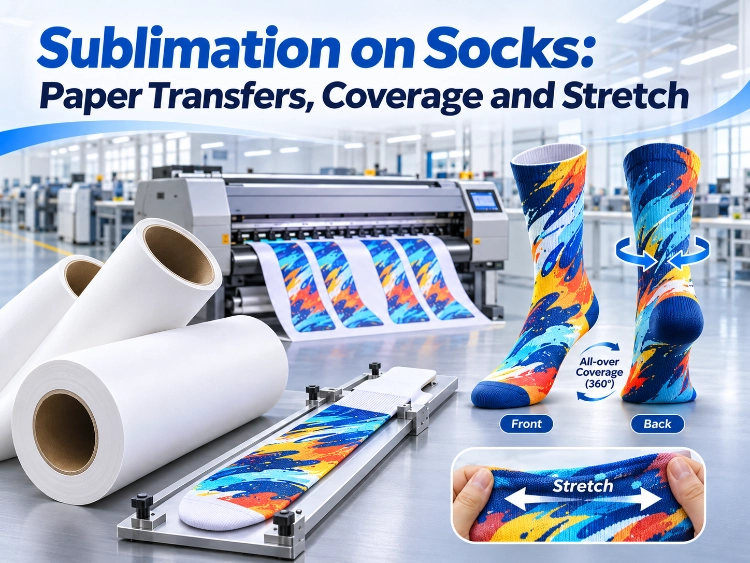
Use dry, correctly sized paper transfers for the front and back, then approve coverage on the sock at its intended wearing stretch. For print shops with roll-fed sublimation printing and a flat heat press, Changfa numérique manufactures polyester transfer-paper rolls and supplies printhead-matched CMYK sublimation inks. Our 100gsm fast-dry paper is a candidate when dense graphics require its ink-carrying and handling properties. The sock blank and jig determine which surfaces can meet that transfer. Choose the paper around the printed design and handling demands, and approve the finished pair before repeating the consumable order.
Choose the Sock Blank and Define the Printed Area
Confirm the Sublimatable Surface and Existing Transfer Route
Before marking out an image, establish what material it will contact. The upper may be polyester while the sole is cotton-rich and the cuff has another construction. That mix can sit behind a single composition label on a white sock. For sublimation on socks, use the confirmed printable material to set the artwork boundary; the white appearance by itself tells you too little.
Here, the sock is already knitted when the paper transfer goes onto it. A compatible blank must fit a supporting form, and the flat press must accommodate the transfer area. Settle that arrangement before ordering paper. Equipment for calendering flat fabric does not provide the same support for a shaped sock.
Match the Sock, Jig and Front–Back Artwork
Put the size being ordered onto its intended jig and measure there. Locate the heel and the change in construction at the cuff as well as the main image area. Opening the sock on the form can move a logo away from a position measured on the relaxed blank. If a small sock needs excessive stretching to fit the form, matching the blank and jig remains the dependable route to a defined print area.
A front and its matching back need to remain identifiable, with their orientation marked outside the print. Leave important lettering clear of the side join. Check that the printed artwork is mirrored correctly through one stage of the workflow; enabling mirroring at several stages makes that check harder. Artwork needing an exact wraparound join requires approval on a physical pair before the full order is printed.
Print and Prepare Transfers for Repeatable Handling
Lay Out Front–Back Pairs on the Actual Paper Width
The printer’s usable print width and the roll width it accepts set the available layout. Fit the front–back pairs into that space with room to cut and handle them. Put pair identification in a blank margin where it remains useful after cutting. Revisit the layout for another sock size: larger images may mean fewer pairs across the roll.
We coat, slit and pack our paper in-house. For a width discussion with Changfa Digital, provide the proposed front–back layout and the printer’s usable width. These describe the roll requirement more usefully than the width of the finished sock. Buying a wider roll does not create extra printing space in a printer that cannot use it.
Match Ink Coverage to Drying and Paper Handling
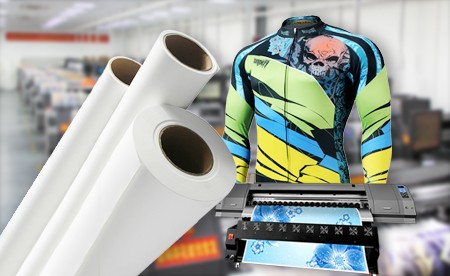
A dark, largely filled image asks more of the transfer sheet than separated small motifs. Look at the print before pressing: it needs to carry the image cleanly, dry for handling and be manageable when cut and positioned. Changfa Digital’s 100gsm rouleau de papier de sublimation sec rapide is made for disperse ink and polyester fabric. Its coating carries rich ink loads and provides a flat printing surface. Consider it where those coverage and handling properties are needed; sock production alone does not make it the default paper.
An approved lighter paper can stay in the job when no change is needed. Neither a white side line nor stretch in the sock establishes a need for heavier paper or more ink. Let the transfers dry before cutting and stacking them, judging readiness with the actual image coverage and workshop conditions. Another printer’s drying interval is not a dependable specification for this roll.
Match the ink order to the installed heads and supply arrangement. Changfa Digital’s gamme d'encres de sublimation includes standard CMYK for Epson I3200 two-to-four-head printers, alongside options for other specified configurations. The CMYK designation is only part of the specification, so confirm compatibility with the precise setup. A paper or ink change also reopens color approval: make the transfer onto the same sock blank before accepting that result.
Transfer Both Sides and Read the Coverage Limits
Control Repositioning Between the First and Second Side
With the sock seated consistently on its jig, the intended print surface should lie smooth and exposed. Place the dry front transfer at the approved artwork location, securing it by a method appropriate to the blank and press. Exposed areas of the form and press need protection from unwanted dye. Begin with the applicable blank supplier instructions, then verify those pressing conditions with the paper, ink and equipment being used.
Handle the first transfer and take it off according to the applicable instructions, without dragging the printed sheet sideways over the fabric. Keeping the sock on its form for the reverse transfer retains comparable supported dimensions. A wraparound image needs the intended join exposed during repositioning and the back aligned to what was actually printed on the front. Approve that overlap on a pair: a shortfall can leave a line, and poorly controlled overlap can alter the join’s appearance.
Distinguish Side Gaps, Heel Folds and Stretch Grinning
Follow a narrow white side line back to the contact area. Where did the fabric turn around the jig, where did the first transfer stop, and did the reverse transfer reach it? An uncovered surface calls for a change in the supported position or artwork boundary. Extra ink on the same image cannot reach fabric that the image does not touch.
At the heel, inspect for a fold before changing the print. Fabric tucked beneath the sock is hidden from the intended transfer contact. Compare that position with the heel when worn. The useful change may be the jig position, the artwork or an agreed unprinted heel. A repeating pattern may accommodate this boundary more readily than lettering, a face or a stripe that must join precisely.
For grinning, stretch the finished sock to its intended wearing extension. Opening the knit can reveal less-colored areas between its printed surfaces, even where the relaxed sock looks satisfactory. The blank, its supported stretch or the design may need adjustment. More ink can change an already adequately colored flat image while leaving this geometry unresolved. A flat paper transfer helps handling; the stitches still open according to the sock’s construction and stretch.
Approve the Pair Before Repeating the Order
Check Relaxed and Worn Stretch Across Sizes
The approval sample needs both transfers completed. Look at the pair relaxed and at the wearing stretch intended for its size, comparing color on the two faces, the side join, heel coverage and lettering. Include the relationship between the two socks in that inspection. Judge these details against the agreed design: leaving a sole unprinted deliberately is a different result from leaving an unintended gap in a logo.
Include the sizes being supplied when approving the job. Moving to a larger sock may shift the heel on the jig, open the knit differently and move the meeting point of the front and back images. Changes in construction, size, jig or artwork therefore call for rechecking the affected areas. The item being approved is a formed sock. Cutting-line and seam-allowance approval belongs to the other route, where fabric is printed before cutting and sewing, and does not replace this check.
Keep the Approved Paper–Ink Setup for Consumable Orders
Keep the approved pair with its sock identification, size, jig, artwork version, print mode, ink, paper specification and applicable pressing conditions. Retain a usable sample and photographs of the coverage boundaries. They provide a reference when deciding whether a later problem concerns paper handling, blank geometry or artwork position.
Use that approved configuration as the reference for repeat paper and ink orders. Send Changfa Digital the printer and head details, usable paper width, both image dimensions, ink coverage and sample observations. This gives a defined result against which to assess a consumable change. A folded heel or a jig mismatch calls for correcting that physical condition while retaining the approved consumables.
Conclusion
Approve the paper transfer and the shaped sock as separate parts of the same job: ink coverage and dry handling justify a paper choice, while side joins, heel exposure and wearing stretch decide whether the finished pair is acceptable. Send Changfa Digital’s sublimation-paper team your printer and printhead, usable roll width, sock material and jig details, front–back image dimensions and sample observations to confirm a paper-and-ink combination around that approved production requirement.
Questions fréquentes
Q1: Can sublimation work on socks with a cotton sole?
A1: A sock may combine a polyester printable upper with a cotton-rich sole. Confirm the composition of the actual print surface and keep the artwork within the supported sublimatable area. The whole-product label alone does not establish that every part will accept the same transfer.
Q2: Will heavier sublimation paper remove white lines on socks?
A2: Heavier paper can be considered when the printed design needs its ink-carrying or handling properties. A side surface missed by both transfers, a folded heel or knit opened by wearing stretch needs its own coverage or blank adjustment. Paper weight alone does not resolve those conditions.
Q3: What temperature and time should be used to sublimate socks?
A3: Start with the applicable instructions for the actual sock blank and pressing equipment, then verify the paper-and-ink combination on that blank. Check the front and reverse after the full two-sided sequence, including the heel and wearing stretch. Approve the finished pair before repeating the settings across the order.


