


ขายร้อน
การประยุกต์ใช้งาน


Phone:+86-15215969856 E-Mail: 396838165@qq.com

A first container is an inventory decision. The price list shows up last.
Your customers set the range. Their rewinds fix the widths. Their holders fix the cores. Their jobs fix the grades and the metres.
Building a sublimation paper roll SKU range starts at the machines. The catalogue itself stays wide: 29gsm to 100gsm, slit anywhere from 61cm to 320cm.
Changfa ดิจิตอล runs both core diameters off the same slitting floor, and picking the range stays your job.
Start With the Rewinds Already in the Field
Three Centimetres Can Cover Three Customers
Look at the machines before the spec sheet. Rewind widths say more about your stock list than any grade table.
The middle of the list crowds badly. 91.4cm answers the machines quoted in inches. Past that, treat five centimetres as the collapse threshold, because neighbours closer than that tend to serve the same press.
Then it tightens.
150, 152, 153, 155, 160 and 162cm sit inside twelve centimetres. The pattern repeats toward the wide end, where 170, 172, 180, 182, 183, 188 and 190cm fill the stretch up to 320cm.
Paper reaches across the printed area. A 154cm print starves on a 152cm roll.
Two shops printing 152cm and 153cm both run on 155cm paper, and the trim takes the difference. Two accounts, one shelf position.
Check the printed width each account quotes before collapsing anything.
Start on the customer’s rack. Rolls already sitting there tell you which width that account trusts.
The fleet list also needs the printed width. Paper width runs wider than a printed area, and wrong orders usually start inside that gap.
A machine outside the list isn’t a lost order. Custom width sublimation paper goes through a sample first, and the width joins the range once a second account asks for it.
Cores Split the Fleet in Two
A 3-inch core won’t slide onto a 2-inch mandrel. No change to the paper fixes that.
Both diameters exist at 30, 35 and 40gsm, and ten slitting machines run either one. The second core costs a shelf position at your end, while the slitting floor carries on.
A sublimation paper roll wholesale sheet puts width and grade in the first columns, and the core ends up as a footnote. That footnote decides whether the roll fits a holder.
Desktop units and wide industrial printers rarely share a holder. A distributor with both in one city carries two light-grade cores, or loses one of those accounts.
Jumbo roll sublimation paper moves the pallet plan too. Add a jumbo width and you pay twice: warehouse floor and container space.
Short Rolls Mean More Changeovers
The metres on a roll fall as the grade climbs.

- 29 to 38gsm: 1,000 to 3,000 m
- 40gsm: 300 to 3,000 m
- 52gsm: 200 to 2,500 m
- 61gsm: 200 to 500 m
- 81gsm and 95gsm: 100 to 200 m
Count the rethreads first, then choose the grade. Divide the metres on a roll by the metres one job eats, and that number is the stoppages your customer buys.
Five short rolls cover a 500m run, where one long roll would do the same run in a single load.
An empty core starts a stop. Threading up pulls the operator off the job, and the shift carries that interruption to the end.
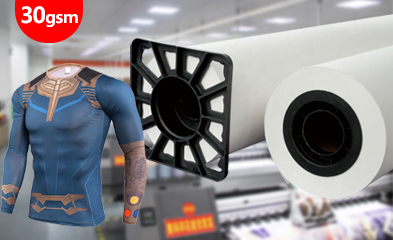
40gsm sits in the busy middle of that ladder. Dry transfer lands at 95% to 98%.
The press holds about 225°C for 20 seconds. Dark or elastic fabric comes off a stretch without cracking.
50gsm comes as a jumbo roll, and it stores best near 40% to 50% humidity. Warehouses with an open roller door fight that number all summer.
ที่ กลุ่มผลิตภัณฑ์กระดาษซับลิเมชั่น also holds a 30gsm protective paper. It comes in white or grey, 160cm, 162cm, 180cm and 182cm wide, 1000m per roll.
That protective paper can wait for a second container. The transfer grades come first.
Price Every SKU Twice
One Shelf Position, One Pallet Slot
A SKU takes space twice. Once on your rack, once inside the container.
Length decides how much of each. 3,000m at 38gsm fills a wide roll. 100m at 81gsm puts a small roll on that same width, so two SKUs at one width still need two pallet plans.
Two pallet plans for one width means two picking rules in the warehouse. A picker who grabs the wrong roll sends a core to a machine that can’t hold it.
Core caps are pushed on before the rolls leave, and the rolls ride on pallets. That packing travels with the pallet.
Packing choices belong on the sample sheet, not on the first container. Settle the cap and the pallet pattern with the account that asked for them.
Length Decides What You Sell
Two distributors can hold 40gsm at the same width and offer different things. One stocks 3,000m rolls for long continuous runs. The other stocks 300m rolls and keeps a part-used roll from sitting as dead capital.
One width of กระดาษถ่ายโอน 40 แกรม reaches from 300m to 3,000m. Length turns into the term you negotiate.
The customer’s run comes first in that calculation. The grade follows from the ink load, and the metres follow from the run itself.
Ask each account one question: what happens when a roll empties halfway through a shift? Shops that print through the change want the longest roll on the pallet. Shops that finish a batch and reset want the short one.
Short rolls suit accounts with many designs. Long rolls suit accounts that count downtime in minutes.
Send the Fleet List and Get a Quotation
Only you can write the fleet list, and the range follows it. Send the widths and cores the machines in the field hold, the grades with the metres behind each one, and the way you load a container. Four lines settle a quotation.
Widths off the standard list start with a sample. That sample also settles the cap design and any OEM sublimation paper requirement your label carries.
Name the substrate when the job leans on it. Dark or elastic fabric behaves differently through a stretch, and that detail saves an argument later.
ที่ coating and slitting halls hold four coating lines, four slitting workshops, one German coating line and ten slitting machines. Both core diameters, and the 61cm to 320cm span, come off that one site.
Send the fleet list as it stands today. One page of widths and cores beats a catalogue read front to back.
ข้อสรุป
Width, core, grade, metres. Four numbers per SKU, and every one of them answers to a machine in the field.
Hold one width where three near-neighbours cover the same machines. Carry both cores in the light grades while the holders in the field ask for both.
The metre ladder sets the changeover bill. 3,000m at 38gsm and 100m at 81gsm promise different service.
Bill each candidate SKU twice. Once for the rack. Once for the container. A range that survives both bills can grow afterwards.
คำถามที่พบบ่อย
Q1: How many widths belong in a first order?
A1: As many as two accounts already share, plus whatever the largest account prints. Collapse near-neighbours first. 152, 153 and 155cm rarely deserve three shelf positions between them. Add a width when a second customer asks for it.
Q2: Do I need both core sizes in stock?
A2: Only where the machines demand them. Two-inch and 3-inch cores both exist at 30, 35 and 40gsm, and ten slitting machines run either diameter. Where every printer in the field holds a 3-inch shaft, the 2-inch stock gathers dust.
Q3: What should I do about a width that is not on the standard list?
A3: Sample it before it takes a shelf position, and find out which account it serves. A width that answers one customer rarely earns rack space on its own.


