


ขายร้อน
การประยุกต์ใช้งาน
Phone:+86-15215969856 E-Mail: 396838165@qq.com
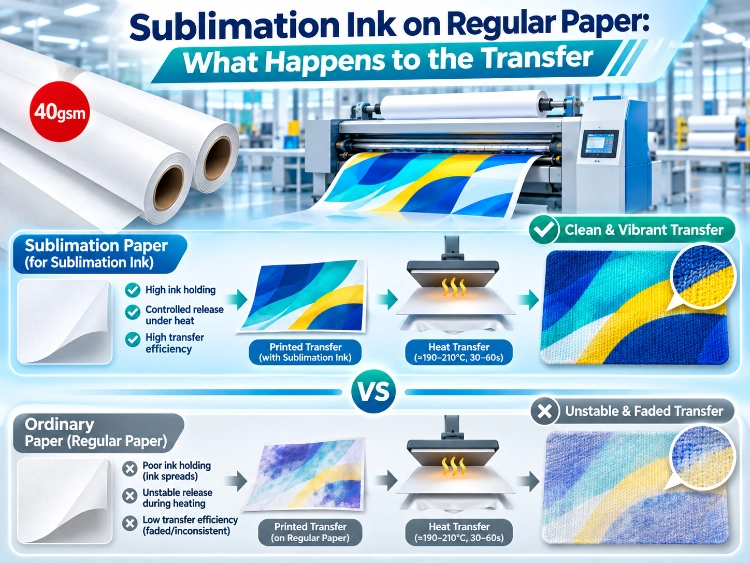
Yes, sublimation ink can be printed onto regular paper: the printer lays it down, the sheet dries, and the image looks presentable. The failure arrives at the press. Sublimation is a two-step process in which the paper is not a passive carrier — it is half of the transfer mechanism — and regular paper performs neither of the two jobs the coating on sublimation paper is there to do. What follows is what happens to the transfer, step by step, and why the result is usable for a rough layout proof and not for production fabric.
The question here is the paper. Which inks belong in which printer, and what a mismatched ink does inside a printhead, is a separate subject with its own article; nothing below depends on it.
The Two Jobs the Coating Does
Hold the Dye at the Surface
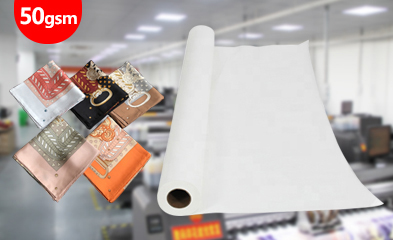
A sublimation paper is a base sheet carrying a coating engineered for one sequence: receive water-based ink, hold the dye in a thin layer at the surface while the sheet dries, and keep it there without letting it soak into the base paper’s fibres. Because the dye sits on top of the sheet rather than inside it, the printed image keeps its density and its edges. On the กระดาษระเหิด grades in the Changfa Digital range, that surface hold is what the ink ratings describe: the coating takes a rated ink load — two stars at 40gsm, three at 50gsm, five at 100gsm — and holds it without bleeding, so the full printed density is still present when the sheet reaches the press.
Release the Dye Under Heat
At the transfer condition — around 225°C for about 20 seconds, inside a working window of 200–250°C — the coating gives the dye up. A rated grade releases 95–98% of it (the 40gsm and 50gsm grades), and the 100gsm grade releases over 98%, which is the transfer rate printed in its specification. Release at that level is what makes the fabric, not the used paper, carry the image. Both halves matter: a carrier that holds the dye but will not release it fails at the press, and a carrier that releases what little it held fails earlier, at the print.
What Regular Paper Does Instead
Regular office or copy paper has no coating. Its surface is bare cellulose fibre, sized for toner or for ink that is meant to stay where it lands permanently. Printed with sublimation ink, three things follow in sequence.
First, the ink wicks into the fibre network instead of sitting on it. The dye spreads along the fibres as it dries, so fine lines soften and solid areas dry unevenly — heavier where the sheet absorbed quickly, lighter where it did not. The printed sheet already carries less usable density than the same artwork on coated paper, before any heat is applied.
Second, under heat, only part of the dye leaves. Sublimation moves dye that can vaporise and travel the short distance to the fabric. Dye held at a coated surface is positioned for that move. Dye soaked into a fibre mat is distributed through the sheet’s thickness; the fraction near the surface transfers, and the fraction held deeper stays in the paper. The used sheet comes off the press still visibly coloured, and the fabric receives a partial, uneven share of the image.
Third, the unevenness does not repeat. Absorption varies across a sheet of regular paper and between sheets, because the fibre mat is not manufactured to a transfer tolerance. Two prints of the same artwork transfer differently, which is the property that ends the discussion for production work: a process whose result changes sheet to sheet cannot be profiled, quoted or re-run.
Why a Test Print Looks Better Than the Run Will
A small test on regular paper can look deceptively close. Light coverage hides the loss, because a pale area has little dye to lose; a small piece hides the unevenness, because there is less sheet for absorption to vary across; and a one-off hides the repeatability problem entirely. The same artwork at production scale — solid blocks, dark saturated areas, a full-width roll, a second and third piece that must match the first — exposes all three losses at once. Shops that test on regular paper and order on the strength of the test are measuring the one configuration in which the carrier matters least.
What It Costs on Real Work
The cost is not the sheet of copy paper; it is the fabric piece, the press time and the reprint. A transfer that delivers part of the dye produces a piece that cannot be sold as first quality and cannot be corrected — sublimation cannot be topped up with a second pass to a predictable shade. Where the work is colour-critical or matched across a set, the partial transfer also breaks piece-to-piece matching, so the loss spreads from one piece to the set. Against that, the price difference between a sheet of regular paper and a sheet or metre of rated sublimation transfer paper is the smallest number in the job.
The One Job Regular Paper Can Do
Regular paper has one legitimate use in a sublimation workflow: a size and position proof. Where the only question is whether the artwork sits correctly at scale — placement on a panel, alignment of a pattern repeat, a check that the file’s dimensions are the ordered dimensions — colour and density carry no information, and a cheap sheet answers the question. The proof must not be read for colour, sharpness or depth; it contains none of the evidence for those judgements. Any proof whose result will be used to approve colour belongs on the production paper.
ข้อสรุป
Sublimation ink on regular paper prints, and then under-transfers: the dye soaks into an uncoated fibre mat, only the surface fraction releases under heat, and the share varies from sheet to sheet. Coated sublimation paper exists to prevent exactly that sequence — it holds the dye at the surface and releases 95–98% of it at 225°C for about 20 seconds on the standard grades. For production fabric, run the paper the process specifies; Changfa ดิจิตอล supplies it from 29gsm to 100gsm in widths from 61 cm to 320 cm, and the grade for a job is chosen by its ink load. Send the printer model, the artwork’s coverage, the fabric and the run length, and the grade can be matched before the first piece is pressed.
คำถามที่พบบ่อย
Q1: Can you use sublimation ink on regular paper at all?
A1: It prints, and a rough size or position proof can be taken from it. The transfer is the problem: uncoated paper absorbs the dye into its fibres, only part of it releases under heat, and the result is pale and uneven compared with coated sublimation paper, which releases 95–98% of the dye at the standard condition.
Q2: Why does the used regular paper stay strongly coloured after pressing?
A2: Because a large share of the dye never left it. Dye soaked through the sheet’s fibre mat is held below the surface; under heat, mainly the surface fraction vaporises and moves to the fabric. Strong colour left in the used sheet is direct evidence of how much of the image the fabric did not receive.
Q3: Does a longer press time fix a regular-paper transfer?
A3: No. Extra time releases a little more of the surface dye but cannot recover dye held deep in the fibre mat, and it does nothing about sheet-to-sheet variation. The limit is set by the carrier, not by the press condition.
Q4: Is the print quality from the printer the same on both papers?
A4: No. On regular paper the ink wicks along the fibres as it dries, softening fine detail and drying unevenly in solid areas. The coated surface of sublimation paper holds the ink in a thin layer at the surface, which keeps edges sharp and density uniform before the sheet reaches the press.


