


Горячая Продажа
Приложение


Phone:+86-15215969856 E-Mail: 396838165@qq.com
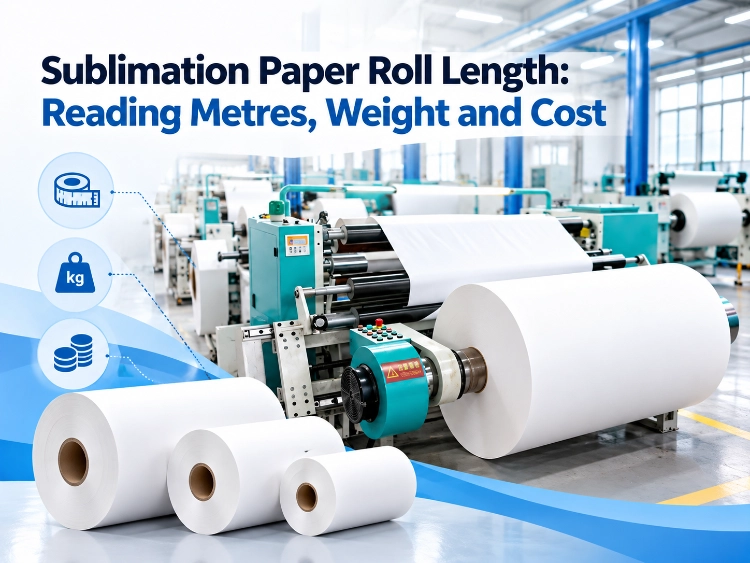
A roll empties halfway through a shift. The line stops. Somebody threads a new one, and the colour check waits.
One figure on the carton decides how often that happens. You can’t read that figure off the roll by eye.
Two suppliers quote 1,000 m and sell two different purchases. Width, grammage and length travel together. Hand me any two, and the third falls out.
What the Label Leaves Out
Metres Alone Compare Nothing
Rolls leave the shed anywhere from 61 cm to 320 cm wide. All of them get quoted in metres.
Start with the metre count alone and you learn nothing. Two rolls can carry the same 1,000 m on the carton and still cover wildly different amounts of fabric.
The press runs on area. The pallet carries weight. Metres do neither job.
В sublimation paper grades from 29 gsm to 100 gsm stretch that difference further.
A metre of the heaviest grade holds near three and a half times the paper of a metre of the lightest.
Same label. Different reel. Different job.
Sublimation paper roll weight is where the gap turns physical. The buyer notices it long before the press does.
The store keeper plans the rack in kilograms. The press supervisor plans the shift in metres. One delivery can look short to one of them and long to the other.
The Core Sits Inside the Reading
Rolls ship on 2-inch or 3-inch cores. The slitting crew matches the core to the shaft on your machine. Changfa цифровой runs both sizes on ten slitting machines. Either one leaves on the same pallet.
Weigh a roll and you weigh paper plus tube. Leave the tube in the figure and the division hands back too many metres. Cut it out first. Then divide.
Get that order wrong and the arithmetic won’t save you.
Interleaving paper carries the same catch. Protective paper runs 30 gsm in white or grey. Widths run 160 cm, 162 cm, 180 cm and 182 cm, wound to 1,000 m. Those rolls need the tube out of the reading too.
Settle it at goods-in, while the truck still sits on the ramp. Once the pallet goes up on the rack, nobody weighs anything again. A short roll then turns into a mystery on the press three weeks later.
Two minutes at the loading bay keeps the claim open. A shortfall gets answered faster when a scale reading and a photograph come with it. After the roll is part-wound, nobody can say whether those metres left the factory or left the rack.
Checking a Delivery and a Cost
Two Checks That Fit in a Minute
Grammage, times width in metres, times length in metres, divided by a thousand. That gives kilograms of paper. Run it backwards and a scale turns into a tape measure.
Say a 40 gsm roll arrives at 162 cm, labelled 1,000 m. Paper of that size should come in near 65 kg. With the core off, the scale reads 58 kg. The same division puts that roll just under 900 m.
Ten percent short, caught before the pallet reached the store room.
One roll per delivery is enough. The check pays best on wide stock. A shortfall on 162 cm costs more fabric per metre than the same shortfall on 61 cm.
What One Job Costs in Stops
Plan a run of 8,000 m on fabric 1.62 m wide. The fabric comes to 12,960 m². The grade decides the day.
On 1,000 m rolls of 40 gsm, the job takes eight loads. Paper weight lands a little over 500 kg. Eight roll changes leave the operator time to check the first prints.
Order the same area in 95 gsm and the rolls hold 100 m to 200 m. The operator loads forty. The fabric order never changed. The shift did.
Freight follows the same line. Those square metres in 95 gsm weigh close to two and a half times as much. The press schedule grows around forty stops in place of eight.
Cost per square metre settles the argument. Divide the roll price by the area the roll covers. A 500 m roll at 61 gsm then becomes comparable with a 1,000 m roll at 40 gsm. The sublimation paper square meters per roll is what that division needs. Width and length together give it.
Quote one job both ways and the shorter roll stops looking cheap.
The disagreement starts at quotation stage, before any paper is ordered. A distributor quotes per roll. A printer costs per square metre. Both can read the same line and disagree, and both of them are right. Put the roll count on the sheet and the metre figure stops being the argument.
One more field belongs on the sheet. Rolls that stand for weeks on a pallet want a humidity window. The 50 gsm jumbo roll paper formats list 40 to 50 percent. Cardboard takes on and gives up moisture with the room around it.
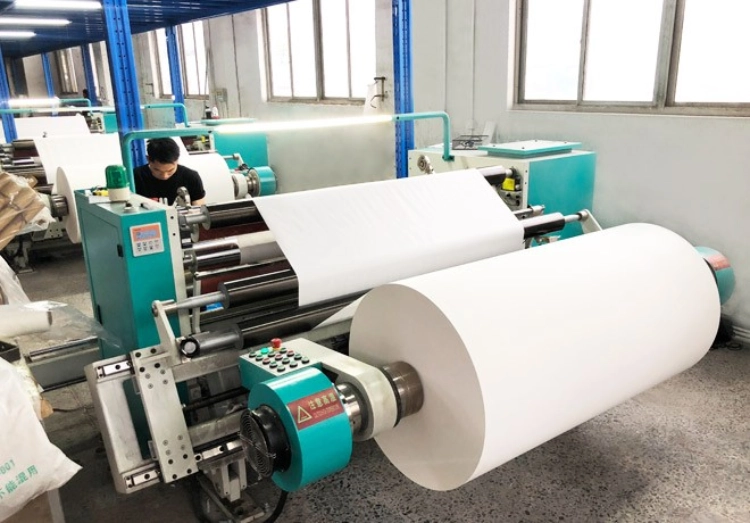
Transfer settings travel with the grade as well. The 40 gsm and 50 gsm pages both list about 225°C for 20 seconds. Transfer runs around 95 to 98 percent.
Diameter Decides What Fits
A roll winds fatter as the grammage climbs. At one width, 200 m of 95 gsm needs more room than 200 m of 40 gsm. That’s the plain part of sublimation paper roll diameter.
A machine with a fixed opening takes fewer heavy metres. Then the roll starts rubbing the frame. Heavy grades on wide lines are where the 3-inch core earns its place. A part-used roll still has to clear the holder at running speed. A roll that grows past the opening won’t run, whatever the label says.
Measure the opening before the order goes in. The person who mounts the roll each morning knows the real number, and it often sits below the figure in the printer manual.
Both core sizes come off the same floor. A 3-inch roll never waits behind a 2-inch queue. Where the whole fleet runs one holder, that saves a shelf position and an adapter at your end.
В full sublimation paper range lists each grade with the widths it ships in. A repeat order then holds the same width and core as the first shipment.
Which grade and width are you running now? What length does the label claim, and what does your scale say once the core is off? Send those answers with the metres one job needs, your printer and print head model, and any changeover or breakage worth explaining.
Вывод
Length, width and grammage are one purchase. Two of them plus a scale give the third. That’s how a declared length gets checked without unwinding a metre of it.
The same three figures produce cost per square metre, freight weight and the roll count a job will need. Quotations tend to leave those out.
Часто задаваемые вопросы
Q1: How many meters in a sublimation paper roll?
A1: It depends on the grammage. Light stock travels far. Rolls of 29 to 38 gsm run 1,000 m to 3,000 m. A 40 gsm roll spans 300 m to 3,000 m. Weight shortens that range. A 52 gsm roll stops at 2,500 m. 61 gsm stops at 500 m. 81 gsm and 95 gsm hold 100 m to 200 m. Width sets the area those metres cover.
Q2: Can a declared roll length be checked without unwinding it?
A2: Yes, with a scale. Take the core out of the reading. Multiply what remains by a thousand, then divide by grammage and width in metres. The answer should land within a few percent of the label. A roll that misses by more deserves a second weighing.
Q3: Does a heavier roll hold more paper?
A3: Not by area. A 200 m roll of 95 gsm at 1.62 m covers less fabric than a 300 m roll of 40 gsm at the same width. The heavy roll still weighs more. Check square metres first when the fabric order is fixed. Check kilograms first when freight or handling sets the limit.


