


Phone:+86-15215969856 E-Mail: 396838165@qq.com
The replacement question is judged here on one ground only: roll-to-roll production on polyester fabric, where printed paper is calendered onto fabric in continuous runs. Garment pieces, cotton and printed merch follow different chemistry and economics; they sit outside this article’s boundary, and the verdict below does not claim them.
The test case is a polyester fabric print shop running roll work on a transfer line: sportswear and flag fabric, printed to paper on a standard inkjet engine and finished on a calender. The shop has been quoted a direct digital line and must decide whether the quote replaces the transfer line or adds a second process beside it. Every step of the sublimation vs digital printing comparison that follows is checked against this one case.
The comparison is made on the full account of each route: every step the print passes through, every consumable the shop stocks, and the points where quality is lost.
The Full Account of Each Route
The Transfer Account: Paper In, Finished Fabric Out
On the transfer route the fabric arrives print-ready and is never prepared. The steps sit on the paper side: print the paper on a standard inkjet engine, dry the printed paper, then calender it onto the fabric at 225°C for about 20 seconds, inside a working window of 200–250°C. The dye leaves the paper as gas and fixes inside the polyester fibre. After that step the fabric is finished, with no fixation stage and no wash, and the web goes straight to cutting.
The consumable the shop carries is transfer paper, bought to a specification, plus ink. Quality on this route is lost at the paper specification, before printing starts: a grade whose ink-load rating sits below the design’s coverage gives weak or uneven colour at the calender, and no printer setting downstream recovers it. For the exemplar shop, sportswear and flag fabric run through the same three steps and one consumable family, and the fabric side of the building holds no chemistry.
The Direct Account: The Fabric Carries the Process
Direct digital printing puts the process on the fabric, which must be prepared first: pretreatment applied evenly across the web, since uneven pretreatment shows up in the print as blotches. The printer images the prepared fabric, the print is fixed, and for the common ink classes a wash follows to clear unfixed dye: reactive inks on cotton work this way, and disperse ink printed directly onto polyester keeps fixation and usually the wash as well.
For the exemplar shop, the quote changes what the building stocks: several ink sets matched to fibre classes, plus pretreatment chemistry, take the place of paper. The failure points move with the stock. A pretreatment fault is printed over and found late, a fixation fault shows at the wash, and a wash fault leaves unfixed dye in a finished web that has passed every earlier step at full cost.
The Trade-Offs Inside the Account
Set side by side, the two accounts differ at defined points. The table states them; the subsections after it take up the ones that decide the exemplar shop’s question.
|
Criterion |
Sublimation transfer |
Direct digital printing |
|
Fabric preparation |
None; fabric arrives print-ready |
Pretreatment applied to the fabric before printing |
|
Steps after printing |
One dry calender step, no wash |
Fixation, then usually a wash to clear unfixed dye |
|
Colour behaviour on polyester |
Dye inside the fibre; ink metered by the paper first |
Ink on the surface or into a pretreated surface |
|
Fabric range |
Polyester only |
Cotton, natural fibres, dark bases, piece goods |
|
What the shop stocks |
Transfer paper bought to a specification, plus ink |
Several ink sets and pretreatment chemistry |
|
Where quality is lost |
At the paper specification, before printing |
At pretreatment, fixation and washing |
Colour Behaviour on Polyester
Transfer holds the stronger position on colour yield and edge sharpness on polyester, for a mechanical reason: the paper meters the ink before it reaches the fabric, so the dye presented to the fibre at the calender is set by the coating, not by a wet fabric surface. The dye then sits inside the fibre, the printed area keeps the fabric’s own hand, and wash behaviour follows the fibre rather than a surface layer.
Disperse ink printed straight onto polyester enters a pretreated surface and still has to be fixed and usually washed; pigment systems lay ink on the surface with a binder. Surface ink changes hand feel, wash behaviour follows the layer rather than the fibre, and edge quality depends on ink behaviour on a prepared textile instead of on a coated paper.
Fabric Range: Where Direct Printing Stands Alone
The fabric range row is the one the transfer route loses outright. Cotton and other natural fibres, dark bases printed with pigment and white ink, and piece goods are direct digital printing’s own territory. Sublimation dye is transparent, bonds only into polyester, and has no white ink, so white in a transfer print is unprinted fabric and a dark base stays dark. No paper specification closes that gap: dye sublimation fabric printing does not reach those orders at any grade.
For the exemplar shop, the order book is polyester roll work, so the direct line’s extra range pays only against orders the shop does not currently take: the range question is a decision about new work, separable from the sportswear and flag work already running. Piece goods make the separation plainly: a direct printer images a cut panel in one pass, while a transfer line built around webs handles pieces as an interruption to roll work.
Show-Through on Flag Fabric
On flag fabric, how far the print shows through to the reverse is a specification the buyer sets. On the transfer route it is tuned by the paper’s ink load: a grade rated for a higher ink volume drives more dye through the fabric at the same calender setting, and the matching of ink load and width to flag and soft signage work is set out in the flags and soft signage guidance.
What the Paper Fixes in the Transfer Account
Ink Load, Bought as a Specification
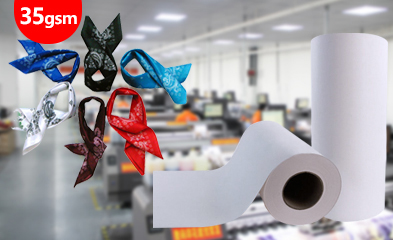
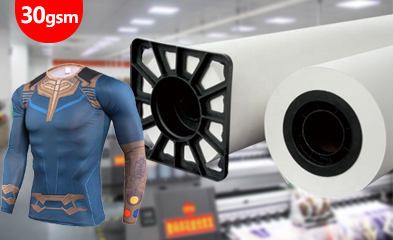
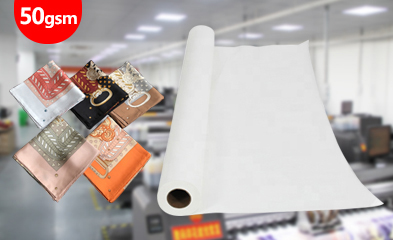
The largest quality variable on the transfer route is bought rather than run as a process in the shop. The paper range at Changfa 디지털 runs 29–100gsm, and its ink-load rating rises with weight: light grades carry two stars, the 50gsm carries three stars, and the 100gsm carries five stars. On full-coverage sportswear work, that rating is the ceiling on the print, because it fixes how much ink the sheet can hold and release evenly.
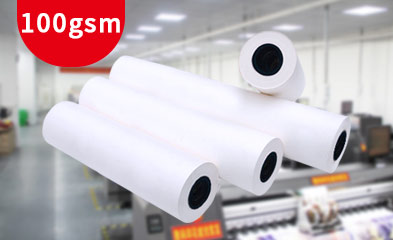
The 100gsm fast dry paper sits at the top of that scale: its coating holds rich ink loads without bleeding, the even coating keeps lines clean on high-ink designs, the sheet stays flat through large prints, and its transfer rate runs over 98% at the same 225°C, 20-second condition. The exemplar case specifies this grade where coverage is heaviest and steps down the range where it is not.
Widths, Rolls and the Grades Below the Top
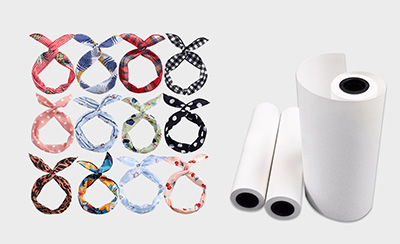
Below the 100gsm, the mid grades (40gsm and 50gsm) transfer at 95–98% under the same conditions, and the range covers widths from 61 to 320cm, with the 100gsm supplied on rolls 91.4–183cm wide and 100–200m long. Roll width is matched to the calender and the fabric web the line already runs. The range comes off an in-house chain of base paper, coating, slitting and packing, run on four coating lines including one imported German line.
결론
For roll-to-roll polyester production, the replacement claim does not survive the full account. Direct digital printing does not take the wet processing out of fabric printing; it moves that processing onto the fabric, as pretreatment before printing and fixation and washing after it. Transfer keeps the fabric untouched until one dry heat step and carries its process burden in a paper bought by specification, which is why sublimation textile printing holds polyester roll work: the fabric arrives print-ready, and print quality is specified at the paper order rather than run as a chemical process in-house.
It holds for polyester web production of the exemplar shop’s kind: continuous runs, white or light fabric, sportswear and flag work. It flips where the work changes material or form: on cotton and natural fibres, on dark bases that need white ink, and on piece goods, direct digital printing is the only route, and transfer has nothing to offer those orders. Shops weighing the same quote can send their fabric type and run structure, and the paper side can be matched grade by grade against it.
FAQ는
Q1: Can sublimation transfer print cotton or other natural fibres? A1. No. Sublimation dye bonds into polyester under heat and has no route into cotton fibre, so natural fibres sit outside the transfer route entirely, and direct digital printing serves them.
Q2: Does direct digital printing on polyester remove the washing step? A2. No. Disperse ink printed directly onto polyester still has to be fixed after printing, and a wash usually follows to clear unfixed dye. The wet steps belong to the direct account on polyester as well.
Q3: Can sublimation print white, or work on dark polyester fabric? A3. No. The dye is transparent and the route carries no white ink, so white areas in a sublimated print are unprinted fabric. A dark base needs a white underlay the route cannot lay down, and dark work belongs to direct pigment printing.


