


Sublimation on Black Polyester Shirts: Practical Techniques for High-Quality Printing
Vente chaude
Application
Phone:+86-15215969856 E-Mail: 396838165@qq.com
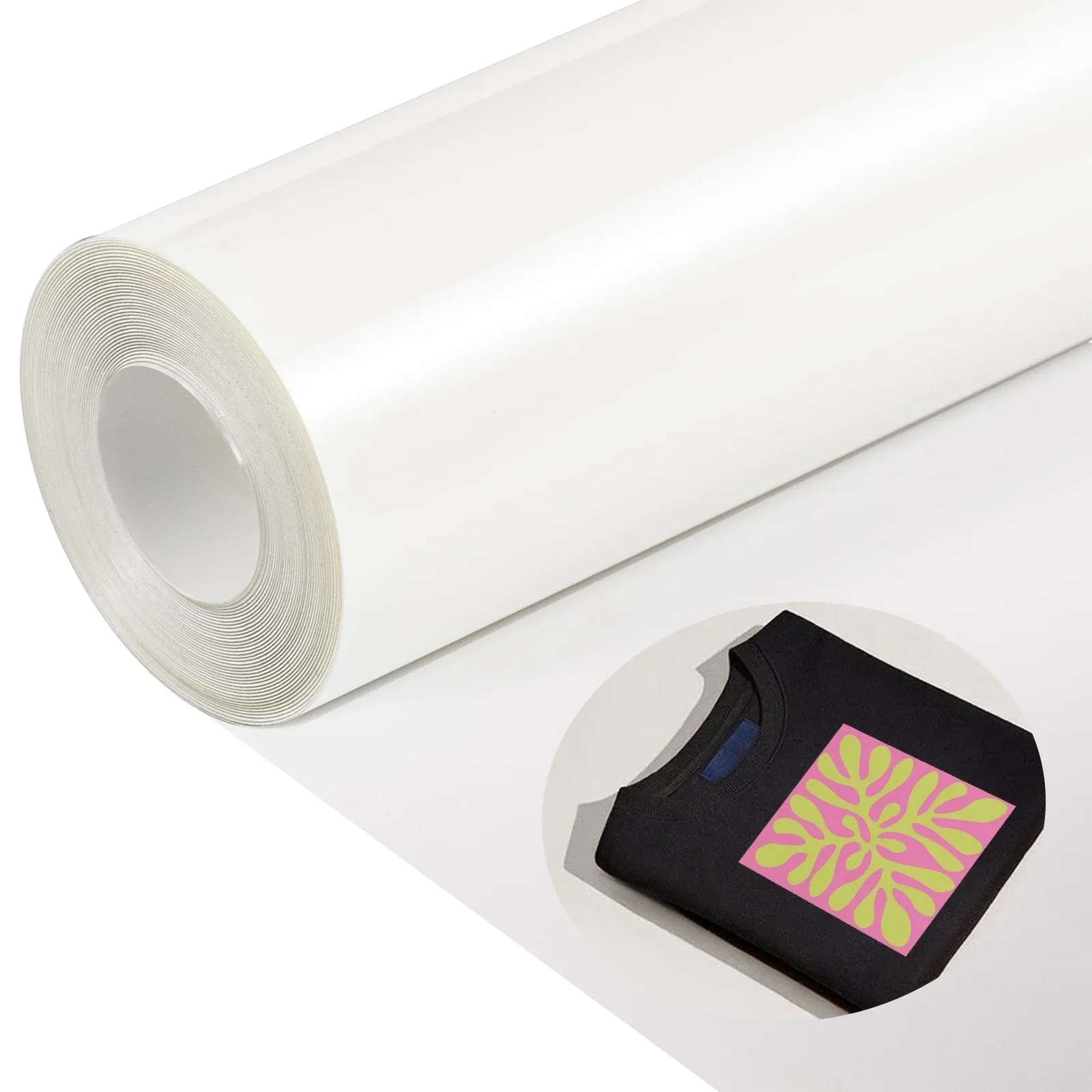
Printing on black polyester shirts pushes sublimation technology to its physical limits. Unlike light substrates, dark fibers absorb most reflected light, which changes how transferred dyes are perceived, so just depending on color chemistry alone cannot solve this constraint. Visual output becomes the result of optical behavior, ink loading strategy, paper release efficiency, and thermal control acting together.
For production teams, success depends on disciplined material selection and process stability. This article examines how to manage those variables to achieve consistent, commercially viable results on black polyester garments.
Why is sublimation on black polyester fundamentally more complex than on white fabric?
White fabric reflects most incident light, amplifying sublimated color. However, black polyester, on the contrary, turns optical physics into the dominant limiting factor.
Does light absorption limit color visibility?
Sublimation dyes are transparent and mainly rely on light bouncing off the fiber surface to become visible. On black polyester, most incoming light is absorbed by the substrate before it can return through the dye layer. Even when transfer chemistry is correct, brightness loss is unavoidable.
This is why identical ink densities appear vivid on white shirts but muted on black ones. The issue is not insufficient dye bonding but reduced reflected luminance.
Can process optimization compensate for optical loss?
Process optimization only partially compensates for the optical loss. Higher ink loads, smoother fiber surfaces, and more efficient dye release can improve perceived color depth, but they cannot reverse absorption physics. The goal shifts from achieving “bright colors” to achieving stable contrast, clean edges, and predictable tone reproduction.
What role does sublimation paper gsm play on dark polyester substrates?
Paper gsm determines how much ink can be carried, how evenly it is released, and how stable the sheet remains during heating.
Is mid-weight paper better for balanced performance?
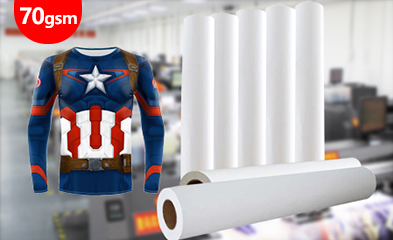
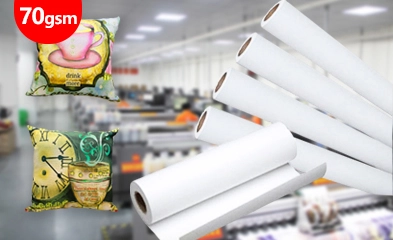
Mid-weight paper often provides the best balance between drying speed and ink buffering capacity. In black-shirt workflows, 70 gsm papier de sublimation à sec rapide supports moderate-to-high ink loads while maintaining dimensional stability during transfer. Faster moisture release reduces smearing risk, and controlled coating structure helps prevent uneven vaporization.
For sportswear panels or medium-density graphics, this type of paper typically delivers consistent transfer behavior without excessive energy input.
When does higher gsm become necessary for deep color reproduction?
Some designs exceed the buffering limits of mid-weight papers.
Does thicker paper improve saturation on black fabric?
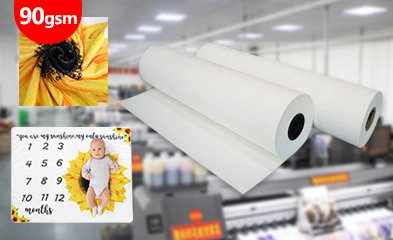
Thicker paper can enhance the color saturation on black fabric, especially in dense graphics or large solid areas, because a thicker sheet provides additional coating volume to hold and release more dye in a controlled manner. Higher gsm paper reduces localized overload, lowers ghosting risk during long dwell times, and stabilizes vapor pressure across the print zone. On premium garments or branding graphics, paper like Papier de sublimation à sec rapide 90 gsm often leads to cleaner edges and more uniform tonal blocks, even if production speed is slightly reduced.
How do ink chemistry and paper coating interact on dark substrates?
Ink and paper operate as a coupled system rather than independent materials.
Does coating porosity influence dye release efficiency?
Excessively dense coatings trap dye in the paper, reducing transfer yield, while overly open coatings allow premature migration, which blurs edges before pressing.
For black polyester printing, controlled temporary adhesion is critical. The ink must anchor during printing, then release rapidly and uniformly within a narrow temperature window.
Can le vaporization window affect edge clarity?
Dark substrates often require slightly higher energy input to reach effective diffusion. If temperature or dwell time overshoots, over-gassing occurs, and detail softens. Otherwise, transfer efficiency drops.
Process windows on black fabric are narrower than on white fabric, making coating consistency and thermal uniformity decisive.
How does fabric structure influence sublimation results on black shirts?
Not all polyester behaves the same under heat and dye diffusion.
Does knit density affect perceived brightness?
Tighter interlock knits reflect light more uniformly and reduce internal scattering losses. Open bird-eye structures increase diffusion depth but scatter returning light, lowering surface brightness. Therefore, two fabrics with identical color values can display different visual intensity after transfer.
Can fabric weight change transfer efficiency?
Heavier fabrics store more thermal energy and prolong the diffusion phase, and lightweight shirts reach equilibrium faster but are more sensitive to overheating. Ink release profiles and press parameters should be adjusted accordingly, especially when switching between 120 gsm and 180 gsm garments.
Why does production consistency depend on manufacturing infrastructure?
Material performance is inseparable from how consistently it is produced.
Do coating lines influence batch-to-batch consistency?
Industrial-scale sublimation paper production relies on uniform coating thickness, stable drying profiles, and repeatable base paper treatment.
Changfa Digital operates four coating lines, including imported high-precision equipment, with a total output of about 3,000 tons per month and global shipments of around 120 containers monthly, enabling a stable long-term supply across markets. This scale matters when black-fabric workflows depend on narrow tolerances.
Does slitting accuracy affect roll stability during printing?
Uneven edges change web tension and introduce micro-wrinkles, which distort ink distribution before transfer. Multi-workshop slitting systems and standardized export packaging reduce this risk, especially in long-run apparel production.
Who can support both material supply and process stability at scale?
At industrial volumes, paper performance, ink behavior, and logistics form a single system.
Changfa numérique is a vertically integrated sublimation paper manufacturer and digital printing service provider with more than 15 years of operation. Our company controls the full chain from base paper processing and coating to slitting and export packaging, and possesses four coating lines, four slitting workshops, and ten slitting machines supporting both two-core and three-core roll systems, with a monthly capacity of nearly 3,000 tons and global shipments of roughly 120 containers. Our services, including OEM/ODM customization, 24-hour technical response, and dedicated service teams, allow production parameters to be aligned with customer workflows, thereby improving our customers’ satisfaction.
What process controls reduce failure risk in black polyester sublimation?
Material selection alone is insufficient.
Should press temperature be more tightly controlled?
Black polyester requires a narrower thermal tolerance. Excess heat accelerates dye diffusion beyond the intended boundary, while insufficient heat lowers release efficiency. Closed-loop temperature mapping across the platen surface is recommended for consistent results.
Is test sampling necessary for each fabric batch?
Fiber finishing methods, residual moisture, and surface coatings vary between lots. Small pilot transfers help detect deviations before full-scale production begins.
How can you evaluate success beyond visual inspection?
Professional workflows rely on data.
Can wash testing reveal hidden instability?
Wash-fastness testing exposes weak bonding that may not be visible immediately after pressing. Consistent results should approach industry standards for repeated laundering.
Should color consistency be tracked across production?
Tracking ΔE values across lots provides early warning of drift caused by ink aging, coating variation, or press instability.
Questions fréquentes
Q1: Can sublimation achieve bright colors directly on black polyester without additional layers?
A: No. Sublimation dyes are transparent, and black fibers absorb most reflected light. Process optimization improves clarity but cannot overcome optical limits.
Q2: Is heavier sublimation paper always better for black shirts?
A: No. Higher gsm supports dense graphics but reduces efficiency for light designs. Paper weight should match ink coverage.
Q3: Why do two black polyester shirts produce different results with identical settings?
A: Differences in knit density, surface finish, moisture content, and heat absorption behavior all affect final appearance.


