


Heißer Verkauf
ANWENDUNG
Phone:+86-15215969856 E-Mail: 396838165@qq.com

A paper sample can look good for ten meters and still become a poor bulk purchase. That is why sublimation paper quality is difficult to judge from a single color chart or one successful transfer. Procurement teams need to know whether the paper keeps drying, feeding, transferring, and winding consistently under the same production conditions used for real orders.
The most useful way to compare suppliers is not to ask each one to show its best sample. Build one benchmark and make every candidate paper pass through the same test. A structured sublimation paper sample test turns an opinion into a repeatable purchasing process. It also makes discussions about transfer paper drying speed, sublimation paper coating, and long-roll behavior much easier because every result is being compared under the same conditions.
What Should Be Kept Identical During a Paper Benchmark?
If three papers are tested under three different conditions, the result tells the buyer very little.
Which Printing Variables Need to Stay the Same?
Keep the printer, printhead configuration, sublimation ink, RIP/profile, PASS mode, print speed, and test artwork unchanged. This gives every paper the same print-side conditions.
Use one artwork file for all candidates, combining a large dark solid, CMYK blocks, fine black lines and reversed text, gradients, neutral areas, and one high-ink graphic; this exposes both detail retention and heavy-coverage behavior.
Which Transfer Variables Need to Stay the Same?
Use the same polyester fabric, heat-transfer machine, temperature, speed or dwell time, and pressure condition for every candidate. If the fabric changes between papers, the test is measuring two variables rather than paper performance.
This is particularly important when evaluating bulk sublimation paper for repeat textile programs where small differences can appear over hundreds of meters.
Which Print-Side Tests Reveal Sublimation Paper Quality?
A printed sheet can reveal useful information before it ever reaches the transfer machine.
How Should Transfer Paper Drying Speed Be Compared?
Use a repeatable timing method rather than judging transfer paper drying speed by touching the paper at random.
Print the same high-ink section on each paper. Check the surface at fixed intervals and note when it can be handled without smearing or offsetting.
Then repeat the test at the working speed the factory actually uses.
Fast drying matters most when the paper reaches take-up quickly. A paper that is dry after several minutes may still be too slow for a production line where the roll begins winding much sooner.
The benchmark should therefore connect transfer paper drying speed to the printer’s real take-up distance and production speed.
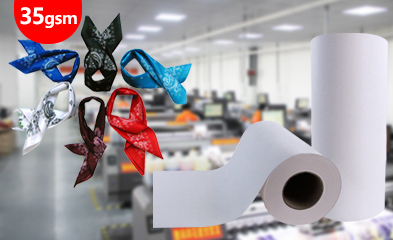
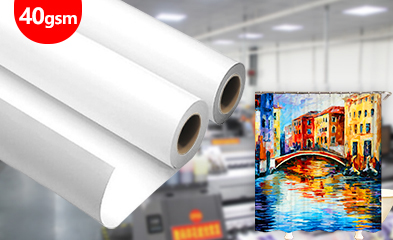
Changfa Digital offers multiple paper weights for different production conditions. The 40gsm transfer paper is available in a broad set of widths used in textile printing, giving buyers a concrete reference for lightweight roll testing.
What Does Fine-Line Printing Tell You About Sublimation Paper Coating?
Fine black lines and small reversed text are useful because they expose how the ink behaves at the surface.
A consistent sublimation paper coating should allow fine detail to remain controlled before transfer.
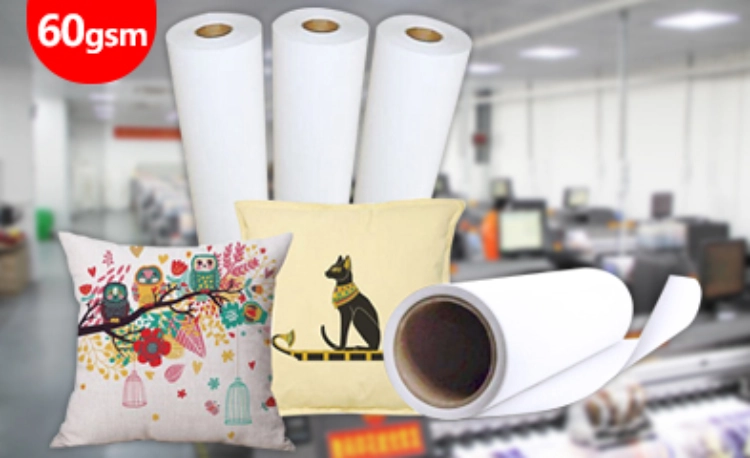
Compare line width, feathering, edge sharpness, small-text legibility, and dense color boundaries after printing, then judge the transferred fabric rather than the paper alone.
Do not score only by how dark the printed paper looks. Sublimation paper is an intermediate carrier. The important result comes after transfer.
What Should Be Measured After Heat Transfer?
The transfer stage separates “looks good on paper” from “works well in production.”
How Should Color and Residual Ink Be Compared?
Transfer the same printed test sections under identical conditions before comparing the fabric output.
Compare transferred density, neutral balance, large-area evenness, gradients, and residual image on the paper; the useful result is the final textile, not residual ink by itself.
Residual ink alone should not be treated as a complete quality score. What matters is whether the final textile reaches the required appearance consistently.
The same rule applies to transfer-rate claims. Buyers gain more from comparing their own controlled fabric output than from comparing percentages measured under different test conditions.
How Can Edge Definition Be Scored?
Score text, logos, diagonal lines, fine patterns, and color boundaries with a shared 1-5 definition scale.
Create a shared score; for example, use 5 for a very clean edge, 4 for minor softening, 3 for visible but acceptable spread, 2 for clear loss of definition, and 1 for an unacceptable result.
This makes sublimation paper quality easier to discuss across purchasing, production, and supplier teams.
Why Must Bulk Sublimation Paper Be Tested Over a Longer Run?
A one-meter sheet cannot reveal every roll problem.
What Does a Long-Run Test Expose?
Run enough paper to evaluate feeding and tracking, edge curl and winding, roll tension, drying during continuous work, and behavior near the roll edges.
Changfa Digital’s paper range includes several long-roll options. Product records cover lightweight grades such as 29gsm, 33gsm, and 38gsm in lengths up to 1000–3000m, while 40gsm specifications include multiple industrial widths and roll lengths for production use.
When a factory buys bulk sublimation paper, those long-run characteristics matter much more than a perfect A4 sample.
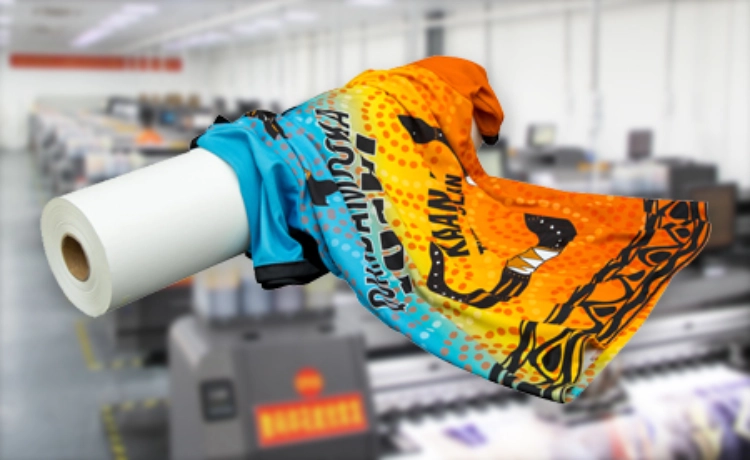
For a different working weight, buyers can compare the 60 g/m² schnelltrocknendes Papier with lighter candidates under the same test protocol rather than assuming higher or lower GSM automatically means better performance.
Why Should a Second Batch Be Tested?
A second production batch tests whether the supplier can repeat the paper, rather than merely produce one strong initial sample. Repeat a shortened version of the same benchmark with the same printer, artwork, fabric, and transfer settings, but use a new production batch.
Compare drying, edge-definition, transfer-output, and long-run scores against the first sample. If the result changes materially, resolve the batch-to-batch cause before release; coating consistency, drying speed, and roll handling are part of supplier evaluation.
What Should a Buyer Put in a Sublimation Paper Scorecard?
Keep the scorecard practical enough that production teams will actually use it.
|
Test Area |
Suggested Check |
|
Print handling and detail |
Drying at fixed intervals, fine-line sharpness, feathering, and small-text control |
|
Transfer output |
Density, neutral balance, large-area evenness, gradients, and residual image |
|
Roll handling |
Curl, feeding, tracking, and winding behavior |
|
Long-run stability |
Tension, drying, edge behavior, and continuous production consistency |
|
Second-batch repeatability |
Repeat the shortened benchmark on a new production batch |
Record a 1–5 score and a brief note for each row; this gives purchasing a better basis for discussion than “Sample A felt better.”
Changfa Digital handles base paper, coating, slitting, packing, and shipping within its sublimation-paper production workflow. Buyers can review export packaging options when the benchmark is being extended beyond print performance to include how long rolls will be protected during overseas delivery.
How Should Buyers Use the Final Benchmark to Place a Bulk Order?
Do not choose a paper from one winning score alone; weigh each result against the production priorities.
A high-speed sportswear plant may place more weight on drying and continuous feeding. A lower-speed operation printing heavy graphics may give more weight to ink handling and transfer uniformity.
The benchmark should reflect the factory’s actual cost of failure.
Before confirming a larger order, buyers can request a bulk paper sample from Changfa Digital and run the same acceptance test on the width, GSM, printer, ink, and fabric planned for production.
Schlussfolgerung
Sublimation paper quality is easier to judge when every candidate faces the same test.
Keep the printer, ink, artwork, fabric, and transfer settings unchanged. Then measure transfer paper drying speed, line definition, curl, feeding, transfer output, and long-roll behavior.
A useful sublimation paper sample test should also include a second production batch. That step turns the process from sample selection into supplier benchmarking.
For bulk sublimation paper, repeatability matters just as much as a strong first result. A consistent test protocol gives buyers a practical way to compare sublimation paper coating and real production behavior without relying on marketing claims alone.
Häufig gestellte Fragen
Q1: What should be included in a sublimation paper sample test?
A1: Use the same printer, ink, artwork, fabric, profile, and transfer settings. Test drying, fine lines, solid colors, curl, feeding, transfer output, and long-run behavior.
Q2: Why does transfer paper drying speed matter in bulk production?
A2: Transfer paper drying speed affects whether printed media can reach take-up without smearing or offsetting. It should be tested at the actual printing speed and take-up distance used by the factory.
Q3: How can buyers compare sublimation paper coating consistency?
A3: Use the same fine-line, solid-color, and transfer tests on more than one batch. Comparing repeat results helps show whether sublimation paper coating behavior remains stable between orders.


