


Bán nóng
Ứng dụng
Phone:+86-15215969856 E-Mail: 396838165@qq.com
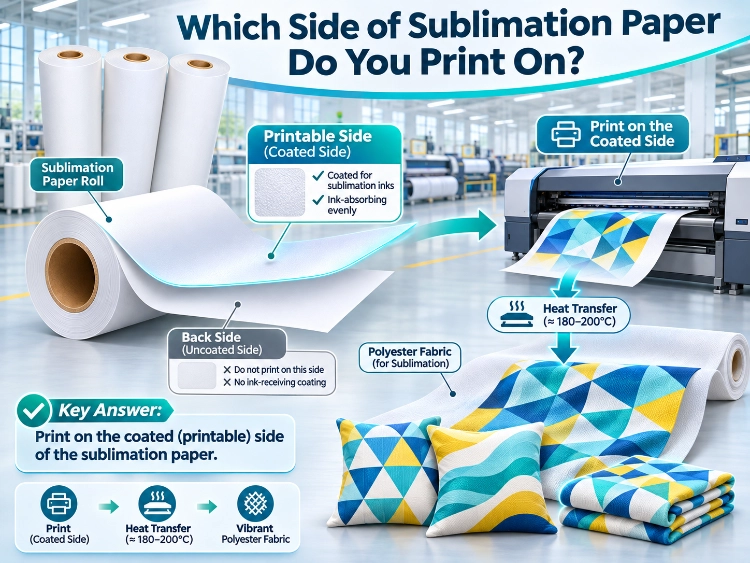
You print on the coated side. On a roll of sublimation paper, that is the side the coating was applied to — one face of the sheet carries the coating that holds the ink and releases the dye, and the other face is plain base paper. The difficulty is not knowing this; it is telling the two faces apart on a white roll, under workshop light, before the roll goes onto the printer. Printing the wrong side is not discovered at the printer, where the back of the sheet accepts ink well enough to look plausible. It is discovered at the press, after a full print run, when the transfer comes out weak and blurred. The checks below identify the coated side of a sublimation printing paper roll in under a minute, at the end of the roll, before any of it is printed.
Why the Two Sides Perform Differently
The coating is the working surface of the paper. It receives the ink, holds the dye in a thin layer at the surface while the sheet dries, and releases 95–98% of that dye at the transfer condition of 225°C for about 20 seconds on the standard grades. The back of the sheet is uncoated base paper: ink printed onto it soaks into the fibre mat, spreads as it dries, and under heat only the surface fraction of the dye transfers. A wrong-side print therefore fails twice — once at print quality, where edges soften and density drops, and again at the press, where the transfer is partial. Neither failure is visible as an obvious error on the printed roll itself, which is why the side check belongs before loading, not after the first transfer comes off the calender.
Check One: The Roll as Supplied
Start with the roll’s own orientation. Sublimation paper is coated, then wound for supply, and on a mill roll the coated face is the outside face of the roll — the face you see looking at the roll is the print side, and it stays the print side as the roll unwinds to the printer. This holds for the Changfa kỹ thuật số range, which is coated and slit in-house from base paper through coating, slitting and packing. Treat the rule as the starting point rather than the whole check: a roll that has been rewound, cut down or handled outside its original packing can lose the convention, and the three checks below confirm the side directly from the sheet itself.
Check Two: Look at the Surface
Unroll the first length and look at both faces under the best light available, ideally raking light at a low angle. The coated face is the brighter, whiter and more even of the two, with a smooth, closed surface. The back shows the base paper’s character: slightly duller, with the fibre texture of an ordinary sheet visible when the light rakes across it. On most grades the difference is plain once the two faces are compared side by side on the same length of paper; judging one face alone, from memory, is where mistakes start.
Check Three: Touch, Then the Water Drop
Run a fingertip across each face. The coated face feels smooth and slightly sealed, closer to a coated art paper; the back feels like plain paper, with a dry fibre drag. Where look and touch still leave doubt, use the water drop on a waste length at the roll end. Put one drop of water on each face. On the coated face the drop sits on the surface and spreads slowly, because the coating is engineered to manage how ink enters it. On the uncoated back, the drop soaks straight into the fibre and the wet mark spreads and darkens quickly. The contrast is immediate and it settles the question on any grade, including the light 29–40gsm papers whose coating is thinnest to the eye.
Mark It Once, Then Load
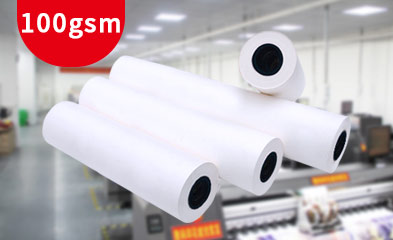
Once the coated side is confirmed, mark the roll so the answer survives handling: a note on the core end, or a marker line on the outer wrap, recording which face is coated. Do this for every new roll at goods-in, including rolls of a grade the shop runs every week, because the check costs a minute at the bench and the failure it prevents costs a full print run plus the press time spent transferring it. Where a shop slits its own widths from a Cuộn giấy khổ lớn 50gsm, mark each slit roll as it comes off the rewinder — slit rolls are exactly the rolls whose orientation can no longer be read from the original packing.
What a Wrong-Side Run Costs
The print itself usually completes, which is what makes this fault expensive. The ink sits in the base paper rather than on a coating, so the printed image looks acceptable on the roll — slightly softer, slightly less dense, easy to pass at a glance. The loss appears at transfer: weak, uneven colour, blurred detail, and a used sheet that stays strongly coloured because the dye never had a release surface to leave from. By that point the full run is printed, and the fabric pieces pressed from it are seconds. The side check is the cheapest inspection in the workflow, and it is the only one that has to happen before the printer starts.
Kết luận
Print on the coated side: the outside face of the roll as supplied, confirmed by the brighter and smoother surface, the sealed feel under a fingertip, and a water drop that sits on the coating instead of soaking into the back. Mark the core once the side is confirmed, and repeat the check on every roll that has been rewound or slit. Shops loading a new grade or a new width can send the grade, the roll width and the printer model, and the loading direction for that roll can be confirmed against the product specification before the first run.
Câu hỏi thường gặp
Câu 1: Bạn in ở mặt nào của giấy in chuyển nhiệt?
A1: The coated side. On a roll as supplied by the mill, the coated face is the outside face of the roll. Confirm it before loading: the coated face is brighter and smoother than the back, feels sealed under a fingertip, and holds a water drop on its surface instead of soaking it in.
Q2: What happens if you print on the wrong side of sublimation paper?
A2: The ink soaks into the uncoated base paper instead of sitting on a coating. The print looks slightly soft but plausible, then transfers weakly and unevenly, because only part of the dye can leave the fibre mat under heat. The fault is normally discovered at the press, after the run is printed.
Q3: Does the print side matter on pre-cut sheets as well as rolls?
A3: Yes. Sheets are cut from the same coated paper and carry the same two faces. Use the same checks — surface brightness, the sealed feel of the coating, and a water drop on a spare sheet — and keep the pack oriented the same way once the side is established.
Q4: Is the coated side always facing out on the roll?
A4: On a mill roll in its original packing, yes — that is how the paper is wound after coating. A roll that has been rewound, cut down or slit in the workshop can lose that orientation, which is why slit rolls should be marked as they come off the rewinder and checked from the sheet when in doubt.


