


Ứng dụng
Phone:+86-15215969856 E-Mail: 396838165@qq.com

A fastness grade on a buyer’s order is a test result with a method attached, not a judgement of how strong the colour looks on the day it is printed. For dye sublimation ink, the grade is largely settled before any laboratory sees the print: disperse dye either completes its move into the polyester fibre during transfer, or part of it stays on the surface, and washing, rubbing and light each expose a different share of that difference. A factory that reads the grade correctly can tell which test a low result belongs to, and which production variable owns it.
This article sets out the test methods behind sublimation ink color fastness — the washing, rubbing and light tests buyers name, the scales their grades are read on, how a test specimen is produced on a production line, and how a supplier’s fastness claim is checked before a bulk order. Changfa kỹ thuật số‘s Mực thăng hoa 1513 Series material states washing fastness at grade 4–5; the sections below set out what a grade at that level is measured against, and what has to hold on the line for a print to reach it.
Read the Grade Before the Method
Colour Change and Staining Are Two Separate Scores
A washing or perspiration result is not one number. It is graded twice: once for its own colour change, once for the staining it leaves on adjacent fabrics, both read against the grey scale. A print can hold its own shade and still fail on staining: unfixed dye that leaves the print lands on the adjacent fabric. An order that states one grade without saying which score it binds is read as binding both.
Half Grades Mark the Pass Line
The grey scale runs from grade 5 (no visible change) to grade 1 (severe change) and is read in half grades. Buyers write their acceptance lines in those half grades — 4, or 3–4 — so passing an order often turns on a half-grade judgement made under standard light. A whole-grade-only report hides the margin the order turns on.
Light Fastness Is Read on Blue Wool, Not on the Grey Scale
Light fastness is the exception: the specimen is exposed beside blue wool references and its fading matched against them on a 1-to-8 scale, not the 1-to-5 grey scale. A light grade and a washing grade are not comparable numbers, and a specification that asks for “grade 4 fastness” without naming the test has not stated a checkable requirement.
How the Test Specimen Is Produced
The Specimen Is a Production Print, Not a Laboratory Sample
A fastness result describes the specimen tested, and for sublimation work the specimen is made, not taken: printed and transferred on the line whose output it is meant to judge. A specimen pressed longer, hotter or on different paper than production grades a print the factory does not ship. The specimen therefore has to be produced with the production ink, production paper and press cycle the order will run on, conditions recorded.
Drying and Release Decide How Much Dye the Tests Can Reach
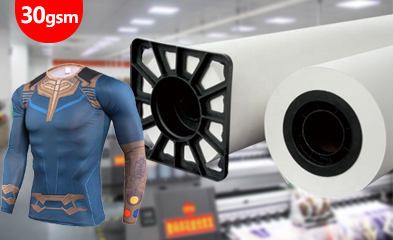
The print reaches the fabric from paper, and the paper’s drying and release decide where the dye sits when the tests begin. Changfa Digital’s 100gsm nhanh khô thăng hoa giấy cuộn is specified for high ink loads with a high transfer rate: the coating takes up the printed ink, dries fast, and gives the dye up to the fibre at transfer. Dye the coating holds back, and dye left on the fabric surface by a short transfer, are what the washing bath and the rubbing cloth reach first. A grade earned on one paper is evidence for that ink-and-paper pairing, not for the ink alone.
Washing Fastness Under ISO 105-C06 and AATCC 61
A Single Test Stands for One Wash, a Multiple Test for Five
ISO 105-C06 washes the specimen with a reference detergent under set temperature, concentration and action. Its single (S) test represents one domestic or commercial wash; its multiple (M) test, with increased mechanical action, represents up to five. AATCC 61 is the American laundering counterpart. The two condition the specimen differently, so a grade earned under one is evidence for the other, not a conversion of it.
Unfixed Dye Is What the Wash Removes First
A sublimation print carries two kinds of dye after pressing: dye that has diffused into the polyester fibre, and dye dried on the surface because the transfer never completed or the ink load exceeded what the fibre took. The wash reaches the second kind first. Colour that survives the multiple test is colour inside the fibre; early wash loss is a transfer record.
Rubbing Fastness Under ISO 105-X12 and AATCC 8
The Wet Test Grades Lower Than the Dry Test
ISO 105-X12 rubs a standard white cloth against the specimen under controlled conditions and grades the staining left on it, dry and then wet; AATCC 8 is the crockmeter counterpart. The wet test is the stricter of the two, because water lifts more of the dye the surface still holds. A specification that sets one rubbing grade is normally setting the wet one, and a dry pass does not predict it.
Surface Dye Is the Usual Cause of a Failed Wet Grade
Rubbing does not reach dye inside the fibre; it grades only what the surface surrenders. A print that passes washing and fails wet rubbing is not carrying a dye problem, it is carrying a transfer problem — ink left on the surface by excess load, incomplete release from the paper, or a press cycle that ended before the dye moved. The failing test names the stage that owns it.
Light Fastness Under ISO 105-B02 and AATCC 16
The Blue Wool Grade States How Long Colour Holds Outdoors
ISO 105-B02 exposes the specimen to a xenon arc (daylight, D65) and matches the fading against blue wool references; AATCC 16.3 is its counterpart. For sublimation work it governs banners, flags and outdoor display fabrics, which are lit every day but washed rarely. It is also the one grade that cannot be improved after printing.
The Dye Sets the Ceiling Before Printing Starts
Light resistance is a property of the dye molecule, not of the press. Changfa Digital’s account of its premium dye sublimation ink states that quality ink uses stable dyes that resist fading and that premium formulas are tested for lightfastness. A line can reach the ceiling its ink sets — through complete transfer and correct loading — but no paper or press setting raises it above the dye’s light grade.
Set Each Target From the Buyer’s Order
Each End Use Weights the Three Tests Differently
Sportswear is washed constantly and rubbed against skin and straps; swimwear adds chlorinated water; outdoor fabrics are lit far more than they are washed. A buyer’s specification weights them accordingly, and a factory standard that applies one house grade to every test either over-tests one direction or under-tests the one the claim comes from.
A Grade Without Its Method Cannot Be Verified
“Grade 4” does not state a test. C06 and AATCC 61 condition a wash differently, and the grey scale and the blue wool scale do not convert into each other. A specification that can be produced to is written as method, score and grade together — ISO 105-C06, colour change, grade 4 — and any shorter line is a question to send back before production, not a target to print to.
Checking a Supplier’s Claim Before a Bulk Order
Ask for the Method, the Score and the Fabric Behind the Grade
A grade offered without its method is a claim, not evidence. Behind any fastness number, three things can be asked: the test method the grade was earned under, both scores where the method gives two — colour change and staining — and the fabric and transfer conditions the specimen was produced under. A supplier who can produce those three can be checked against the order; one who offers only the grade cannot.
“High Quality” Has to Be Carried by the Grade Behind It
Ink is sold on quality wording, and fastness is where that wording is tested. Changfa Digital lists its High Quality Dye Sublimation Ink with washing fastness stated at grade 4–5 in the product material — a claim a buyer can take to the washing test and check. Any supplier’s high quality sublimation ink is worth what the named method and grade behind the wording are worth; a sample run on the buyer’s own fabric and press cycle settles the rest.
Run the Sample Under Production Conditions Before the Order
The buyer’s own check needs no laboratory for the two tests that fail most often: a wash cycle and a wet rub on a production-condition specimen expose surface dye within a day. Light fastness cannot be judged on that timescale; it comes from the supplier’s reported method and grade. The sample run cannot rescue a claim that arrived without a method — it tests the ink, not the wording.
Production Settings That Move the Grade
Ink Load Beyond the Paper’s Release Fails as Rubbing Loss
The paper’s coating holds the printed ink until the press, then has to give it up. A file loaded past what the coating releases cleanly leaves the surplus on the fabric surface, where the washing test may forgive it once and the wet rubbing test will not. The failing grade in that case belongs to the file and the paper pairing, not to the dye.
Temperature and Time Complete the Dye’s Move Into the Fibre
Disperse dye moves into polyester only while the press holds temperature. A cycle shortened to raise output, or a temperature that varies across the platen, leaves part of the dye uncommitted in every panel — invisible at inspection, graded at the first wash. Fastness is partly a press record: the same ink and paper return different grades off different cycles.
Change One Variable, Then Retest
When a result falls short, the failing test says where to look: washing loss to the dye and the transfer, wet rubbing loss to the surface, light loss to the ink alone. Change the one variable that owns that test and retest; do not adjust the whole line. Holding colour steady between batches is the companion problem, covered in the account of achieving batch-to-batch color consistency; the prior question is whether the colour produced meets the grade the buyer wrote.
Kết luận
A fastness grade is read off a test, set by the buyer’s order, and produced on the line. The grey scale and the blue wool scale state what was measured; the method named beside the grade states how; and on a sublimation line the result is fixed by the dye in the ink, the release of the paper and the completeness of the transfer — the ground covered by Changfa Digital’s Sublimation Ink series and its paper range. Send Changfa Digital the fabric composition and weight, the buyer’s fastness standard — the test items and the grade for each — the ink and paper now in use, the transfer temperature and time, and any grade measured at sampling, and the ink and paper pairing and the transfer conditions can be checked against that grade before the next run.
Câu hỏi thường gặp
Q1: What fastness grade does an export order usually require?
A1: There is no single export grade. The order sets a grade per test, weighted by the end use — washing and rubbing lines for apparel, light for outdoor fabrics — and each grade is binding only with its method and score named. A factory asked for “grade 4” without a method should have the line completed before production, because a C06 grade and an AATCC 61 grade are earned under different conditions.
Q2: Why does the same print pass dry rubbing and fail wet rubbing?
A2: The two tests grade the same surface under different conditions. The dry cloth lifts loose surface dye; the wet cloth lifts more of it, because water carries dye off the surface and onto the cloth. A wet failure after a dry pass means dye is still sitting on the print — the transfer did not complete or the ink load exceeded what the fibre took — and the correction is on the line, not in the laboratory.
Q3: Can a low fastness grade be fixed by changing the paper alone?
A3: Only when the loss is transfer-side. A paper whose coating releases more completely can remove the surface dye behind a wet rubbing failure. It cannot raise a washing grade limited by unfixed dye throughout the print, and it cannot change a light grade at all — that ceiling is set by the ink’s dye. Match the change to the test that failed.
Q4: What should a supplier’s fastness claim include before it is accepted?
A4: Three things: the test method the grade was earned under, both scores where the method gives two — colour change and staining — and the fabric and transfer conditions the specimen was produced under. A grade that arrives without them cannot be checked against the buyer’s order, whatever number it carries.


