


HOT SALE
APPLICATION
Phone:+86-15215969856 E-Mail: 396838165@qq.com
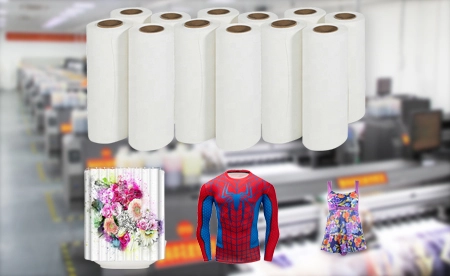
Sublimation printing has evolved into a highly engineered industrial process rather than a creative hobby technique. For professionals responsible for stable output, yield control, and repeatability, success depends less on aesthetic experimentation and more on disciplined process architecture. Ink behavior, coating physics, paper structure, press uniformity, and environmental control interact as a closed system. When one variable drifts, defects scale rapidly across thousands of meters of output.
This guide addresses sublimation printing from a production-centric perspective. It focuses on material logic, equipment alignment, and workflow design to reduce waste, stabilize quality, and support long-term operational performance.
Why does sublimation printing still fail in controlled production environments?
Many production failures are incorrectly attributed to operator technique. In practice, most defects originate from incompatibility between paper, ink, fabric, and thermal conditions. When system components are mismatched, no level of operator skill can compensate for the resulting instability.
Is transfer efficiency limited by paper structure or coating chemistry?
Transfer efficiency is primarily dictated by the balance between coating porosity and binder density. A coating layer that is too open absorbs ink well but releases it inconsistently during heat transfer, while a coating that is too dense resists ink penetration and reduces total dye load. The most stable configurations rely on calibrated micro-porosity that allows predictable ink anchoring during printing and controlled vapor release during pressing.
Base paper fiber density also plays a role. High-quality sublimation papers use a uniform fiber structure to prevent lateral ink migration, which directly impacts line sharpness and color edge integrity.
Does roll consistency affect color repeatability?
Roll-to-roll variation is a hidden risk in large-scale sublimation environments. Coating thickness variation leads to uneven ink uptake, and slitting imprecision introduces edge instability and variable tension. These issues accumulate during long production runs, causing visible density drift across fabric batches.
Consistent coating control and precision slitting are not cosmetic advantages, but operational necessities when color consistency is contractually required.
How do you select sublimation paper for different production goals?
Paper selection should be treated as a process decision, not a procurement shortcut. Print speed, ink load, fabric weight, and press dwell time should all influence gsm selection.
Should low-gsm paper be used for high-speed textile lines?
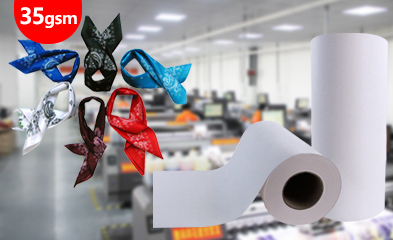
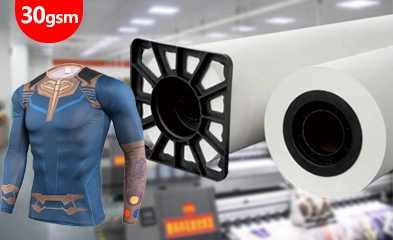
Low-gsm papers are well-suited to high-throughput environments where fast drying and minimal moisture retention are priorities. A technically appropriate reference is the 30 gsm non-tacky sublimation heat transfer paper, which aligns with high-speed sportswear and performance textile production.
Papers in this range typically offer faster ink drying under industrial airflow, lower paper stretch under tension, reduced ghosting risk on lightweight polyester fabrics, and stable behavior in long continuous roll operations. These characteristics directly support productivity when production speed is critical.
When does heavier paper improve process stability?
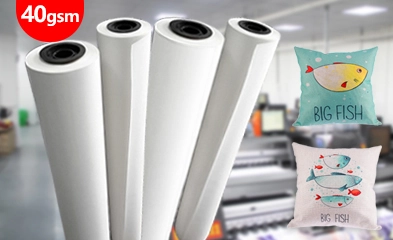
Heavier papers provide greater buffering capacity during complex transfers. The
40 gsm sublimation transfer paper demonstrates this logic well, particularly in applications that involve heavy ink coverage, deep tonal gradients, or textured fabric surfaces.
Higher gsm offers increased ink holding capacity, more stable dimensional behavior under heat, better performance for dense graphic elements, and lower sensitivity to press temperature fluctuation. For premium garment panels, signage, and décor textiles, these characteristics often justify the slightly reduced speed.
What role does ink formulation play in long-term color stability?
Ink chemistry is not a generic variable, but has to be matched to both printhead behavior and paper coating response. A mismatch results in nozzle instability, inconsistent density, or incomplete transfer.
Does nozzle type change ink requirements?
Different printheads operate with distinct droplet architectures. Systems built around high-nozzle-density configurations demand higher flow stability and finer dispersion. Ink optimized for broader droplet systems often underperforms in these environments. High-density formulations with strong dispersion stability are required when continuous long runs are expected.
High-density sublimation inks designed for advanced nozzle platforms can maintain continuous printing at 360 dpi over extended distances without broken lines, which directly supports production continuity.
Can solvent composition affect line reliability?
Solvent systems influence both print stability and safety. Environmentally friendly solvent systems reduce odor and operator exposure while also improving flow behavior. Stable sublimation inks maintain performance across both elevated and low-temperature environments, which supports consistency across seasonal and geographic operating conditions.
How does fabric choice reshape sublimation outcomes?
Fabric is not only a substrate, but also a structural participant in the transfer process. Yarn geometry, weave density, and fabric mass all influence dye diffusion.
Does polyester filament geometry affect color sharpness?
Interlock fabrics, bird-eye structures, and high-filament constructions each produce distinct diffusion pathways for sublimated dye. Fabrics with tighter knit and higher filament density generally yield sharper edges and higher perceived saturation, while loose structures allow deeper penetration but reduce surface chroma.
How does fabric weight influence heat transfer windows?
Heavier fabrics store more thermal energy and extend the effective transfer window. Lightweight fabrics reach equilibrium faster but are more sensitive to temperature overshoot. Professionals managing multiple fabric types should treat dwell time and press temperature as fabric-specific parameters, not fixed constants.
Why does production infrastructure determine print consistency?
Material quality loses value if production infrastructure cannot preserve it through processing. Infrastructure scale, precision, and stability directly shape quality outcomes.
Do coating lines directly impact batch-to-batch stability?
Multi-line coating architecture allows tighter process control and better reproducibility between batches, which is essential for international buyers managing long-term programs.
Changfa Digital operates four coating lines, including imported high-precision equipment, supporting a monthly capacity of approximately 3,000 tons and global shipments exceeding 120 containers.
Does slitting accuracy influence roll tension behavior?
The presence of multiple slitting workshops and dedicated machinery for different core systems supports controlled roll geometry and packaging stability. Precision slitting reduces edge deformation, improves roll unwind behavior, and minimizes web instability during high-speed printing.
Who can support both material supply and process optimization at scale?
In industrial sublimation, supplier capability is defined by system integration rather than catalog breadth. A reliable partner must control base paper selection, coating, slitting, packaging, and delivery while also offering technical response and customization.
Changfa Digital is a vertically integrated sublimation paper manufacturer and digital printing service provider with more than 15 years of operational experience. Our production structure spans base paper processing, coating, precision slitting, and export packaging. Monthly output reaches roughly 3,000 tons, with global shipment volumes exceeding 120 containers. We offer OEM/ODM services, customized widths across a broad gsm range, and 24-hour technical support, enabling stable collaboration across apparel, sportswear, and technical textile sectors.
How should beginners structure their first industrial sublimation workflow?
Even experienced teams entering sublimation production for the first time benefit from structured rollout.
Should equipment calibration come before material testing?
Printer linearization, ink limit control, and press temperature uniformity must be validated before evaluating material performance. Without baseline calibration, material testing results become unreliable and misleading.
Is pilot sampling necessary for every fabric category?
Pilot sampling should be mandatory whenever fabric composition, weight, or structure changes. Wash resistance, UV stability, and color consistency must be verified under real production conditions rather than extrapolated from prior data.
What process controls prevent long-term quality drift?
Sublimation systems drift over time. The goal is not to eliminate drift, but to detect it early.
Can environmental monitoring reduce defect rates?
Humidity fluctuations influence paper moisture balance, which affects ink absorption and drying. Besides, storage temperature impacts ink viscosity. Maintaining controlled storage and production environments significantly reduces unpredictable behavior.
Should data logging be part of daily production?
Process-oriented teams treat data logging as infrastructure. Tracking ink usage, transfer yield, reprint rates, and defect frequency creates visibility into process health and supports continuous improvement.
FAQs
Q1: Is low-gsm sublimation paper always better for high-speed printing?
A: No. While low-gsm papers support faster drying and throughput, heavier papers offer superior stability for dense designs, complex gradients, and premium fabric surfaces.
Q2: Can one ink formulation be used across all printer platforms?
A: Ink chemistry must align with nozzle architecture. Using mismatched formulations often leads to clogging, density inconsistency, or reduced transfer efficiency.
Q3: Why does identical fabric behave differently across production sites?
A: Differences in coating release behavior, press temperature uniformity, humidity control, and equipment calibration typically outweigh fabric variables.


