



Phone:+86-15215969856 E-Mail: 396838165@qq.com
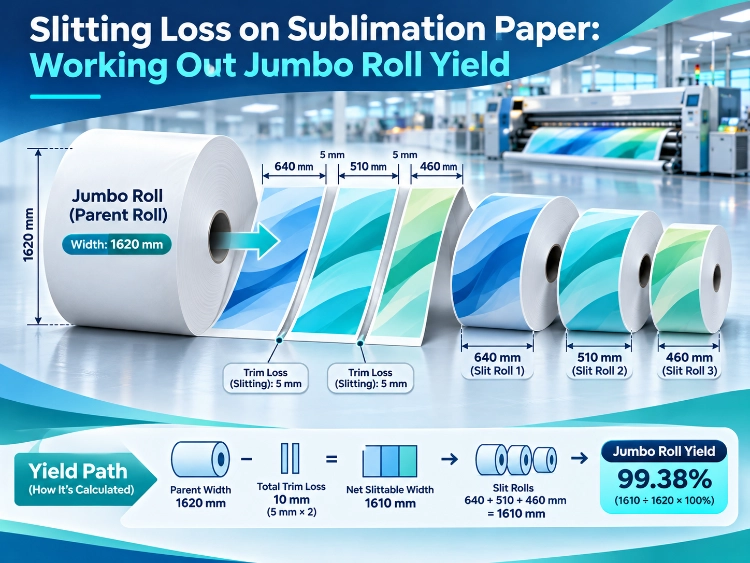
A jumbo roll is bought whole: the full stock width, the full wound length. What arrives as finished slit rolls is less than both, and the difference is slitting loss. It is not one deduction but three — width that no order occupies, length lost at the outside and the core of the roll, and the interaction between them when a slitting layout is chosen. This article works through where each loss sits and how to calculate the yield of a jumbo roll before ordering, so the usable metres in a quote can be compared between suppliers on the same basis. How the slitting itself is done — unwinding, knife setting, rewinding — is covered by the factory conversion article; this one keeps the accounts.
Loss Point One: The Width No Order Occupies
A jumbo roll is slit across its width into the widths the orders call for. Whatever width is left over after the order widths are combined becomes trim, and trim is the largest and most controllable of the three losses. The stock widths on the 50gsm 점보 롤 run to 183 cm, in steps that include 61, 91.4, 112, 122 and 162 cm. Combined against a 183 cm stock, the same jumbo gives very different yields depending on how the widths are laid out:
|
Layout on a 183 cm stock width |
Width used |
Trim |
Trim share |
|
122 cm + 61 cm |
183.0 cm |
0 cm |
0% |
|
91.4 cm + 91.4 cm |
182.8 cm |
0.2 cm |
0.1% |
|
112 cm + 61 cm |
173.0 cm |
10.0 cm |
5.5% |
|
162 cm alone |
162.0 cm |
21.0 cm |
11.5% |
The lesson of the table is that slitting loss is mostly decided before the knives move, by the combination. A single wide order taken from a wider stock carries the whole difference as trim; the same width ordered alongside a second width that fills the stock carries almost none. This is why mills ask for non-standard widths — 152 cm or 163 cm instead of a round figure — when a small change lets two orders share one stock width with little left over. A buyer who can flex an order width by a centimetre or two, or who consolidates widths into one shipment, is negotiating the largest loss term directly.
Loss Point Two: Length Lost at the Outside of the Roll
Length loss starts before slitting. The outer wraps of a jumbo roll take the handling damage of storage and transport — scuffed, creased or dirty metres that cannot be sold as first-quality printing paper and are stripped before or during slitting. A roll that has travelled far or stood long loses more here than a fresh one. There is also a short start-up length while the slitter is threaded and brought to tension and speed. Neither figure is fixed: both are measured on the actual roll, in metres, and both come off the wound length before any order is cut. On a 3,000 m jumbo — the top of the 300–3,000 m range the 50gsm grade is wound in — a combined 10 m of outer damage and start-up length is 0.3% of the roll. On a 300 m roll the same 10 m is 3.3%, which is why short jumbos carry proportionally heavier length loss.
Loss Point Three: The Tail Left on the Core
At the other end of the roll, the last metres wound against the core cannot be run: the paper at the core is crushed and creased by the winding pressure of everything above it, and a working tail is left on the core when the roll is taken off. Like the outer loss, the tail is a fixed number of metres per roll rather than a percentage, so it weighs most on short rolls and least on long ones. Between the outer wraps and the core tail, the usable length of a jumbo is its wound length minus two measured deductions — and any yield figure that does not state both deductions has not finished the calculation.
The Yield Calculation, Worked Once
Yield is usable area over bought area, and it separates into a width term and a length term:
Yield = (order widths combined ÷ stock width) × (usable length ÷ wound length)
Worked on the 183 cm, 3,000 m jumbo above, with 10 m of combined outer and core length loss (2,990 m usable):
- Layout 122 cm + 61 cm: (183 ÷ 183) × (2,990 ÷ 3,000) = 1.000 × 0.997 = 7%. The jumbo delivers two rolls — one of each width — at 2,990 usable metres each.
- Layout 162 cm alone: (162 ÷ 183) × (2,990 ÷ 3,000) = 0.885 × 0.997 = 2%. The same jumbo, the same length loss, and 11.5 percentage points of yield gone to trim.
The buyer’s own figures go into the same two brackets: the widths actually ordered against the stock width actually slit from, and the length deductions actually measured on the roll. Any supplier quoting slit rolls from jumbo stock can be asked for those four numbers, and a quote that gives only a price per roll is withholding the term that decides the comparison — the cost per usable metre, which is the roll price divided by the usable metres the yield calculation returns.
Ordering Slit Rolls Against the Loss
Three instructions to the supplier remove most avoidable loss. First, order widths that combine: give the full set of widths in one order so the slitting plan can fill the stock width, rather than releasing widths one at a time. Second, state the core: Changfa 디지털 slits in-house across four slitting workshops and ten machines, for 2-inch and 3-inch cores, across a 승화 종이 range of 29–100gsm in widths from 61 cm to 320 cm, so the core and the width set are set at the same desk that runs the knives. Third, agree how length is counted — wound length or usable length — before the order, because the two differ by exactly the deductions above, and a dispute about them after delivery has no clean answer.
결론
Slitting loss is trim width, outer length and core tail, in that order of size, and the first of them is chosen by the buyer’s own width set before production starts. Work the yield as two brackets — combined order width over stock width, usable length over wound length — and compare suppliers on cost per usable metre rather than price per roll. To have a slitting plan worked out for a specific order, send the widths and lengths required, the core size, and the grade, and the layout can be calculated against the stock widths before the order is placed.
FAQ는
Q1: What is a normal slitting loss for sublimation paper?
A1: There is no single normal figure, because the largest term is the trim left by the width combination, which runs from 0% when the order widths fill the stock width to over 11% when one wide order is taken from a wider stock. Length losses at the outside and the core add a smaller, measurable amount on top. A yield claim is only meaningful with its layout and length deductions stated.
Q2: How do I check the yield a supplier is quoting?
A2: Ask for the four inputs: the stock width slit from, the combination of widths on that stock, the wound length, and the length deductions for outer damage and the core tail. Yield is the combined order width divided by the stock width, multiplied by the usable length divided by the wound length. If a supplier cannot state the layout, the yield figure cannot be checked.
Q3: Does ordering a non-standard width really reduce loss?
A3: Yes, when the change lets widths combine. On a 183 cm stock, moving an order so it pairs with a second width can cut trim from 21 cm to under 1 cm per pass. Mills request widths such as 152 cm or 163 cm for exactly this reason: the small change removes most of the trim term.
Q4: Why does a short jumbo roll lose proportionally more than a long one?
A4: The length losses — damaged outer wraps, start-up length and the tail left on the core — are fixed metre amounts per roll, not percentages. Ten metres of combined length loss is 0.3% of a 3,000 m roll and 3.3% of a 300 m roll, so short rolls carry the heavier proportional deduction.


