


Phone:+86-15215969856 E-Mail: 396838165@qq.com
A print shop set up for polyester sublimation gets offered a nylon job: flags, mesh banners, a run of sportswear fabric. The printer, calender and paper stock are in place; the fabric is the only new variable. The question the shop is really asking is can you sublimate on nylon with a line built for polyester, and the answer is conditional. The decision is whether the job goes on the existing line as it stands, goes on the line under different conditions, or does not go on the line at all. That decision turns on one variable: the temperature the fibre will tolerate, set against the temperature the transfer process is specified to run at. Everything else in the job, paper grade included, is settled after that variable is priced in.
Two Fibres, Two Relationships With the Dye
How Polyester Takes Disperse Dye
Polyester and disperse dye are a matched pair. Under heat the dye leaves the paper as a gas and enters the polyester fibre, and once the fabric cools, the dye is held inside the fibre structure. That hold is what the standard transfer specification is built around: sublimation paper is rated at 225°C for about 20 seconds, inside a working window of 200–250°C, because at those temperatures the release off the paper and the uptake into the fibre complete together. Transfer rates and ink-load ratings are measured at that window, and they describe polyester behaviour only.
How Nylon Takes It, and What It Is Matched With Instead
Nylon is a polyamide, a different polymer family, and its relationship with disperse dye is weaker on both sides of the transfer. The dye enters, but the uptake is lower and the hold is less firm, so colour comes out duller than the same artwork on polyester, and wash and rub fastness sit lower. The dye classes matched to nylon are acid dyes, and reactive dyeing is also used on it, which is why dedicated nylon printing is built on those chemistries rather than on sublimation. Sublimation on nylon is a borrowed process: workable, but running on a fibre that was never the specification target.
What the Temperature Gap Does in Practice
The Ceiling the Fibre Sets
Trade guidance for transferring onto nylon puts the working window at roughly 160–177°C, with one guide quoting about 165–170°C held for a long dwell of 80–90 seconds. Set that ceiling against the standard point of 225°C and the gap is about 50°C. Dye release off the paper is driven by temperature, so at nylon temperatures the release runs incomplete by design: a share of the dye stays on the sheet no matter which grade is loaded. Extending the dwell to 80–90 seconds, four times the standard 20 seconds, recovers part of the transfer, but dwell substitutes for temperature only up to a point. The ceiling on the result is fixed before paper grade enters the discussion.
What Happens at Polyester Settings
The other direction is worse. Running a nylon job at the line’s polyester settings, 225°C inside the 200–250°C window, exposes the fabric to heat it is not specified to take. The documented risks are scorching, yellowing and glazing of the surface, and thin nylon can pucker under the heat. A shop that treats the job as a paper change rather than a temperature change damages fabric before it learns anything about transfer quality.
Colour and Fastness Once the Print Is Made
What comes off a correctly run nylon transfer is a print with a lower ceiling than the same job on polyester: duller colour from the weaker uptake, and lower wash and rub fastness from the weaker hold. On flags, the trade verdict is poor outdoor colour life compared with polyester, and nylon is a classic flag fabric, so flag and banner shops meet exactly this gap between what the order asks for and what the fibre returns. None of that is a paper defect. It is the fibre’s terms, and the paper can only work inside them.
Judging a Nylon Job Before It Reaches the Calender
Read the Fabric Before the Paper
The first check is the fabric itself, not the paper stock. Fibre content on the label decides the starting point: a nylon-polyester blend behaves by its polyester share, so a blend with a high polyester content is a different job from a pure nylon. Some nylon is sold with coatings or finishes, and a coated nylon changes transfer behaviour again, so the finish has to be identified before conditions are set. A job quoted without the fibre content and the finish is a job quoted blind.
Set the Test Conditions by the Fibre
The test run belongs at nylon conditions from the first metre: roughly 160–177°C, the dwell extended toward 80–90 seconds, and an ink load kept realistic rather than loaded to the paper’s maximum, because dye the fibre cannot take up has nowhere to go. The strike-off is judged after washing, not off the calender, since the weaker hold shows itself in the wash and a fresh print overstates the result. Colour, wash fastness and rub fastness are all read off that washed sample.
Work That Should Be Refused or Routed Elsewhere
Some nylon work should not be priced on the sublimation line at all. Jobs specified on colour strength or fastness grades that the fibre cannot reach, and outdoor flag work expected to hold colour the way polyester does, belong with acid dye printing, the process matched to the fibre. The refusal is cheaper than a bulk run that fails the customer’s fastness check after delivery.
Where the Paper Range Sits Inside Those Criteria
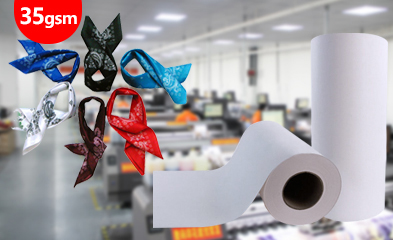
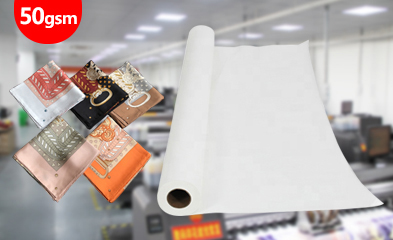
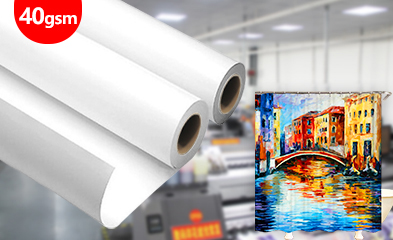
Changfa 디지털 grades its range, 29–100gsm, at the standard polyester window, and the ratings in the table are stated at those conditions. They will not be reached at 160–177°C, and the table has to be read that way: the standard-window figures show what each grade carries; the last column shows what nylon temperatures do to that capacity.
|
Paper grade |
Transfer rate at standard polyester conditions |
Ink-load rating |
What changes on a nylon job |
|
40gsm |
95–98% |
2 stars |
Release is temperature-starved; the smaller ink load leaves less dye stranded on the sheet |
|
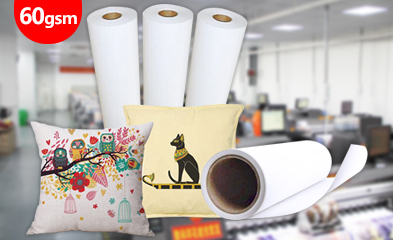
50gsm |
95–98% |
3 stars |
Release is temperature-starved; in practical terms this grade loses least, as its capacity sits closest to what nylon takes up |
|
100gsm |
Over 98% |
5 stars |
Release is temperature-starved; the extra ink capacity has nowhere to go, because the fibre caps uptake well below it |
Inside a nylon job that passes the criteria above, the grade decision is a matching of capacity to a capped uptake, which points to the lighter and mid grades. The 100gsm fast dry paper earns its rating on full-coverage polyester work, where the standard window applies and the fibre can take what the grade releases. The range comes off an in-house chain of base paper, coating, slitting and packing, run on four coating lines including one imported German line, so grade behaviour stays consistent from roll to roll when a test result has to be repeated at bulk scale. Shops working through flag work specifically can cross-check width and ink-load matching against the flags and soft signage guidance.
결론
Before a metre of bulk fabric is committed, run one strike-off on the actual nylon: the chosen grade loaded at a realistic ink load, transferred at 165–170°C with the dwell extended to 80–90 seconds, then washed and judged on colour, wash fastness and rub fastness as it comes out of the wash. That single test prices the temperature gap for this specific fabric, and its result, not the artwork file, decides whether the job is taken and on what terms. To have the grade matched before the test is run, send the nylon fabric specification (fibre type, weight, any coating or finish) and the order size, and the grade can be set against the fabric rather than against the catalogue.
FAQ는
Q1: Which paper grade should be ordered for a nylon job? A1. Order against the capped uptake, not against the catalogue maximum. The lighter and mid grades, 40gsm and 50gsm, carry ink loads closest to what nylon takes up at 160–177°C. The 100gsm grade’s five-star ink load and over-98% transfer rate are specified at the standard polyester window and will not be reached at nylon temperatures, so its extra capacity buys nothing on this job.
Q2: What should be checked on the fabric before paper is ordered? A2. Three things: the fibre content on the label (pure nylon, or a blend, and if a blend, the polyester share, since the blend behaves by that share), any coating or finish on the fabric, because a coated nylon changes transfer behaviour again, and the fabric weight. A paper order placed before those are known is placed against an assumed fabric.
Q3: What test should be run before committing to a bulk nylon order? A3. A strike-off on the actual production fabric, transferred at 165–170°C with an 80–90 second dwell and a realistic ink load, then washed before it is judged. Colour, wash fastness and rub fastness are read off the washed sample. If that sample misses the standard the job is specified to, the work is routed to acid dye printing rather than scaled up on the sublimation line.


