


アプリケーション
Phone:+86-15215969856 E-Mail: 396838165@qq.com"

Dye sublimation has become one of the most efficient coloration systems for polyester-based textiles. Its molecular bonding strength, wash resistance, and transfer mechanism are particularly well-suited for use in sportswear, soft signage, and industrial fabric decor. However, as the color of the fabric changes from light to dark, the physics that make it so clear, permanent, and strong begin to place limits on its structure. Managing those limits requires a process-level approach that integrates material science, coating behavior, ink formulation, and thermal control rather than relying on surface-level adjustments.
Why is dye sublimation naturally limited to dark fabrics?
Sublimation colorants are transparent by nature. Their visual presence depends entirely on light reflection from the fabric surface after diffusion into polyester fibers. On light substrates, reflection dominates, while on dark substrates, absorption dominates. This optical imbalance is the core reason sublimation struggles when the base color deepens.
How does fabric color interfere with dye visibility?
Dark fibers absorb a larger fraction of the incident light before reaching the embedded dye molecules. Even if gas-phase transfer is successful, the back-reflected luminance is substantially reduced. Increasing the ink density may slightly enhance chroma but cannot alter the absorption pattern imposed by black or blue substrates.
Why can’t sublimation ink create opacity?
Disperse dyes form molecular bonds within the polymer structure of polyester rather than build surface layers. Unlike pigment systems, they cannot stack to form a blocking film. Each molecule diffuses individually, which prevents any mechanism capable of covering dark backgrounds.
What technical routes allow sublimation graphics to appear on dark textiles?
Industrial production does not try to overcome the laws of physics, but rather works around them. The only reliable methods for achieving vivid graphics on dark polyester involve the addition of an intermediate white or reflective layer between ink and fabric.
What is the role of white base layers?
White polymer layers, thermal adhesive films, and coated intermediates serve as optical reset points and reflect light through the dye layer after transfer. Without this reflective base, chromatic energy dissipates into the fabric.
How do coated transfer papers change the process?
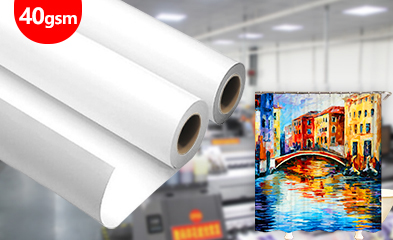
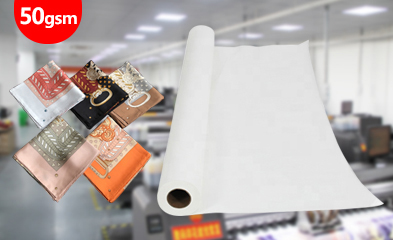
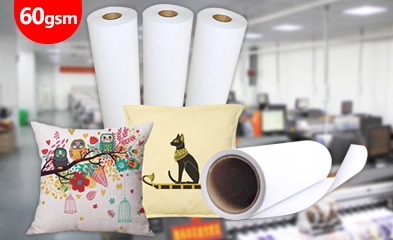
Advanced coated papers regulate ink absorption and release timing. Their function is not only to hold more dye but to control vaporization uniformity during transfer. Fast release reduces lateral diffusion and improves edge fidelity. Transfer media such as 60 gsm速乾昇華紙 are engineered for this behavior, where coating chemistry balances ink load with controlled desorption under heat.
How does ink formulation affect performance on dark-fabric workflows?
When dealing with coated intermediates and layered workflows, ink behavior becomes even more critical. Migration efficiency, stability under temperature cycling, and dispersion uniformity directly influence how much color survives the transfer path.
Why is high-density dispersion critical?
High-density dispersions increase molecular availability without requiring excessive liquid volume, thus improving transfer yield and preserving dot integrity. Poor dispersion leads to inconsistent vapor pressure and mottled tonal output, especially noticeable in shadow regions.
How does thermal stability influence edge sharpness?
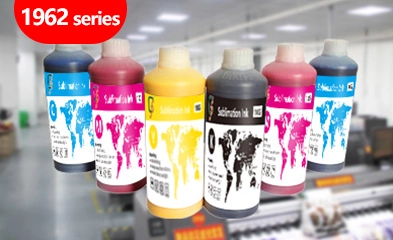
Ink systems that tolerate both elevated storage temperatures and low-temperature printing environments maintain viscosity control. Stable formulations allow continuous operation without nozzle interruption and prevent uncontrolled vapor spread during transfer. Systems such as the 1962年シリーズCMYK昇華インク are developed with this thermal balance in mind, supporting strong black channel density while retaining fluid consistency.
How should heat transfer parameters be adjusted for dark fabrics?
Thermal control becomes more sensitive when additional layers or coated substrates enter the workflow. Temperature, dwell time, and pressure must align with the coating chemistry rather than the textile alone.
What temperature range enables full dye diffusion?
Optimal dye mobility for most polyester systems occurs between 190°C and 205°C. Below this range, there is incomplete diffusion. However, if above this range, there is too much vapor velocity, thereby resulting in haloing and edge distortion, especially for transfer layers.
How does pressure affect coated layers?
Insufficient pressure produces incomplete surface contact and localized color loss, while excessive pressure compresses the coating structure and distorts diffusion paths. Balanced pressure ensures even heat flux and stable gas transfer without mechanical degradation.
How do fabric structures influence final image clarity?
Even with optimized transfer materials, the textile itself remains a determining variable. Yarn geometry, filament density, and elastic content influence how dyes anchor and how light behaves post-transfer.
Why does filament density change color そして sharpness?
Tightly packed filaments limit horizontal diffusion, preserving contour integrity. Open structures allow vapor to migrate laterally before fixation, softening edges and reducing contrast.
How does elastane content complicate sublimation?
Polyester-spandex blends expand and contract at different rates during heating and cooling. This differential movement can distort transferred graphics if thermal stabilization is not carefully managed. Cooling curves matter as much as peak temperature.
Where does industrial consistency come from in dark-fabric sublimation?
Consistency is rarely the result of a single component. It emerges from production systems that control every variable from coating thickness to roll tension to export logistics.
What production capabilities ensure coating uniformity?
Facilities operating multiple coating lines with calibrated drying profiles achieve predictable ink release behavior. Control of web tension, solvent evaporation, and coating rheology determines whether every meter of paper behaves identically.
How does in-house slitting affect registration accuracy?
Edge straightness, roll balance, and tension uniformity influence how transfer paper feeds during printing. Misalignment errors accumulate rapidly in long production runs when slitting quality is inconsistent.
At this system level, チャンファ デジタル operates integrated operations that combine base paper sourcing, coating, slitting, and exports under one structure. With the experience of sublimation production for more than fifteen years, four coating lines, four slitting workshops, and an output of 3,000 tons per month, such a structure is possible for stability in our processes. Our ability to offer custom widths, support OEM production, and offer 24-hour technical support indicates our business maturity in handling relevant problems related to sublimation systems.
What quality metrics matter most for dark-fabric sublimation?
Without objective measurement, visual assessment becomes misleading. Dark substrates require stricter evaluation criteria.
How is black coverage objectively evaluated?
Optical density measurements quantify luminance reduction after transfer. ΔE comparisons between proof and production samples reveal whether coated systems truly improve perceived contrast.
How are wash and UV resistance verified?
Durability must be validated under standardized protocols. Lightfastness testing, wash cycle stability, and post-transfer migration assessments reveal whether layered sublimation solutions remain viable beyond short-term presentation.
When does sublimation become less suitable than alternative methods?
Sublimation excels within its chemical domain. Beyond that domain, forcing it into unsuitable applications increases cost without delivering performance.
What fabric colors exceed sublimation limits?
Pure black, heavily dyed navy, and coated blackout textiles absorb too much light for sublimation to perform effectively, even with advanced intermediates.
What production volumes justify coated workflows?
Layered processes increase material cost and labor complexity. They are economically justified only when production scale, product value, or design permanence outweighs those costs.
FAQについて
Q1: Can true black polyester be printed using sublimation without coatings?
A: No. Without a reflective base, sublimation dyes remain visually suppressed due to the light absorption behavior of black fibers.
Q2: Does higher ink density always improve color on dark substrates?
A: Only marginally. Beyond a certain point, excess density increases diffusion and reduces sharpness rather than improving perceived brightness.
Q3: Is coated transfer paper essential for professional dark-fabric workflows?
A: Yes. For predictable contrast and consistency, coated media provide the only viable control over ink release and vapor behavior.


