


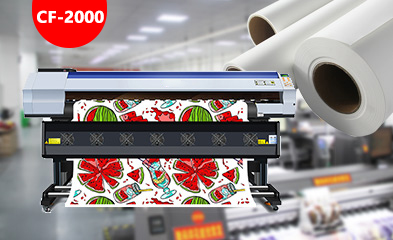
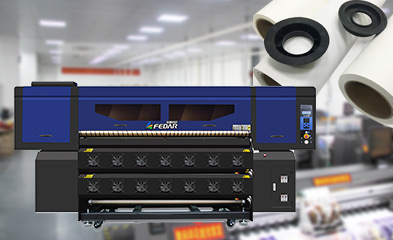
アプリケーション
Phone:+86-15215969856 E-Mail: 396838165@qq.com
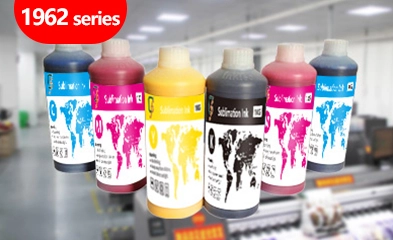
Sublimation ink is not a simple consumable. In production environments, it functions as a control variable that influences nozzle reliability, transfer efficiency, color repeatability, and long-term operating cost. A stable ink system supports predictable dot formation, controlled vaporization during transfer, and consistent bonding with polyester substrates. An unstable formulation, by contrast, amplifies mechanical tolerances into visible defects.
Therefore, reliable printing results rely not only on color density alone, but also on chemical stability, controlled particle dispersion, thermal tolerance, and compatibility with printhead architecture, transfer paper, and fabric structure. This article examines sublimation ink from that system perspective.
Why does sublimation ink quality determine production stability?
In continuous textile printing, the ink loop never operates in isolation. It passes through filters, dampers, piezo chambers, paper coatings, and heat-transfer stages before reaching the fiber surface, and weakness at any point propagates forward.
Does particle dispersion affect nozzle reliability?
Particle dispersion determines whether ink behaves as a fluid or as a suspension under pressure. Fine, uniformly distributed dye particles reduce sedimentation in reservoirs and micro-channels. In contrast, coarse dispersion increases the probability of partial nozzle blockage and asymmetric jetting, especially in multi-nozzle arrays operating at high firing frequencies.
Over long runs, this difference becomes structural: stable dispersion preserves drop velocity and placement accuracy, while unstable systems accumulate micro-deposits that distort dot geometry and gradually shift color balance.
Can ink viscosity shift during continuous printing?
Viscosity is temperature-dependent and sensitive to solvent evaporation. Inks formulated for production conditions are designed to maintain flow consistency even during uninterrupted 360-dpi printing over long distances. High-quality formulations are capable of continuous output of at least 20 meters without line breakage or local voids, even under thermal stress cycles between elevated and low ambient temperatures.
What chemical properties define a reliable sublimation ink?
Chemical formulation governs both safety and performance. Production teams evaluate inks by how predictably they behave under heat, storage, and mechanical stress.
Do environmentally friendly solvents change performance?
Modern sublimation inks increasingly rely on environmentally friendly solvent systems, which can reduce operator exposure and odor while improving volatility control. Current formulations adopt non-toxic solvent carriers designed for industrial use, balancing evaporation rate with nozzle lubrication to avoid premature drying inside printheads.
When properly formulated, eco-solvent systems do not compromise transfer efficiency. Instead, they stabilize viscosity curves and reduce residue formation during repeated heating cycles.
Does color gamut correlate with ink structure?
Color gamut is not purely a pigment issue, and is shaped by molecular size, dispersion quality, and carrier chemistry. High-performance sublimation inks exhibit wide gamut behavior and, in particular, enhanced black-channel coverage after transfer, producing deeper neutral tones on polyester fabrics. The same formulations are tested for durability, reaching sun-resistance level 6 and wash-resistance levels of 4–5 after transfer.
How should ink be matched with different printhead architectures?
Printheads impose mechanical constraints on ink chemistry. Ignoring these constraints shortens component life and destabilizes output.
Do high-nozzle systems require higher–density inks?
High-nozzle platforms demand inks with consistent particle size and stable concentration. High-density formulations are commonly specified for multi-nozzle systems, where flow rate must remain uniform across dozens of channels. High-density sublimation inks developed specifically for large nozzle arrays support the color saturation and contribute to jetting stability.
Are industrial heads more sensitive to solvent composition?
Industrial heads operate under higher firing temperatures and tighter tolerances. Solvent composition directly affects the lubrication of piezo elements and membrane elasticity, and improper solvent balance accelerates wear and increases misfiring risk. Stable industrial inks, therefore, prioritize controlled evaporation and chemical neutrality toward internal polymers.
How does sublimation ink interact with transfer paper and fabric?
Ink performance only becomes visible after passing through paper and into the fiber, where the stage determines final visual quality.
Does paper coating influence dye release efficiency?
The coating process for transfer paper determines the strength of ink adhesion during the printing process and the extent of vaporization in the heating process. Too much adhesion results in a higher amount of dye being trapped in the coating layer, thus reducing the amount of dye transferred, while too little adhesion results in feathering and blurring before the transfer process. Good inks are designed to temporarily adhere to the polymers in the coating and easily release at a specific temperature.
Can fabric weight change color perception?
Fabric mass and knit density influence diffusion depth. Heavier fabrics absorb more gaseous dye and scatter light differently, often producing deeper but less saturated surface color, while lightweight fabrics display higher chroma but lower depth. Ink formulations with stable vapor pressure help maintain predictable behavior across fabric categories.
Which sublimation ink series suits high-speed textile production?
Throughput-oriented lines require inks that dry quickly, flow smoothly, and tolerate long duty cycles.
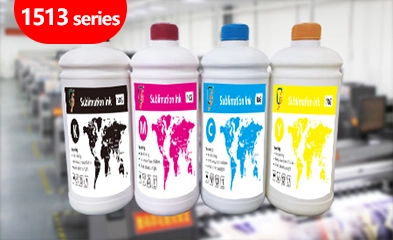
Is the 1513 series optimized for continuous operation?
「 The 1513シリーズ昇華インキ is designed for digital textile workflows that emphasize speed and nozzle stability. It is formulated to meet high-density CMYK requirements while keeping sedimentation risk low, ensuring continuous printing without any visible banding. These properties will directly improve productivity rather than merely visual quality.
When should higher-coverage sublimation ink be prioritized?
Not all production emphasizes speed. Decorative textiles, dense patterns, and premium garments impose different requirements.
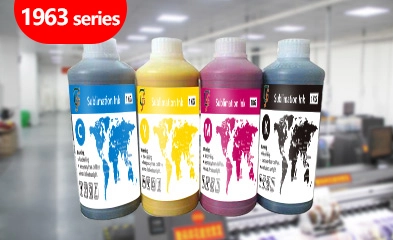
Does the 1963 series support heavy ink loading?
「 The 1963シリーズ昇華インキ is positioned for applications where deep blacks and high color concentration are critical. More dye in the formulation ensures adequate coverage in solid areas and reduces mottling in textured or heavier fabrics. These types of inks are generally used in applications where depth of color and tonal uniformity are more important than the speed of production, including branding textiles or interior décor materials.
Who can supply sublimation ink with both scale and process support?
Material performance is inseparable from supplier capability. Production consistency depends on whether ink chemistry, quality control, and logistics operate under unified standards.
チャンファ デジタル is a vertically integrated sublimation paper manufacturer and digital printing service provider with more than 15 years of industry operation. We control the full chain from base paper processing and coating to slitting and export packaging. Our production infrastructure includes four coating lines, four slitting workshops, and ten slitting machines supporting both two-core and three-core roll systems. Our monthly capacity is approximately 3,000 tons, with global shipments totaling about 120 containers per month. Besides, we also provide OEM/ODM customization services, 24-hour technical support, and dedicated service teams to help scale production capacity and adapt manufacturing processes.
How should sublimation ink be tested before full production rollout?
Ink selection without validation introduces systemic risk.
Should long-run printing be simulated?
Long-run simulation is essential. Continuous printing tests reveal nozzle fouling behavior, viscosity drift, and color stability far more effectively than short sampling runs. The 20-meter uninterrupted printing benchmark commonly used in technical validation offers a practical baseline for screening unsuitable formulations.
Is thermal aging evaluation necessary?
Storage at elevated temperatures and restart tests at low temperatures expose solvent separation tendencies and pigment aggregation. Reliable inks maintain flow stability after such cycles, reducing the probability of seasonal performance shifts.
What operational controls keep ink performance consistent?
Ink reliability is maintained, rather than assumed.
Can storage conditions alter ink chemistry?
Temperature fluctuations accelerate solvent evaporation and alter viscosity, and direct sunlight promotes photochemical degradation. Controlled storage between moderate temperature limits and regular container agitation reduces stratification risk.
Should ink usage data be tracked?
Tracking batch numbers against defect rates enables early detection of formulation drift. Data correlation between ink lot, printhead behavior, and fabric outcome forms a practical quality feedback loop.
FAQについて
Q1: Can one sublimation ink formulation serve all printer models?
A: No. Printhead design defines acceptable viscosity, particle size, and solvent volatility ranges. Mismatch increases clogging risk and color instability.
Q2: Does higher ink density always improve color output?
A: Only when paper coating and fabric structure allow full vapor release. Excess density on incompatible systems reduces sharpness and increases residue.
Q3: How often should sublimation ink be validated in continuous production?
A: At a minimum per batch, and after any change in environment, equipment, or supplier process.


