


Penjualan Panas
Aplikasi
Phone:+86-15215969856 E-Mail: 396838165@qq.com
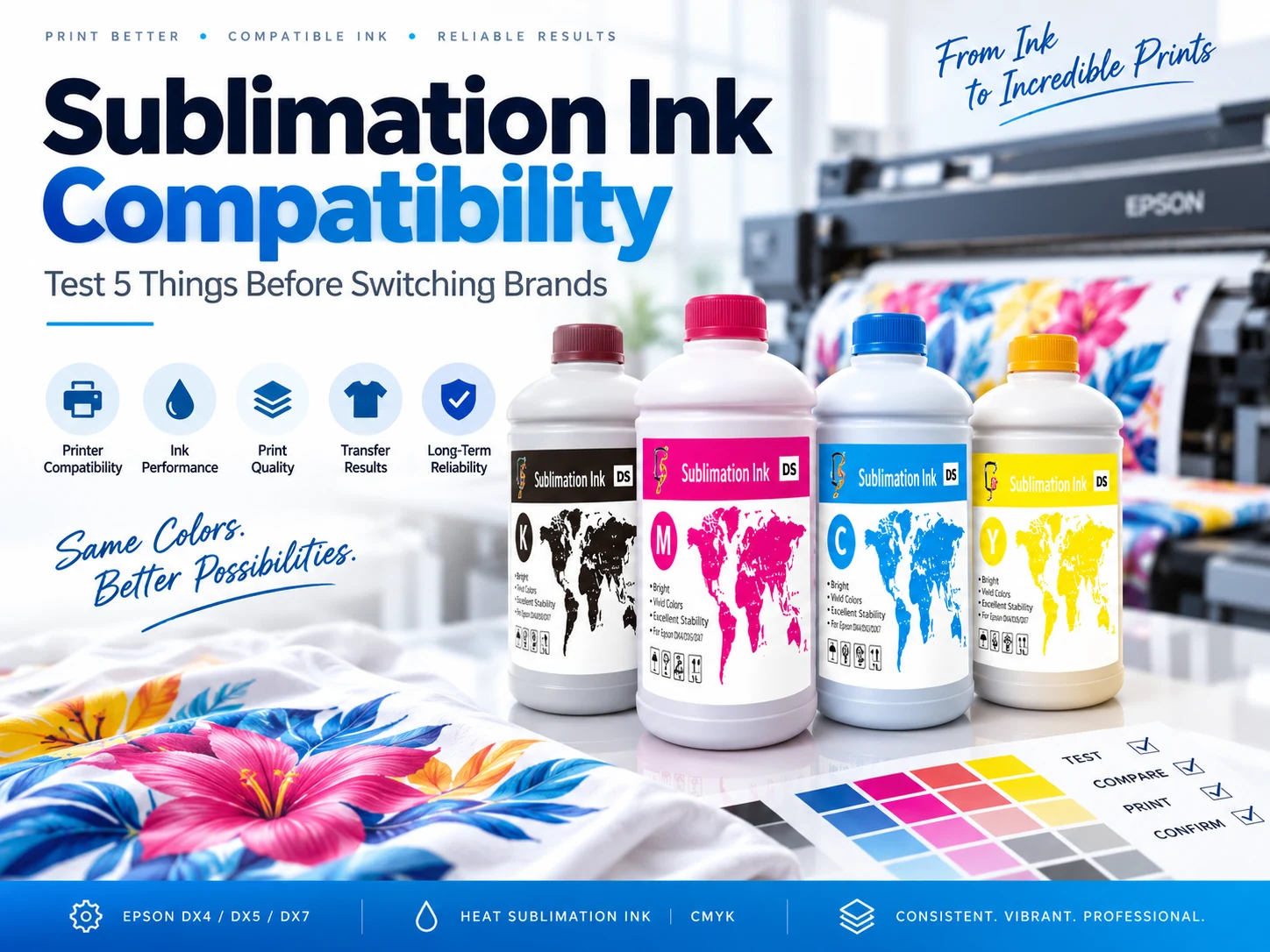
Switching sublimation ink brands is a production change, not a simple bottle replacement. A new ink can look acceptable on a short sample and still create nozzle dropouts, banding, drying changes, color drift or unstable output after the printer runs for hours. The decision should be based on the complete printer, printhead, ink, paper, fabric and transfer combination. Changfa Digital’s rangkaian tinta sublimasi includes series matched to different printer families, while its experience across sublimation paper production and digital printing service gives buyers a practical basis for checking the whole workflow before a supplier change reaches a bulk order.
Why Can a Short Test Look Normal After Switching Sublimation Ink Brands?
A Short Sample Can Hide Ink-Path and Reservoir Effects
A short print may draw mostly from the ink already sitting near the printhead, dampers and supply line. The replacement ink has not yet traveled through the entire system in a representative way. That is why switching sublimation ink brands needs more than a clean nozzle check at the start of the change.
Color on Untransferred Paper Is Not the Same as Color on Polyester Fabric
Paper shows the printed dye before heat and pressure move it into the fabric. The final appearance depends on how much dye transfers, how the polyester accepts it and how the substrate reflects light. A paper sample can therefore look close while the transferred result remains visibly different.
Short Nozzle Tests Can Hide Long-Run Instability
Continuous sublimation printing exposes small differences in viscosity, filtration, degassing and ink delivery. A missing nozzle may appear only after the cartridge, tube or damper has been under sustained demand. The beginning, middle and end of a long run should all be checked.
Separate Color, Flow, Drying and Maintenance Results
One score cannot explain every change. Record color difference, nozzle condition, ink flow, drying behavior, cleaning frequency and reprint reasons separately. This makes sublimation ink compatibility a measurable production question rather than a visual judgment made from one sample.
Can Old and New Sublimation Ink Be Mixed Directly?
Why Similar CMYK Labels Do Not Prove Chemical or Physical Compatibility
Two inks can share a CMYK label and still differ in carrier chemistry, viscosity, filtration behavior and drying response. Similar color names do not show how the liquids will interact or how the mixture will perform after weeks in the supply path.
Residual Ink in Tanks, Tubes, Dampers and Printheads Can Change the Test Result
Residual material remains in tanks, tubes, dampers, filters and the printhead after the old ink is drained. It can alter flow or color during the first test. A controlled switching sublimation ink brands procedure must define what is flushed, replaced or retained before the new ink is introduced.
Create a No-Mix and Line-Cleanliness Check Before Filling the New Ink
Check the supply path before filling. Confirm whether the printer manufacturer or ink supplier permits direct mixing, or whether the line must be cleaned first. Record the condition of filters, dampers and nozzles so later changes can be separated from the initial cleaning result. A no-mix decision is therefore part of sublimation ink compatibility, not a separate cleaning task.
Record a Baseline Before the Ink Change
Capture the current ink name, batch, RIP settings and nozzle pattern before anything is changed. Print the same test file under the same room and printer conditions. Without a baseline, a later claim about better flow or color has no reliable comparison.
Check the Actual Ink Supply Path
Guidance can explain the ink, but the equipment path determines how it behaves. Ink-line length, filter condition, degassing, cartridge design and printhead model all matter. Review the complete configuration rather than asking only whether two inks can be mixed.
How Should Ink and Printhead Compatibility Be Checked?
Confirm the Printer, Printhead and Ink Path
Start with the exact printer and printhead, the channel layout and the ink supply path. A compatible ink label is not enough if the line has the wrong filter, an unstable damper or an unsuitable cartridge. These details define what can be tested.
1513 Series: Epson DX4/DX5/DX7 and CF-2000/3000
The official 1513 Series product page lists Epson DX4, DX5 and DX7 printheads and CMYK ink in 1 L bottles. It is positioned around CF-2000 and CF-3000 printer families. Buyers should verify the exact machine configuration instead of treating the series name as a universal compatibility approval.
1962 Series: Epson DX4/DX5/DX7 and CF-6000/8000
The 1962 Series product page also lists Epson DX4, DX5 and DX7 printheads, CMYK color and 1 L packaging. It is associated with CF-6000 and CF-8000 printer families. Confirm the printhead channels and the production settings before using the same profile or ink-load assumptions from another machine.
1983 Series: Epson DX4/DX5/DX7 and CF-15000
The 1983 Series follows the same general printhead family but is listed for Model-xplus-8 and CF-15000 printer families. Its price position does not remove the need for a nozzle, color and long-run test. Each machine still has to demonstrate stable performance with the selected ink.
How Should Printhead and Nozzle Tests Be Run?
Run nozzle checks first, then print solid CMYK blocks, gradients, fine lines and repeated passes. Each target exposes a different failure mode: missing nozzles, banding, tonal steps, deflection or drift across the run. Compare the page with the saved baseline instead of judging it in isolation. This is the practical core of sublimation ink and printhead compatibility.
Why Does a New Ink Require New ICC Color Calibration?
An ICC Profile Describes a Specific Ink, Paper, Fabric and Transfer Combination
A profile describes a complete color path, not the ink alone. Changing ink changes the amount and behavior of the dye reaching the paper and fabric. The old profile may still produce acceptable color in some areas, but it no longer describes the new combination accurately.
Keep Artwork, RIP, Paper and Fabric Constant
Change one major variable at a time. Use the same artwork, RIP, paper, fabric, transfer conditions and viewing light for the first comparison. This makes the effect of the new ink visible instead of hiding it inside several simultaneous changes.
Compare the Printed Chart After Heat Transfer, Not Only Before Transfer
The paper image is only an intermediate stage. Read the color chart again after transfer onto the production fabric. Measure or compare the final sample because heat, pressure, dwell time and cooling can change the final color, especially in dark and saturated areas.
Check Grays, Dark Tones and Saturated CMYK
These targets reveal problems that one bright color block can miss. Neutral grays expose casts, dark areas show compression or over-inking, gradients show steps, and saturated colors show channel balance. Any new ICC color profile for sublimation should be assessed across these zones.
Lock the New Profile and Approval Sample
Name and store the new profile with the ink, paper, fabric, printer and date tested. Keep the approval sample and its settings together. A locked profile prevents operators from mixing old and new conditions when a reorder returns to production.
How Do Paper, Fabric and Transfer Conditions Change the Result?
Match Paper Coating and Ink Load to Drying
The paper carries the image and controls how ink dries and releases. Coating, GSM, ink load and drying affect dot formation, migration and transfer yield. A paper that worked with the old ink may need a different setting or grade with the replacement.
Check How Fabric Construction Changes Color
Polyester content, yarn structure, weight and surface finish influence how much dye is accepted and how the color appears. Two fabrics can receive the same transfer and still look different. Approval should use the actual production fabric or a documented equivalent.
Keep Transfer and Cooling Conditions Consistent
Heat, pressure, speed, alignment and cooling are part of the color result. Keep them fixed for the first ink comparison, then adjust one factor only when the test identifies a specific problem. Changing the press while changing the ink creates an unclear result.
Check Roll Width and Paper Consistency
Ink selection does not stand apart from the paper roll. Changfa Digital’s base-paper, coating and slitting capability supports discussion of roll width, coating supply and paper handling alongside ink choice. The aim is to match the full ink-paper-fabric path before bulk orders are approved.
Do Not Approve From a Printer-Only Test
A nozzle check on plain paper cannot prove the final order will match. If the order depends on a specific paper grade, fabric, color target and press condition, the test must include them. The approved combination should reflect what production will actually run.
What Five Tests Should Be Completed Before Continuous Production?
Test 1: Confirm Line Cleanliness and No Mixing
Confirm the permitted changeover method, remove incompatible residue where required, and document filters, dampers and cleaning steps. The first test starts with a known line condition, not an assumption that the old ink has disappeared.
Test 2: Check Printhead and Nozzle Stability
Run a structured printhead test and keep the file consistent with the baseline. Check the nozzle pattern before, during and after the run. Any dropout, deflection or recovery difference should be recorded with the ink and printer settings.
Test 3: Recheck ICC Color After Transfer
Build the new profile from the actual ink, paper and fabric path, then compare the transferred result with the approved target. Check light, medium and dark tones, neutrals and saturated colors. A new ICC color profile for sublimation is only useful when it represents that exact production condition.
Test 4: Match Ink, Paper, Fabric and Transfer
Use the intended paper grade, width, fabric and transfer machine. Match ink load to drying and release behavior, then confirm that the final hand, sharpness and color meet the order requirement. This is where sublimation ink and printhead compatibility connects to the complete production result.
Test 5: Run an Extended Production Check
Run long enough to expose gradual drift, ink starvation, drying changes or intermittent nozzle recovery. Compare the beginning, middle and end with the same test targets. Continuous sublimation printing can reveal problems that do not appear during a short approval sample.
Record Defects and Reprint Causes
Record each defect with its time, position and operating condition. Note how often the line needs cleaning and why reprints occur. The decision should be based on production evidence, not only on whether the first meters looked acceptable.
Send the Full Ink-Change Details
Provide the equipment and material details that define the change. Include the current defect, the target run length and the color or output requirement. A focused review can then match the printer family with the relevant ink series and test conditions.
Kesimpulan
A sublimation ink change should be approved by production evidence, not by a short sample that only looks acceptable on paper. The five checks cover line cleanliness, printhead and nozzle behavior, post-transfer color calibration, ink-paper-fabric matching and extended continuous printing. Changfa Digital can discuss the relevant series around the actual printer family: Seri 1513 for CF-2000 and CF-3000, Seri 1962 for CF-6000 and CF-8000, and Seri 1983 for Model-xplus-8 and CF-15000, with Epson DX4, DX5 and DX7 printhead information listed for each product page. Share the current printer and printhead, old and replacement ink, paper and fabric details, target run length and the defect that prompted the change so the next test starts with a defined production question.
Pertanyaan FAQ
Q1: Can old and new sublimation ink brands be mixed in the same printer?
A1: Do not assume that two CMYK sublimation inks can be mixed safely. Residual ink in the supply path can change flow and color behavior, so the printer, ink path and supplier instructions should be checked before the new ink is introduced.
Q2: Do I need a new ICC profile after changing sublimation ink brands?
A2: In most production changes, the ink, paper, fabric and transfer combination has changed enough to require a new comparison and often a new profile. Approve the result after heat transfer on the actual fabric rather than relying on the old profile or the untransferred paper image.
Q3: How long should replacement sublimation ink be tested before bulk production?
A3: There is no universal test length. The run should represent the planned order and continue long enough to compare the beginning, middle and end, while recording nozzle stability, drying, color consistency, cleaning frequency and reprint causes.


