


Bán nóng
Ứng dụng

Phone:+86-15215969856 E-Mail: 396838165@qq.com
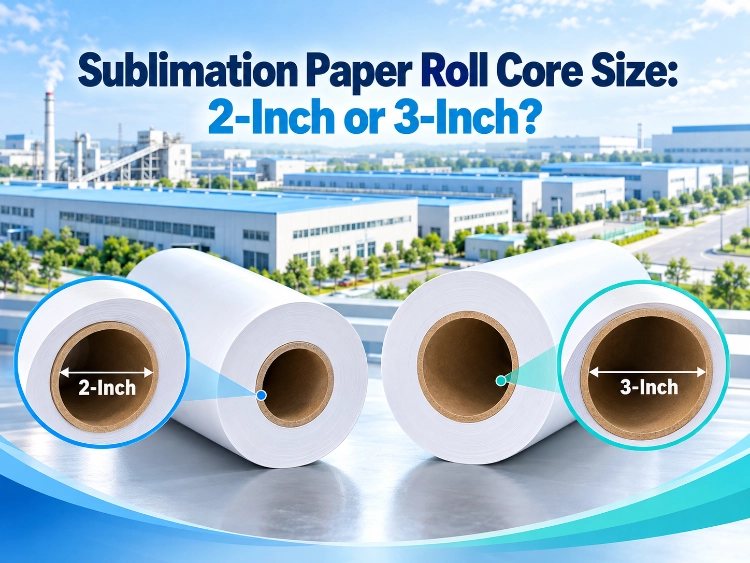
A roll reaches the machine and stops there. The core won’t go on the shaft, and every other number on the order stops mattering until somebody walks to the store room for an adapter.
Both cores come off our own slitting machines, ten of them, so neither size counts as a special build on the schedule.
Quick answer: the holder narrows it, the roll diameter your line and pallet allow narrows it again, and the metres you need finish the job.
What the Holder Allows
The Shaft Comes First
Start at the shaft. A printer built around a 2-inch mandrel won’t take a 3-inch core until a matching holder goes on. Industrial machines built around 3-inch mandrels take a 2-inch roll with an adapter, and the adapter has to hold the roll straight at running speed.
Measure two things. Shaft diameter. The biggest roll the machine accepts. A shop that keeps its original 2-inch holder buys 2-inch rolls. The neighbour who fitted a 3-inch holder orders those instead, for the same 24-inch model.
What the Thicker Core Costs You
Paper fills the ring between the core wall and the outside of the roll. A thicker core eats into that ring.
Do the sum on a 300 mm roll. A 2-inch core leaves a 25.4 mm radius of empty tube in the middle, a 50.8 mm bore, and roughly 68,600 square millimetres for paper. Swapping in a 3-inch core widens that radius to 38.1 mm, a 76.2 mm bore, and cuts the paper to about 66,100 square millimetres.
Four percent, gone, at the same outside diameter.
Let the diameter grow and you get it back. That’s why jumbo rolls for wide lines ship on 3-inch cores.
So which limit bites first in your workshop? The holder, the roll diameter, or the metres.
Roll Changes and the Pallet
Count roll changes before you pick a core. Compare two rolls off our own list. A 95gsm roll carrying 100 m against a 38gsm roll carrying 3,000 m. Every change swallows a thread-up, an alignment check, and the metre the line was halfway through printing.
Packing sets the other limit. Rolls go out with core caps pushed on and stacked on pallets, which means the core survives a container before it ever meets a printer. Tell us how the roll gets lifted at the far end, and name the equipment. Two men and a trolley asks for a different roll than a crane and a sling. That one answer usually settles the core before the grade table does.

Match the Core to the Job
Light Grades, Narrow Rolls
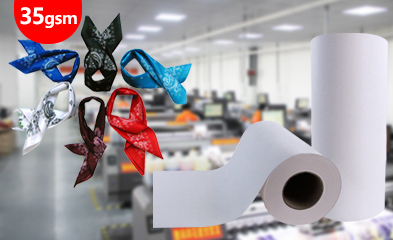
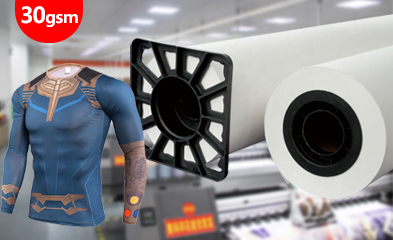
Desktop inkjet units, hand-fed presses and small-format shops take 2-inch cores as they come. No holder swap, no adapter in the box. Changfa kỹ thuật số supplies 30gsm, 35gsm and 40gsm paper on either core size.
What matters at this scale is feed stability over a short run, and whether one person can lift a part-used roll without help.
Wide Rolls and Production Orders
Wide production moves to 3-inch cores. Our các loại giấy in chuyển nhiệt covers 29gsm to 100gsm across 61cm to 320cm, and the metres on a roll fall away as the grade climbs. 29 to 38gsm runs 1,000 to 3,000 m. 40gsm runs 300 to 3,000 m. 52gsm holds 200 to 2,500 m. 61gsm drops to 200 to 500 m, and 81gsm with 95gsm comes in at 100 to 200 m.
Quote the core together with the length. Take the 50gsm jumbo roll paper as the reference: press at about 225°C for 20 seconds, transfer rate 95 to 98 percent, and an operator watching that same window while a new core settles into the reel stand.
Cores Outside the Standard List
Some distributors need a custom core that matches a fleet they inherited, or a custom width that isn’t on the standard list. Both go through samples before a bulk run.
Bring the holder diameter, the width and the metres. Move the core and the outside diameter moves too, and the outside diameter is the number the pallet plan is drawn around.
Running Two Core Sizes in One Workshop
Plenty of workshops keep a desktop unit next to a wide printer, and those two machines never want the same core. Stocking both costs less than fighting one into the other.
Write the core on the roll label, in the same place every time. When two customers run identical artwork and one of them changes rolls twice as often, the paper gets blamed first. Same grade, same width, different core.
One rule saves the argument. Small rolls, 2-inch cores, desktop queue. Order both from one production batch, so a colour question never turns on which machine caught the job.
Write the Core Into the Order
Six Fields Make It Quotable
Printer model. Holder diameter. Maximum roll diameter. Paper width. Grade in gsm. Metres per roll. Add the core diameter and the packing requirement, and the quotation runs without a second round of emails.
Three Checks When It Lands
Does the roll slide onto the holder without an adapter? Does the measured outside diameter clear the machine and the pallet? Does the changeover count over a full shift match what you planned from the quoted length?
Then look at the core ends. A cap that works loose in transit turns a routine roll change into a scrap decision.
Fixing the Next Order
One order usually tells you the answer. More changes than planned, and you want a longer length at the same grade, which may push the order to 3-inch cores. Lifting complaints, with a machine that takes the smaller core, and you keep the length and change only the core.
Either move stays inside the same grade. Nothing else needs re-qualifying.
Send the printer model, the holder diameter, the grade and width you run, the metres per roll, the fabric and the changeover problem. We’ll review the roll against a production condition instead of a catalogue line, and both core sizes come off the coating and slitting lines on the same site as the paper.
What a Sample Roll Settles
Sample the core you plan to run, even if the other size leaves our dock sooner. Questions answered by a roll standing in your workshop don’t get answered on paper.
Does the core cap survive a courier? Does the roll sit flat after two days in a humid room? Does the outside diameter still clear the holder after half the paper is off and the tension has slackened?
That last one catches more orders than any grade discussion. A roll can sit inside the limit when it’s full and still drift once it’s half used. The operator spots that weeks before anyone in the office does.
One roll through your own machine, and the core question is closed.
Kết luận
The holder, the roll diameter and the metres. Three numbers, and the core is decided before anyone quotes paper. Two-inch cores live on the smaller mandrels, where light rolls are easier to lift. Three-inch cores carry the long production rolls and shrug off the handling that wide work puts on them. Just remember the geometry. Four percent of the paper section disappears when the core thickens at a fixed outside diameter.
Câu hỏi thường gặp
Q1: Can I run a 3-inch core roll on a machine built for 2-inch cores?
A1: Only with a holder or adapter that matches the core, since the roll has to sit on the mandrel without wobble. Get the shaft diameter and the maximum roll diameter out of the machine supplier before paper is ordered.
Q2: Does a bigger core carry more paper?
A2: Less paper at the same outside diameter, since the tube itself takes up room in the roll. Give the outside diameter room to grow and the 3-inch core carries more metres than the 2-inch one.
Q3: What do I send for a private-label order?
A3: Core diameter, width, grade, metres per roll, the outside diameter limit, and the packing pattern. If the core cap carries your brand, mention it early, because the cap belongs to the packing specification and travels with the order as one line rather than a later addition.


