


HOT SALE
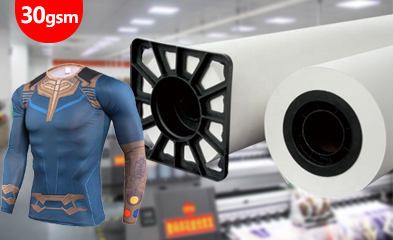
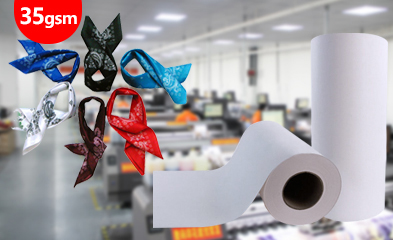
APPLICATION
Phone:+86-15215969856 E-Mail: 396838165@qq.com
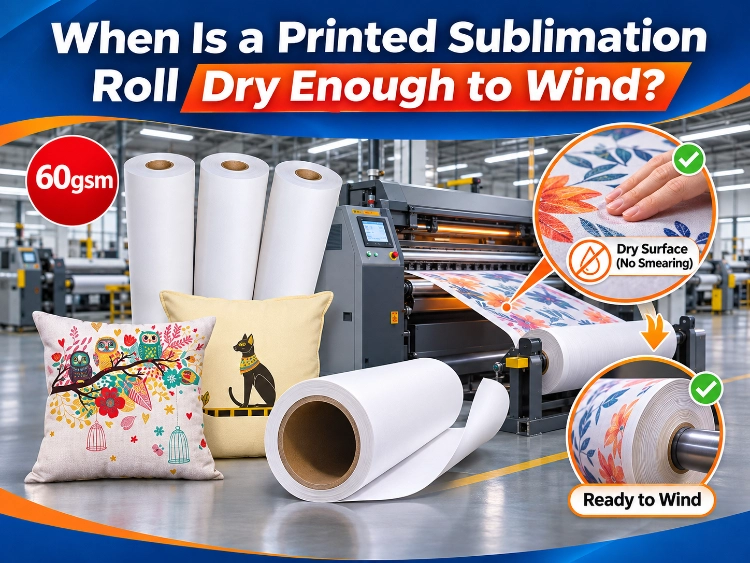
Every printed roll reaches the take-up with a decision attached: wind it now, or give it more time. The decision is usually made by habit, and the cost of making it early does not appear on the printer. It appears hours or days later at transfer, as a faint copy of the design ghosting onto the fabric from the back of the layer above, or as printed faces that have stuck lightly together inside the roll. By then the roll is finished and the metres are spent.
Dry enough has a specific meaning at the take-up. It does not mean the ink has dried through the sheet. It means the printed surface has set hard enough to bear the contact pressure of being wound against the next layer without giving up dye or sticking to it. That threshold is set by the job, the paper and the line together, and it moves during a single shift.
What Has to Dry, and What Slows It Down
It Is the Water in the Ink That Has to Leave
Sublimation ink prints as dye carried in water. The coating’s work in the first seconds after printing is to take the dye onto its surface and let the water go. Until that water has evaporated, the printed layer is a wet film resting on the sheet, and anything pressed against it — including the back of its own next wrap — can pick dye up. Drying is therefore not a property of the ink alone. It is a race between the water the job lays down and the evaporation the line provides.
The Heaviest Patch on the Web Sets the Clock
Coverage is never even across a real design. A roll of sportswear panels may carry pale logos on one panel and a saturated black background on the next, and the two areas finish drying minutes apart. The take-up decision has to be made on the wettest square on the web, not on the average of the design and not on the unprinted margin. Lines that judge dryness by the edge of the web or by the lightest panel are winding the heavy panels wet.
The Line Decides How Much Time the Water Gets
Dryer capacity, line speed and the distance between the printheads and the take-up fix the drying window before any operator judgement is involved. A faster line lays down more wet metres per minute and gives each metre less time in front of the dryer. Room conditions move the window as well: warm, moving air shortens the wait, while a humid room on a rainy day lengthens it noticeably. This is the same ground covered in the overview of fast dry sublimation paper on high-speed industrial lines, and it is why the same paper can wind safely at one speed and mark at another.
The Grade Changes the Wait
Coatings are built to different drying speeds. A fast-dry coating releases the water quickly and brings the surface to a windable state sooner, which is what makes continuous high-speed work practical; most grades on the Changfa Digital range carry a four-star drying-speed rating, and the fast-dry grades sit at the top of that behaviour. The grade does not abolish the wait. It shortens it, and on a heavy-coverage job the coverage still has the final say.
Judging the Moment on a Running Line
Test the Worst Area, at the Take-Up, Not at the Printer
Dryness judged beside the printheads is optimistic, because the web still has its drying distance to travel. The honest test point is the last moment before winding, and the honest test area is the heaviest coverage on the web. A surface that feels dry and leaves nothing on a clean fingertip or the back of a glove at that point is close to windable. A surface that still feels cool and damp — evaporating water keeps it below room temperature — is not, whatever the lighter areas feel like.
The Trial Wrap Tells the Truth
Feel is a guide; the trial wrap is the proof. Wind a short length at production tension, leave it for the length of a normal pause, then unwind it and read the back of the layer that sat against the print. Any dye shadow there means the roll is winding wet, and the full roll would have carried that shadow through every wrap. The test costs a few metres. Winding a full production roll wet costs the roll.
Build the Wait Into the Schedule, Not Into the Roll
A roll wound early does not finish drying safely inside itself. Wrapped tight, the remaining moisture is trapped between layers, and a warm roll left standing can block — printed faces adhering lightly to the backs above them — so the damage grows with storage time instead of fading. The working answer is sequencing: print heavy-coverage jobs with a resting interval before they are needed at the calender, and keep wound printed rolls under the same dry, stable conditions described for storing sublimation paper rolls. The wait belongs in the production plan, where it is free, rather than inside the roll, where it is charged by the metre.
The Fast-Dry Grade Buys Back the Interval
For lines whose schedule cannot hold a long resting interval, the paper itself is the lever. The 60gsm Fast Dry Sublimation Paper Roll is the grade Changfa Digital builds for polyester fabric production at speed: its coating takes the ink, releases the water quickly and presents a surface that can be wound sooner, which is what allows a printing line and a calender line to run in the same rhythm without a warehouse of resting rolls between them.
Conclusion
A printed roll is dry enough to wind when its heaviest printed area can sit against the next layer under winding pressure and give up nothing. That point is set by coverage, coating, dryer capacity and room air together, and the trial wrap — not habit, and not the feel of a light panel — is what confirms it. Winding early converts a drying problem into a transfer defect, several hundred metres at a time.
If printed rolls are marking or blocking, send the printer and dryer setup, the paper grade and GSM, the line speed, and whether the marking follows the heaviest coverage. Those facts separate a drying-window problem from a paper problem in one step.
FAQs
Q1: Does fast-dry paper remove the wait completely?
A1: No. A fast-dry coating shortens the wait by releasing the ink’s water faster, and on light and medium coverage the surface may be windable almost as it reaches the take-up. Heavy coverage still lays down more water than any coating can clear instantly, so the heaviest patch on the web still sets the winding moment.
Q2: What does set-off look like when the fabric is transferred?
A2: A faint, offset copy of the design appearing where no print should be — typically a ghost of one panel showing beside or behind another. The dye reached the back of the printed sheet inside the roll, then transferred from there. It follows the winding, so it repeats through the roll rather than appearing on one piece only.
Q3: Can a printed roll wait too long before pressing?
A3: The printed image sits on the coating surface, so a wound printed roll should be kept clean, dry and out of direct light, and pressed within the normal production cycle. Under those conditions a wait of days is ordinary scheduling. Rolls left open in a damp or dusty room give up quality at the exposed edges first.


