


HOT SALE
APPLICATION
Phone:+86-15215969856 E-Mail: 396838165@qq.com
A sublimation line can look stable during a short approval run and still lose its rhythm during a full shift. Ink choice is part of that difference. It affects drying behavior, head condition, color build, and the way paper carries the job into transfer. The useful question is not which ink sounds more powerful. It is whether the ink density fits the printer, the workload, and the fabric result the line is expected to deliver.
What Separates Standard and High-Output Sublimation Ink?
|
Line condition |
Standard ink |
High-output ink |
|
Typical setup |
Epson I3200, 2-4 nozzles |
Epson I3200, 8+ nozzles; Atexco Kyocera |
|
Best fit |
Routine, medium-output textile work |
Larger lines or stronger color demand |
|
Main watchpoint |
Consistent print and transfer settings |
Drying, saturation, supply system, and banding risk |
Standard sublimation ink is generally the balanced choice for regular textile work. It is designed around steady color, good fluency, and the practical pace of medium-output production. “High-output ink” refers to higher-density solutions used where a line carries more nozzles, prints more aggressively, or needs stronger color build after transfer.
That distinction matters because density is not a free upgrade. The sublimation ink range includes options for different nozzle arrangements, but more color strength can be valuable only when the production line is ready for it. In black-heavy jersey art or saturated flag graphics, it also asks more of drying, paper absorption, ink delivery, and transfer settings.
Where Standard Sublimation Ink Fits Best
Routine Textile Production with Balanced Cost and Stability
For polyester apparel, standard sportswear, home textiles, and regular soft signage, the priority is usually repeatable output rather than maximum density. A line with two to four Epson I3200 heads often needs an ink that runs cleanly through normal schedules and gives operators a manageable window for drying and transfer.
Changfa Digital’s 1513 Series and 1962 Series CMYK ink are sensible examples of this position. They fit the everyday need for fluent printing, clear color, and a controlled production routine.
This is often the lower-risk route when artwork changes frequently but coverage remains moderate. Operators can keep the print profile, paper, and transfer settings closer to the conditions already proven on the line. That reduces the chance that a late artwork change turns into a drying problem halfway through a shift.
Before a bulk order, run the chosen ink with the actual sublimation paper and the intended fabric. Check nozzle condition after a long run, not only at start-up. A good short sample does not show whether a line will hold color or develop light banding after several rolls.
When High-Output Sublimation Ink Makes More Sense
Larger Lines, More Nozzles, and Stronger Color Demand
Higher-density ink earns its place when production capacity and image demand move together. Lines using eight or more Epson I3200 nozzles, or Atexco Kyocera configurations, may need a formulation built for that workload. It can also be the better fit where dark jersey panels, bold flags, and saturated graphics need a more pronounced black after transfer.
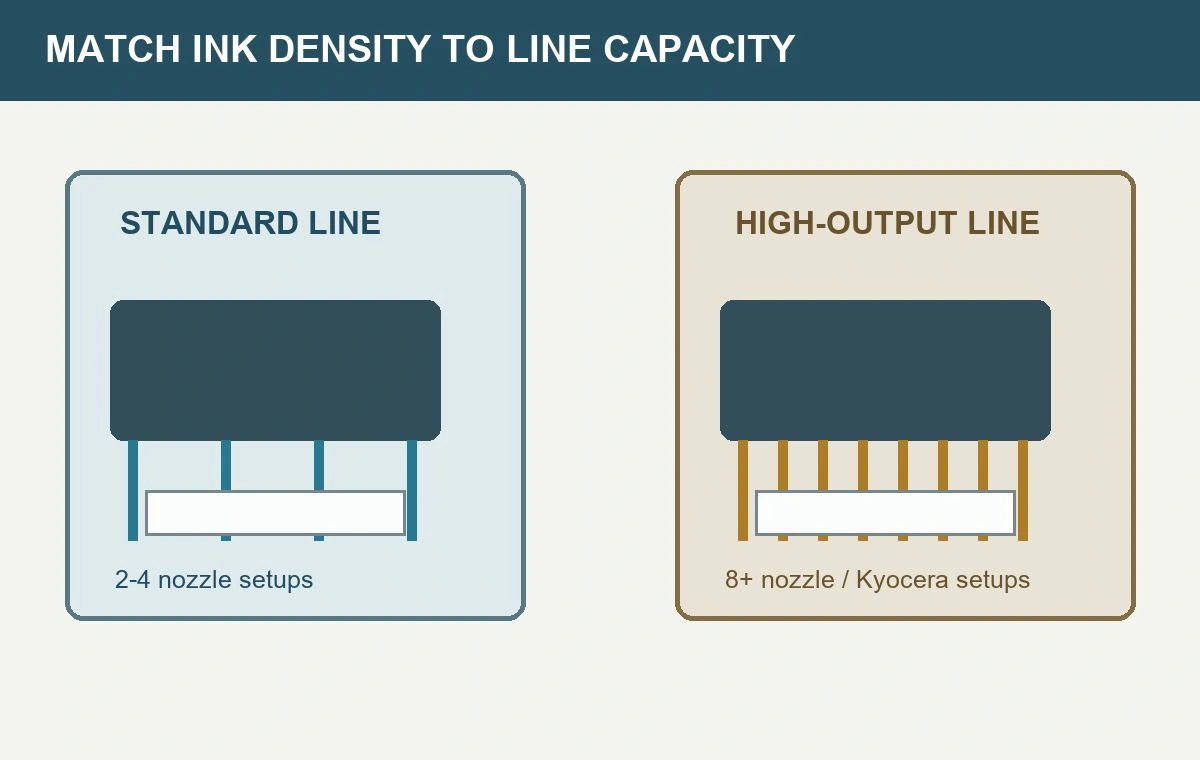
The 1963 and 1983 series can be discussed as examples for these heavier-demand situations, rather than treated as a universal replacement for standard ink. The value lies in stronger color coverage when the rest of the process is ready to carry it.
That last point deserves attention. A higher-output sublimation printer should be paired with paper that accepts the assigned ink load, a drying section that clears moisture before winding, and an ink-supply system that keeps the feed stable across all heads. When one part is behind, the result can be wet print, bleeding at fine edges, paper saturation, or banding that becomes obvious after transfer.
The Ink Must Match the Rest of the Sublimation Line
Ink is only one setting in a linked process. A denser formulation can change how quickly the printed paper dries, how flat it stays on the roll, and how much energy is needed at transfer. If the paper curls or the web is wound before it is dry, the next defect may appear as offsetting, not as an obvious ink fault.
Start with the printer head and nozzle count, then confirm ink supply, paper weight, print mode, dryer capacity, transfer temperature, dwell time, and fabric construction. Use the same production file through the test. Changing the artwork, paper, and heat setting at once makes it impossible to tell what caused a color shift.
Long-run verification is more useful than a single meter of output. Print enough material to include start-up, steady running, and the end of a roll. Inspect fine lines, large black areas, paper surface condition, and transferred color. For garments, test the actual polyester fabric; coating, weave, and fabric batch can all change the transferred result.
During a changeover, keep a retained transfer panel from the approved run. It gives production and quality staff a direct reference when black depth or a fine color starts to drift. Without that reference, a paper change, a dryer adjustment, and a fabric variation can be blamed on the ink without enough evidence.
How Buyers Can Choose Between Standard and High-Output Ink
Choose standard ink when the line is a regular two-to-four-head I3200 setup, output is moderate, and the product mix is everyday polyester apparel, home textile, or routine signage. The aim is a stable working balance: clean print behavior, dependable color, and fewer variables for operators to chase.
Move toward a higher-output option when the line has the nozzle capacity, drying margin, and color demand to justify it. It is a production decision, not just a color decision. A factory running high-volume sportswear with dense black graphics may gain more from the change than a shop printing mixed, low-coverage fashion orders.
Supplier support also matters when the specification is being set. Changfa Digital service support includes sample customization and OEM/ODM discussion, which is useful when a buyer needs to match ink, roll format, and a particular print routine. Changfa Digital handles base paper, coating, slitting, and packing in-house, with four coating lines, four slitting workshops, and ten slitting machines. That production control is relevant when a tested paper and ink combination must be repeated on later orders rather than treated as a one-off sample.
Ask for a sample plan that reflects the real line. Confirm the head model, nozzle count, ink feed arrangement, paper specification, expected coverage, printing speed, and transfer conditions before approving a bulk shipment. Missing one of those details can turn stronger ink into extra waste and unplanned downtime.
FAQ
Q1: Is high-output sublimation ink always better for a textile printer?
A1: No. It is more suitable when nozzle count, drying capacity, paper absorption, and color demand all support it. A regular I3200 line with moderate coverage may run more consistently with standard ink.
Q2: What should be tested before changing from standard to high-output ink?
A2: Test a long continuous run with the actual printer head, ink supply system, paper, fabric, and transfer settings. Check drying before winding, fine-edge bleed, banding, black depth after transfer, and color consistency across the roll.
Q3: Can Changfa Digital help build a matched ink and paper setup?
A3: Yes. For a new or changing line, provide the head configuration, target fabric, artwork coverage, and production speed when discussing samples or OEM/ODM requirements. The goal is to approve a workable combination before it reaches regular production.


