


HOT SALE
APPLICATION
Phone:+86-15215969856 E-Mail: 396838165@qq.com
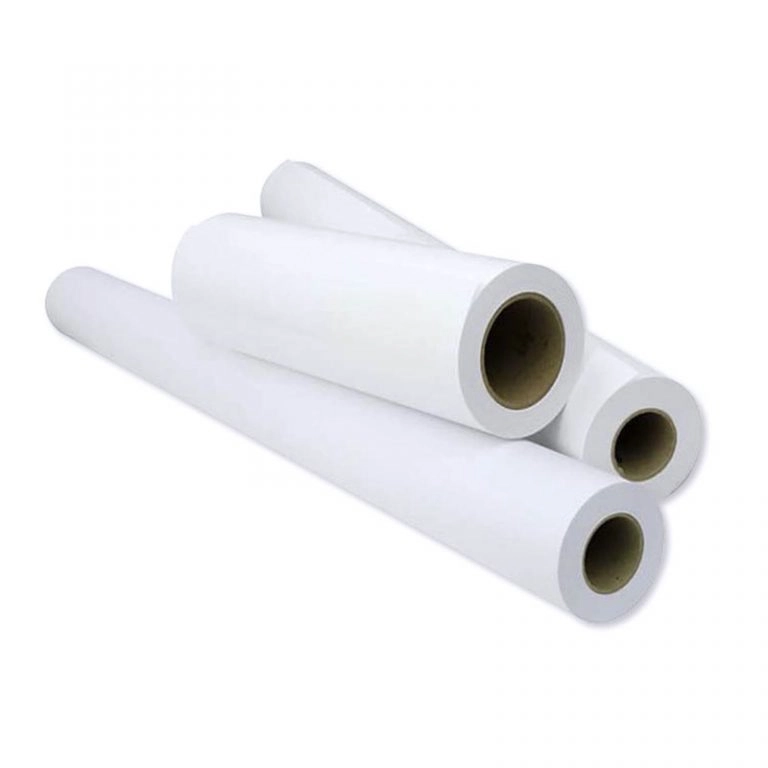
Sublimation on black polyester is often described as “impossible,” but, in industrial practice, it is better framed as a problem of physics, material interaction, and process control. Dark substrates do not reject color by default, but absorb light, distort contrast, and magnify small deviations in ink release and thermal balance.
If you approach black shirts with the same workflow used for white fabric, color loss is inevitable. If you treat the process as a system, including fabric optics, dye diffusion, paper release speed, and heat behavior working together, you can achieve stable and commercially acceptable results.
This article focuses on industrial-level strategies rather than surface-level parameter tweaks.
Why does sublimation appear dull on black polyester?
Before changing parameters, it is necessary to identify why the color appears weak in the first place. The limitation is not primarily chemical, but optical and structural.
How does fabric color interfere with light reflection?
Sublimation dyes are transparent after fixation. On white fabric, light reflects through the dye layer and returns to the eye, creating strong perceived brightness. However, on black fabric, most incoming light is absorbed by the substrate instead of reflected.
As a result, even when dye concentration is technically sufficient, visual saturation collapses. This is why prints that measure well on spectrophotometers still look muted on black garments.
Why does higher ink density not solve the problem?
Increasing ink density only pushes more dye vapor into the fiber, and will cause some problems if exceeding a certain point, such as uncontrolled lateral diffusion that softens edges, migration into deeper fiber layers that reduces surface chroma, and thermal overload that destabilizes neighboring colors.
So, the issue is not “too little color,” but the lack of a reflective interface.
What technical strategies allow color to remain visible on black fabric?
Once the optical limitation is clear, the solution becomes structural rather than chemical.
How does pre-treated coating change dye behavior?
Pre-treated coatings act as controlled absorption layers. Instead of letting dye vapor penetrate directly into dark fibers, the coating holds part of the color closer to the surface, thus increasing apparent brightness and stabilizing gradients.
In production lines, it also slows diffusion speed, which reduces haloing and keeps fine details intact.
How does layered transfer improve brightness?
Layered transfer introduces a functional intermediate zone between dye and fabric. By controlling how heat reaches the dye and how vapor exits the paper, you control where color settles. This approach is common in premium sportswear and branding garments where black is mandatory, but visibility cannot be compromised.
How does transfer paper influence color retention on dark garments?
On black polyester, transfer paper behavior often matters more than ink formulation.
Why does faster release improve contrast?
Fast-release coatings transfer dye before excessive lateral movement occurs, making pigments closer to the surface and maintaining edge definition.
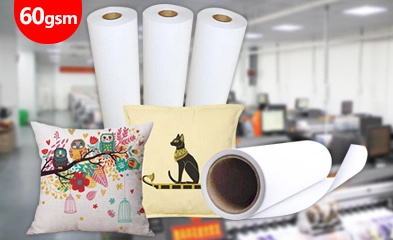
In practice, production teams favor papers engineered for rapid desorption, such as 60 gsm fast-dry sublimation paper, whose lower thermal inertia allows controlled vapor bursts instead of slow diffusion, which is critical on dark fabrics.
When is heavier paper more suitable?
Heavier papers are valuable when:
graphics exceed A2 size,
presses show uneven pressure zones,
fabric thickness varies between batches.
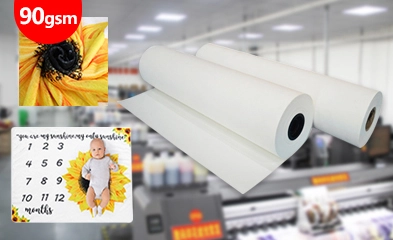
For these cases, heat storage stability becomes more important than release speed. A structured alternative is 90 gsm fast-dry sublimation paper, which can buffer thermal fluctuations and improve repeatability in wide-format production.
How should you adjust heat press parameters for black polyester?
Heat control is not about maximizing temperature, but positioning color at the fiber surface.
How does excessive temperature mute colors?
High temperatures increase polymer mobility. This allows dye molecules to migrate deeper into fibers and lowers visible saturation and darkens tone. Once missing the optimal window, black fabric becomes a color sink.
How does dwell time affect perceived vibrancy?
Short dwell time leads to pale images, while excess dwell time leads to “sunken” colors. In controlled lines, dwell time is tuned to paper type first, fabric structure second, and ink density last.
How does fabric construction change the sublimation outcome on black shirts?
Two fabrics with identical dye uptake can look completely different after transfer.
Why do smooth interlock fabrics perform better?
Smooth interlock surfaces reflect light more uniformly, which amplifies perceived brightness and preserves sharp contours. These fabrics also heat evenly, contributing to stabilizing the depth of vapor penetration.
Why do textured knits weaken color clarity?
Bird-eye and rib structures create micro-shadows that interrupt reflection, leading to uneven absorption and loss of details. For high-definition prints on black shirts, surface geometry matters as much as fiber chemistry.
Who can provide stable materials for demanding sublimation applications?
Once your process is optimized, supply stability becomes the next limiting factor.
Changfa Digital is a vertically integrated manufacturer that produces sublimation paper and provides digital printing services in the same production system. Our company has operated in sublimation media manufacturing for more than 15 years, covering base paper selection, coating, and precision slitting before export.
Our facilities include multiple coating lines, dedicated slitting workshops, standardized palletized packaging, and large-scale monthly output designed for continuous global shipment. Our production capacity reaches thousands of tons per month, supporting consistent roll behavior across long supply cycles.
For manufacturers working with black garments, this type of upstream consistency reduces coating variance, stabilizes release curves, and minimizes recalibration during season-to-season production.
How can you evaluate whether results are truly optimized?
Visual inspection alone is not enough.
How consistent is color across multiple batches?
There is a need to track ΔE variation between lots, not just within a single run. On black fabric, small deviations appear larger to the human eye. Besides, repeatability across sizes and layout density should also be evaluated.
How stable is the result after washing cycles?
Initial brightness means little if contrast collapses after five washes. Stable systems maintain surface-level chroma even when fiber-internal dye migrates slightly during laundering.
Conclusion
Sublimating on black polyester is not about forcing more ink into darker fabric, but about restructuring how color is positioned, released, and perceived. When fabric geometry, transfer paper behavior, thermal timing, and supply consistency align, black shirts become printable—not by fortune, but by controlled physics.
FAQs
Q: Can sublimation ever look as bright on black polyester as on white?
A: No. Black fabric absorbs reflected light. The goal is maximizing contrast and clarity, not matching white-fabric brightness.
Q: Does increasing the temperature always improve visibility on black shirts?
A: No. Excess heat drives dye deeper into fibers and reduces surface chroma, making prints appear duller.
Q: Is paper selection really more important for dark garments?
A: Yes. Release timing and vapor control from transfer paper influence visual color strength more than ink density on black substrates.


