


HOT SALE
APPLICATION
Phone:+86-15215969856 E-Mail: 396838165@qq.com

Dye sublimation on polyester has matured from a niche decoration method into a core industrial process for sportswear, signage, and functional textiles. However, once production scales, many operations discover that color inconsistency, unstable transfer, and batch deviation become structural risks rather than occasional faults. Mastery is no longer about isolated parameter tuning, but rather depends on how well you control fiber behavior, ink chemistry, paper release, thermal energy, and upstream material stability as a unified system.
This article walks through that system step by step, focusing on practical control points that matter in professional production environments.
Why does polyester behave differently during dye sublimation?
Polyester does not simply “accept” sublimation dye, but reacts to it. The polymer structure governs how dye vapor diffuses, how deeply it fixes, and how stable the final image remains.
How does polymer structure affect dye diffusion?
Disperse dyes rely on molecular mobility inside the fiber. When the temperature approaches the glass transition point of polyester, amorphous regions open and allow dye molecules to migrate inward. If diffusion occurs too quickly, edge sharpness suffers. However, if it is too slow, the color appears dull and undersaturated. This is why the same transfer profile can behave differently across fabrics that look similar on the surface.
How do fabric density and filament type change transfer efficiency?
Weave structure and yarn type change vapor dynamics. Interlock fabrics trap heat more evenly and support higher color depth, and bird-eye structures release vapor more quickly and often need tighter timing control. Filament fineness also influences perceived sharpness—higher filament counts tend to deliver smoother gradients but demand stricter ink load control.
How should you prepare polyester fabrics before printing?
Many color problems originate long before ink ever touches paper. Fabric preparation determines whether your process window stays wide or collapses under heat.
How do residual oils and sizing interfere with ink bonding?
Spinning oils, softeners, and finishing agents can migrate during heat transfer. When this happens, dye vapor competes with surface chemistry rather than entering the fiber cleanly. The result is uneven saturation or unpredictable haze, especially visible in dark tones.
How much moisture is acceptable before transfer?
Polyester itself absorbs little water, but ambient moisture trapped between layers can disturb thermal balance. Excess humidity causes local temperature drops during pressing, leading to inconsistent fixation. Conditioning fabric in a stable environment before printing remains one of the simplest but most ignored controls.
How do you select sublimation ink for consistent color output?
Once fabric variables are controlled, ink formulation becomes the main lever for color stability, gamut width, and nozzle reliability.
How does ink density influence saturation on polyester?
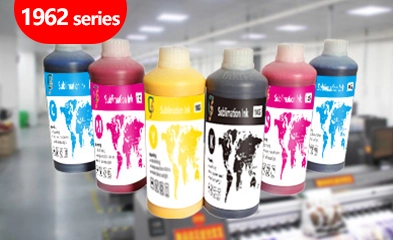
High-density ink allows deeper blacks and stronger primaries, but only if paper release and heat energy support full diffusion. In production environments that require strong chroma without sacrificing detail, many printers rely on formulations such as the 1962 series CMYK sublimation ink, designed to maintain vivid color while improving black channel coverage after transfer. The benefit is not only a stronger tone, but also more predictable profiling across long runs.
How do nozzle compatibility and viscosity affect long runs?
Ink performance is also mechanical. Viscosity stability, sedimentation resistance, and flow consistency determine whether a line can print continuously without banding. Relevant data from industrial environments consistently shows that smooth fluency enables long continuous output at 360dpi without breaks, which directly reduces downtime and waste.
How does transfer paper weight change final image quality?
Ink and fabric alone do not define image quality, and the transfer paper controls how and when dye vapor releases.
How does low-gsm paper influence dot spread?
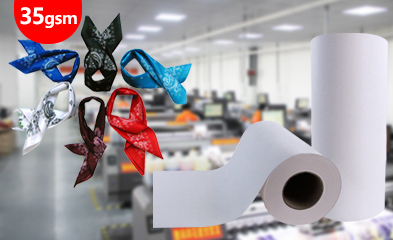
Lightweight papers (29–40gsm) allow rapid gas release, which benefits high-speed printing and fine detail, and their coating uniformity becomes critical. Inconsistent coating thickness can lead to mottling in gradients or unstable edges.
How do heavier papers stabilize large-format output?
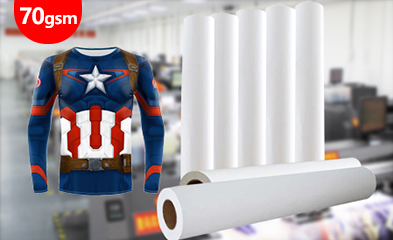
Papers in the 60–100gsm range offer stronger dimensional stability. They maintain tension better on wide-format equipment and provide more controlled vapor release. This stability is particularly valuable for industrial widths such as 180–190cm, where even small curl variations can distort registration. A wide range of paper grammages and widths are commonly used in professional environments, from 29gsm to 100gsm and widths exceeding 180cm.
How do heat press parameters control color fixation?
Thermal energy is the true driver of sublimation. Poor temperature control can erase all upstream optimization.
How do temperature deviations shift color tone?
A deviation of only ±5°C can visibly alter hue. Excessive heat can cause over-gasification, washing out detail, and pushing colors toward brown or gray, while insufficient heat leads to incomplete diffusion and flat color.
How long should the transfer dwell time be?
Dwell time depends on fabric thickness and construction. Lightweight sports fabrics often complete fixation quickly, while dense interlock structures require longer exposure. The key is not maximum time, but the minimum time that achieves full diffusion without surface overloading.
Why does production scale change process priorities?
What works in sampling often fails at scale. Volume introduces new variables that small workshops rarely face.
How do coating consistency and slitting accuracy affect batch repeatability?
Paper roll tension, coating uniformity, and slitting precision directly affect transfer stability. If roll edges vary or coating density shifts, color output drifts even when ink and press settings remain unchanged.
How does monthly volume influence material sourcing strategy?
Operations running container-level volumes need reliable upstream partners. At this level, the cost of one unstable batch exceeds the cost difference between suppliers. Predictability becomes more valuable than marginal price advantages.
Who can support long-term stability in sublimation supply chains?
At an industrial scale, process stability depends not only on equipment and profiles, but also on how well upstream materials are controlled before they reach your factory.
Changfa Digital is a manufacturer that integrates base paper processing, coating, slitting, and digital printing services within a single production system. With more than 15 years dedicated to sublimation media manufacturing, multiple coating lines, specialized slitting workshops, and monthly output reaching approximately 3,000 tons, our operation is structured for continuous industrial delivery rather than short-term trading.
This type of vertically organized structure allows tighter control over coating uniformity, roll width tolerance, and batch stability. For printers managing large export orders or long-term textile programs, such consistency reduces color deviation between shipments and simplifies internal quality control workflows.
How can you balance color vibrancy with wash durability?
High saturation looks impressive on day one, but durability defines real value.
How does fixation depth affect wash resistance?
When dye remains near the surface rather than diffusing into the fiber core, wash performance suffers. Deeper diffusion improves both abrasion resistance and long-term color stability.
How can post-transfer curing improve fastness?
Allowing fabric to rest after transfer before washing helps stabilize the bond between dye and polymer. Many inks tested under textile conditions achieve wash resistance grades of 4–5 and light fastness up to level 6 when transfer parameters remain controlled.
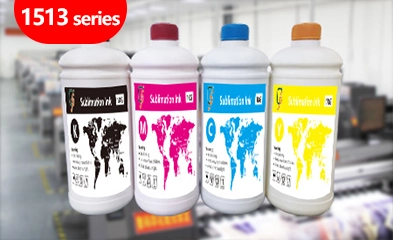
For production lines seeking a balance between color vibrancy and durability, the 1513 series sublimation ink is commonly used due to its stable color output and compatibility with long-run textile workflows.
How do you diagnose common sublimation defects on polyester?
Most defects follow clear patterns, and the challenge lies in tracing them to the correct variable.
How do you identify gas shadow and ghosting?
Ghosting often results from paper movement or uneven pressure. If the paper shifts during transfer, vapor redistributes and creates a secondary image. Stabilizing tension and pressure uniformity usually resolves this issue.
How can you trace color banding to ink flow?
Banding often reflects mechanical or fluid instability rather than color profiling issues. Pump pressure variation, inconsistent head temperature, or viscosity drift can all create visible striping. Regular monitoring of these parameters provides more reliable results than repeated ICC profile adjustments.
Conclusion
Mastery in dye sublimation printing on polyester does not come from perfecting a single variable, but from treating fabric behavior, ink formulation, paper release, heat control, and supplier consistency as one interconnected system. When each layer supports the next, color stability becomes predictable, scale becomes manageable, and production efficiency increases naturally.
FAQs
Q: Can sublimation printing deliver strong durability for sportswear applications?
A: Yes. When diffusion reaches the fiber core and transfer conditions remain stable, sublimated polyester can achieve high wash resistance and strong lightfastness suitable for performance textiles.
Q: Why does the same profile behave differently on two polyester fabrics?
A: Weave structure, filament density, and surface finishing all affect how dye vapor diffuses. Even minor structural differences can shift color appearance under identical settings.
Q: Is a higher transfer temperature always better for deeper color?
A: No. Excess heat often reduces detail and shifts tone. The goal is full diffusion at the lowest effective temperature, not maximum thermal input.


