


HOT SALE
APPLICATION
Phone:+86-15215969856 E-Mail: 396838165@qq.com
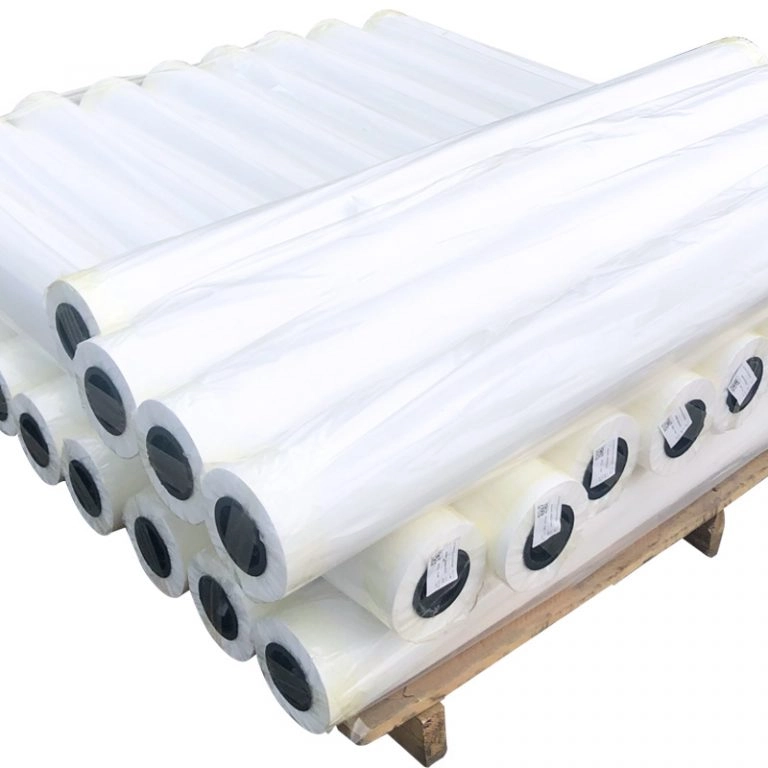
Selecting transfer paper in professional sublimation workflows is no longer a matter of convenience, but a strategic decision that influences color fidelity, process stability, energy efficiency, and long-term production cost. For advanced operations managing varied fabrics, printer configurations, and throughput demands, paper choice becomes part of the engineering system rather than a consumable. The article follows a structured approach to help evaluate paper performance against real production variables.
Why does transfer paper selection determine print stability?
In industrial environments, consistency is rarely limited by printer hardware. More often, deviations appear when paper behavior fails to match ink load, temperature curve, or fabric structure. Stable output depends on how the paper interacts with droplets during jetting and how it releases dye during transfer.
How does paper coating affect ink release?
The coating layer governs the balance between ink hold and dye migration. If the coating absorbs too aggressively, color density suffers after pressing, while if it releases too early, dot gain and edge diffusion appear. A well-engineered coating maintains droplet shape on the surface while preserving the ability to sublimate efficiently under heat. This balance becomes critical in gradient artwork, microtext, and complex tonal transitions.
Why does gsm influence heat transfer efficiency?
- Grammage defines not only thickness but also thermal mass.
- Lightweight paper heats quickly and releases dye faster, which supports high-speed workflows.Medium weights provide greater thermal buffering, leading to
- more predictable saturation on dense graphics.Heavy paper introduces stability for extreme ink coverage but demands higher energy and longer dwell time.
- Choosing gsm is, therefore, not aesthetic but structural.
How should you match transfer paper to different fabric types?
Fabrics behave differently under pressure and temperature. Yarn density, knit construction, and elasticity determine how dye penetrates and how sharp edges remain after cooling. A mismatch between fabric and paper often shows up as ghosting, blur, or uneven saturation.
Which paper works better for lightweight polyester fabrics?
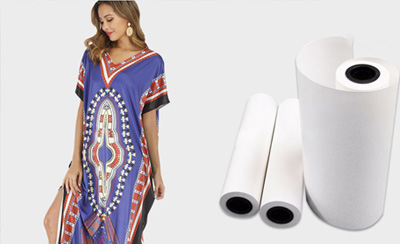
Thin polyester materials, such as scarves or lightweight sports textiles, respond best to rapid dye release. Excessive paper mass can trap heat too long and push dye deeper than needed, leading to muted contrast. Low-gsm paper supports fast release, contributing to preserving line clarity and reducing the risk of overheating delicate structures.
What about dense sports fabrics and interlock materials?
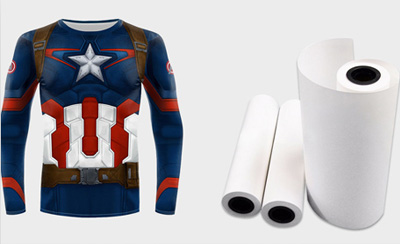
Interlock and high-density athletic fabrics require controlled energy delivery. Their compact structure resists penetration, so a slightly higher gsm improves dwell consistency. Medium-weight paper also stabilizes release across larger ink loads, especially on solid blocks and brand-heavy graphics where uniformity matters more than speed.
How does production speed change your paper choice?
Paper performance cannot be evaluated without reference to line speed. The faster the printer and calender operate, the narrower the margin for error. Paper must respond in sync with mechanics, not fight against them.
Can low gsm paper handle high-speed industrial printers?
Low gsm paper can be applied to high-speed industrial printers, provided coating quality remains consistent. Lightweight paper reduces roll inertia, supports faster feeding, and stabilizes tension across long runs. This kind of paper performs especially well when paired with optimized ink limits and calibrated press curves.
In continuous production, this combination minimizes downtime caused by curling or deformation.
When does heavier paper become more reliable?
Heavier paper has its advantages when ink coverage is much or when production demands absolute uniformity across deep tones. Applications such as photographic panels, dark fashion prints, or branding textiles with heavy black coverage often benefit from the additional thermal buffering. In these cases, stability outweighs speed.
What role does customization play in professional workflows?
Standardized materials rarely satisfy advanced production environments because each operation balances printer type, artwork profile, fabric range, and customer expectations differently. Customization allows alignment between paper behavior and system architecture.
Why does width flexibility matter?
Width flexibility directly affects efficiency. Multiple available widths reduce trimming waste, enable better layout utilization, and support diverse machine configurations. Changfa Digital supports widths ranging from approximately 61 cm to 190 cm and offers OEM/ODM services, enabling tailored solutions for specific operational needs. This adaptability matters in facilities where multiple presses and fabric formats coexist.
How does production scale impact consistency?
Large-scale production infrastructure supports batch stability. We run four coating lines, multiple slitting workshops, and produce approximately 3,000 tons per month, with exports exceeding 120 containers monthly. For buyers managing repeat programs, such capacity reduces the risk of seasonal fluctuation, coating variance, and delivery interruption.
Which paper types fit different application scenarios?
While theory shapes selection logic, real decisions often come down to use cases. The key is not to seek a universal paper but to map specific scenarios to paper behavior.
When should you use ultra-light transfer paper?
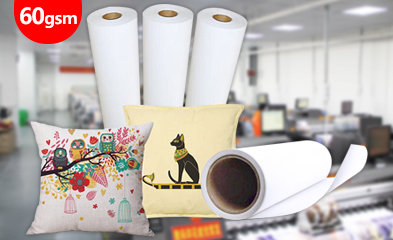
Ultra-light paper is well-suited for delicate textiles, high-speed printing, and applications where precision outweighs saturation, excelling in scarves, fashion panels, and technical textiles requiring fine lines. A representative example is the 35 gsm sublimation transfer paper, which has been positioned for lightweight fabrics and continuous digital workflows.
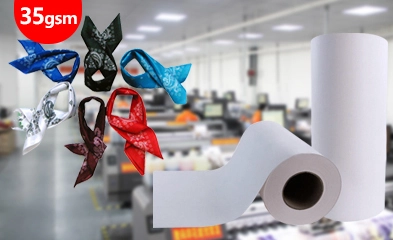
Changfa Digital operates as a fully integrated sublimation paper manufacturer with over 15 years of experience and handles the whole process from base paper sourcing to coating and slitting in-house, which is supported by multi-line production and global export capability. This background explains why the thin paper produced by us tends to show higher stability than generic lightweight alternatives.
When is medium gsm more suitable for mass production?
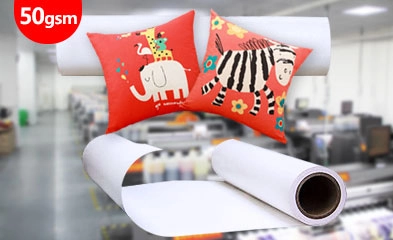
Medium-weight paper is often preferred in commercial apparel, signage, and large-format textile orders where the great balance of efficiency and stability is critical. The 50 gsm sublimation transfer paper represents this type of paper, offering a balance between release control and thermal stability. In practice, such a paper performs consistently across a broad range of polyester substrates, making it suitable for long production runs with fewer parameter adjustments.
How can you reduce waste through smarter paper selection?
Waste in professional printing hardly comes from obvious failures, but accumulates through subtle inefficiencies—repeated calibration, color drift, unexpected reprints, or inconsistent batch behavior. Paper choice can either amplify or reduce these losses.
How does correct gsm lower reprint rates?
Choosing gsm according to fabric density and ink load can reduce common defects such as feathering, banding, and color inconsistency. When paper releases dye in sync with substrate absorption, the first print is more likely to meet the specification. Over time, this lowers reprint volume and improves throughput reliability.
Why does stable coating reduce tuning time?
A stable coating reduces the need for frequent ICC curve recalibration and press adjustments. Operators can spend less time compensating for paper behavior and more time optimizing creative output. In multi-machine environments, consistency across rolls also supports standardized profiles and simplifies cross-device production management.
FAQs
Q1: How do you choose gsm when printing on very thin polyester fabric?
A: Low gsm paper is typically more suitable because it enables faster dye release and limits excessive penetration. This helps preserve detail and keeps edges sharp on delicate materials.
Q2: Is heavier paper always better for color saturation?
A: No. Saturation depends on release behavior, not thickness alone. Medium gsm often achieves a stronger balance between density and clarity, especially for commercial textile applications.
Q3: Can one type of transfer paper fit all printers and fabrics?
A: A single paper rarely performs optimally across all systems. Matching paper to fabric structure, printer speed, and ink profile produces better consistency and lower operational waste.


