


Penjualan Panas
Aplikasi
Phone:+86-15215969856 E-Mail: 396838165@qq.com
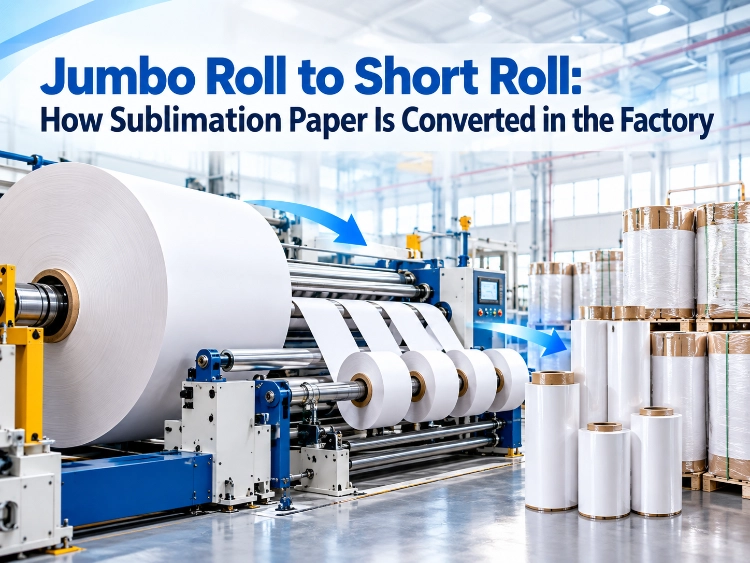
A sublimation paper order usually starts with the gram weight, and that is where the trouble starts. A quote for a 50 gsm jumbo roll, somewhere between 300 and 3000 metres long, tells the print floor which grade of paper it is. It says nothing about the roll that will actually go on their printer. The width the knives will cut, the metres to wind for the batch in hand and the core the finished roll will sit on are not decided by that quote, and until they are set, the jumbo cannot be scheduled for the slitter.
Those three numbers are set after coating, in the converting pass. The coated master roll is unwound, slit to the width the printer and the panel layout call for, rewound to the metres that batch will run, and finished on the core the printer’s unwind takes. That is the pass where the Changfa Digital 50gsm Pabrik Pasokan Berkualitas Tinggi Jumbo Roll Kertas Sublimasi stops being a coated web and becomes a roll one specific printer can mount. Gram weight chooses the paper. It does not choose any of the three.
Section 1: What Is Still a Master Roll After the Coating?
Coating Is Finished; the Converting Has Not Started
At the coater’s discharge, the master roll is still one broad web. A 61 cm order and a 162 cm order need different knife positions, and the printer’s holder determines the core for each finished reel.
Changfa Digital starts with imported base paper and applies the paper and sublimation coatings before slitting and packing. The slitter works from the coated master roll.
One Pass Unwinds, Slits, Rewinds and Packs the Roll
Sublimation paper slitting begins with the coated parent roll on the unwind. The operator threads the web through the knife set from the ticket, then guides each cut lane onto its core. The counter stops when the reel reaches its specified metres. We pack the rewound rolls for the print floor.
A log saw and a hand-trimmed sheet skip the moving web. Neither can show whether the lane tracks through a printer. The trial needs the same slit-and-rewind sequence as bulk.
The Roll a Printer Can Mount Is Made in This Pass
Take the finished roll to the printer and three checks decide whether it mounts: accepted media width, core bore and outside diameter. The batch adds the metres per roll. A 50gsm label answers none of those questions.
For a sample, use the actual holder and width from the production line. Feed the reel through the path. A loose sheet can show the coated surface, but it cannot show that run.
Section 2: How Do Width, Metres and Core Get Set in One Pass?
Width Follows the Printer and the Panel Layout
A printer model name rarely gives the width we need. We ask for the media path limit and the panel width, then check the transfer line. If a job uses less than the printer’s 162 cm path, we slit to the panel width on the ticket. The ticket should say whether the reel covers the full path or only the panel.
A 44-inch path measures 111.76 cm; our 50gsm roll is 112 cm, so the printer has to allow the 2.4 mm difference at its media path and edge guides. Our general slitting range is 61 cm to 320 cm. This 50gsm jumbo is listed at six widths from 61 cm to 183 cm; confirm before assigning another width to its ticket.
Metres Follow the Batch This Roll Has to Run
Read the last batch sheet at the changeover entry; that roll length records how much paper the job used before the next reel went on. Add the thread-up and test-print metres from that line’s sheet, then check whether the resulting diameter and weight fit the unwind.
For a recorded 800 m run, choose one 800 m reel or split the order into the two lengths the press needs. Write each length beside its width and core. Use the job sheet to set metres per reel; the 3000 m maximum is the jumbo range, not automatically the finished-roll length.
The Core Has to Match the Printer’s Unwind
Measure the actual unwind shaft before cutting. A 3-inch tube does not fit over a 2-inch shaft without an adapter; the sample must use the same adapter planned for the bulk run. Check the reel’s outside diameter and weight on that setup.
Write 2 inch or 3 inch on the ticket instead of “standard.” In our core-size comparison for paper rolls, we explain what the holder and roll diameter change. Test the core planned for bulk.
Section 3: What Do the Knife and the Wind Change on That Roll?
The Knife Sets the Edge the Printer Has to Track
If a speck shows beside the paper edge, start there. Wipe the trial edge with a dark cloth and look again at the printed face. Fibres on the cloth with a clean face point toward cutting or handling. That result narrows the search, not the verdict.
Ask us for a wound sample at the ordered width. A hand-cut edge never passed through a slitter, so use a wound sample to judge whether the knives left fibres on the roll. At the printer, wipe the slit edge with a dark cloth; if it picks up fibres, inspect the outer wrap for transit rub marks. If the cloth collects fibres while the print face stays clean, check cutting and handling before coating.
Tension Decides Whether the Width Holds or Drifts
For a 162 cm trial roll, take one reading near the start, one midway through and one at the tail, all from the same edge. A narrow middle reading can mean the parent web drifted at the knives; check the guide and tension before changing the ticket width.
Mark the first point in the reel where a wrinkle or width change appears, then compare that location with the front, middle and tail readings.
The Wind Decides the Roll Edge and the Face of the Roll
After the knives cut a lane, the rewind has to keep its face square. A telescoped roll shows a side layer projecting past the one beneath it. Winding pressure can crush the core wall; a deformed tube may no longer fit over the printer holder. Sight down the roll face, then unwind a few turns and watch whether the web pulls to one side.
Trial reels need the same core caps and pallet packing as export rolls, or the sample does not test the pack used for bulk. Core caps cover the tube ends; the pallet holds the rolls together for handling.
Section 4: How Does a 50gsm Jumbo Become the Roll on the Printer?
Widths From 61 cm to 183 cm, Wound From 300 m to 3000 m
Our 50gsm jumbo is for disperse ink on polyester fabric. It is listed in six slit widths: 61, 91.4, 112, 122, 162 and 183 cm. Choose a roll length from 300 m to 3000 m, then put that value beside the width on the ticket.
At the slitter, we set the knife positions from the width and the counter stop from the length. The first number determines how the web fits the printer; the second tells the operator when to change the reel.
2 Inch and 3 Inch Cores, Capped and Packed on a Pallet
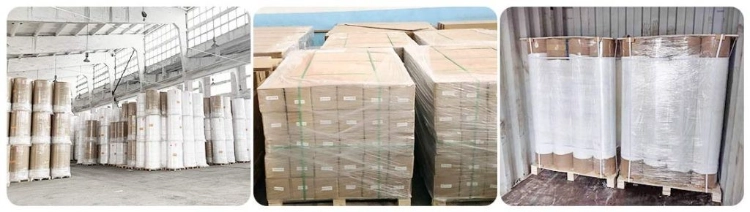
Our slitting machines wind 2-inch and 3-inch cores. We pack export rolls with core caps and pallets. Tell us which holder will receive the roll; grade and width do not settle that fit.
A sample ticket might read “50gsm, 162 cm, 800 m, 3-inch core.” Set length from the batch record and the unwind’s diameter limit, then keep the same core and packing on the bulk ticket.
Gram Weight Alone Leaves the Slitting Ticket Blank
50gsm settles one line on the order. We still need the printer model, accepted width, roll length, holder and maximum diameter before we set the slitting ticket.
Kami jumbo-roll production specification guide covers winding and handling details. Keep the sample and bulk ticket the same; otherwise the sample is a different roll.
Kesimpulan
Coating decides how the paper prints. Converting decides whether it can be printed on at all. A jumbo leaves the coater as a wide master roll, and the roll that mounts is made in the next pass: cut to the width of the printer and the panel, wound to the metres of the batch, and finished on the core the unwind holds. The knife, the tension and the wind then decide whether that width, that edge and that face arrive at the printer intact.
Changfa Digital slits this 50gsm jumbo in its own workshops, in widths from 61 cm to 183 cm and lengths from 300 m to 3000 m, on 2 inch and 3 inch cores, with a cap on the core and the roll packed on a pallet. Send the printer model and its width in centimetres, the core on the unwind, the metres one batch runs, and the ink and the fabric in use, and the trial roll can be slit to that ticket instead of to a gram weight alone.
Pertanyaan FAQ
Q1: Can a jumbo roll go straight onto the printer as it is delivered?
A1: Only when its width, its core and its metres already match that printer and that batch. A 183 cm jumbo on a 3 inch core is a supply roll. A printer that runs 162 cm on a 2 inch core cannot mount it until it has been slit and rewound to that size. A jumbo is bought to be converted, not to be mounted as it arrives.
Q2: We know the gram weight and that we want a long roll. Is that enough to schedule the slitter?
A2: No. Gram weight selects the grade of paper, and the span from about 300 metres to about 3000 metres is only the range this jumbo can be wound to. The slitting ticket still needs the finished width in centimetres, the core size and the metres this batch will actually run. Until those three are on the ticket, the knives cannot be set.
Q3: The width is right and the print is dusty at the edge. Is that the coating?
A3: Check the slit edge before the coating. Dust that wipes off the cut edge came from the knife, or from the edge rubbing in transit, which is why the finished roll gets a cap on the core and a pallet under it. A coating fault does not wipe off; it repeats down the web as a lane on metre after metre. If the dust comes away on the wipe, look at the converting and the pack. If it stays, look at the coating.


