


Venta caliente
APLICACIÓN
Phone:+86-15215969856 E-Mail: 396838165@qq.com
Route decisions in display shops often start with two hand samples held up under showroom light. On that test, the UV sample usually wins. Its ink sits on the surface at full density, edges look hard, and colours read strong at arm’s length. The problem is that a hand sample is flat, front-lit, unstretched and unfolded, and fabric display work is none of those things. The variables that decide whether a finished face performs are light transmission through the print, behaviour under the tension of a frame, what happens when the graphic is folded, shipped and refitted, and which fabrics and effects the route can print in the first place. None of them show up in a sample you can hold.
This article checks sublimation vs uv printing against those criteria, and it does the checking on one defined job rather than in general terms: a retail rollout of 24 backlit SEG faces (silicone-edged graphics tensioned in aluminium frames), each 2.4 m × 1.0 m, printed on polyester backlit fabric with full-coverage dark artwork. Every criterion below is tested against that job’s numbers, because sublimation vs uv printing has one answer on a lightbox face and another on a dark cotton banner.
The Criteria That Decide Fabric Display Work
Light Through the Face
A backlit face is judged from behind, with light passing through the print. In dye sublimation, the dye leaves the paper under heat and enters the polyester fibre itself, so the colour sits inside the material and light travels through the printed fabric. The face glows evenly, including across dark, saturated areas. UV printing on fabric works the other way: the ink cures where it lands, as a film on the surface of the fibres. A film absorbs and blocks light at the surface. On a backlit face that means dull, uneven illumination, with the darkest patches where the artwork carries the most ink. For any face that has to transmit light, this criterion settles the route before cost or speed are discussed.
Stretch Into the Frame
SEG graphics are pulled into an aluminium frame by a silicone edge and held under constant tension. A sublimated print stretches with the fabric because the dye is part of the fibre; the printed area keeps the fabric’s own softness and give. A cured UV film is stiffer than the cloth under it. Under frame tension, and again when the graphic is pulled out and refitted, the film can crack along stress lines, and the cracks show as pale breaks across the image. Front-lit faces under low tension hide this for longer, which is why the failure tends to appear on refits rather than on the first install.
Folding, Shipping and Reuse
Display graphics travel. They are folded into cases, shipped between stores, washed, and installed again. Sublimated fabric folds without marking the print, because there is no surface layer to crease. A UV print that is hard-folded keeps the crease, and repeated folding works on the same lines that frame tension stresses. For one-off graphics installed once and discarded, this matters little. For a rollout set that ships repeatedly, it decides how many installs a face survives. The same questions govern flags and banners, worked through in detail for soft signage print jobs.
Fabric Range, White Ink and Surface Effects
On this criterion the order reverses. Sublimation bonds only with polyester or polymer-coated surfaces, and it has no white ink: white in a sublimated print is unprinted fabric, so the route starts from white or light polyester. Natural fibres, dark fabrics and coloured bases are outside it. UV printing covers almost any material, lays white ink under or over colour, and adds surface effects such as spot gloss and raised texture. Its pigments also hold colour longer under direct sun. A shop quoting dark cotton banners, white-ink work on coloured fabric, or textured display pieces is quoting UV work, and no paper specification changes that.
|
Display job |
What decides it |
Route that meets it |
|
Backlit SEG face |
Light must pass evenly through the print |
Sublimación |
|
Front-lit SEG graphic, refitted often |
Print must stretch and fold without cracking |
Sublimación |
|
Touring backdrop, shipped folded |
Creases must not mark the print |
Sublimación |
|
Dark or natural-fibre banner |
Colour and white must sit on a dark base |
UV printing |
|
Graphic needing gloss or raised texture |
Surface effects and white ink |
UV printing |
|
Mixed set of fabric faces and rigid panels |
Each piece has a different deciding requirement |
Split by piece |
One Job Worked Through: 24 Backlit Faces
The Paper Arithmetic
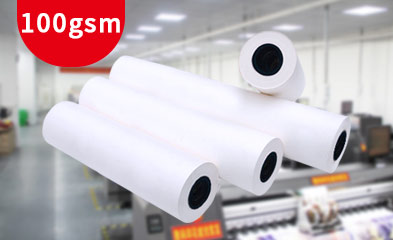
The rollout is 24 faces at 2.4 m × 1.0 m. On the sublimation route, each face is printed to transfer paper and calendered onto the fabric at 225°C for about 20 seconds, inside a working window of 200–250°C. The grade specified for the job is the 100gsm fast dry paper in the Changfa Digital range, run on a 162 cm stock width. Each face takes about 2.5 m of paper: the 2.4 m graphic plus a handling lead. A 100 m roll therefore carries about 40 faces, and the full 24-face job consumes roughly 60 m of one roll, leaving the rest of the roll for the next set of faces.
Ink Load Sets the Ceiling
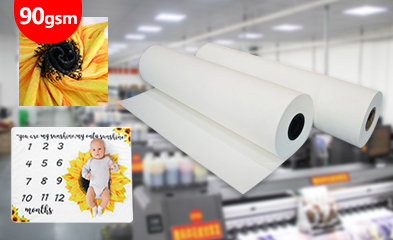
The binding specification on this job is ink load. Backlit faces run saturated, full-coverage colour, and the grade’s maximum-ink-volume rating decides whether that coverage transfers evenly or breaks into banding and weak patches. On this range the rating rises with paper weight: light grades carry two stars, the 50gsm carries three stars, and the 100gsm carries five stars, with a transfer rate rated over 98% at the same 225°C, 20-second condition. Mid grades transfer at 95–98%. The 100gsm coating holds rich ink loads without bleeding, and its even coating keeps lines clean with no fuzzy edges on high-ink designs; the sheet also stays flat through large prints, which keeps registration steady across a 2.4 m face. These grades come off an in-house chain (base paper, coating, slitting and packing) run on four coating lines including one imported German line. The wider range runs 29–100gsm, in widths from 61 cm up to 320 cm for wide and custom work, so the grade is chosen per job rather than stretched across all of them. On full-coverage backlit work, output quality is capped at the transfer step, by the paper’s ink-load rating and coating uniformity; a faster printer cannot lift a ceiling set by the sheet it prints on.
Where UV Stops on This Job
Costed the other way, the same 24 faces go through direct uv printing on fabric. There is no paper consumption, no 60 m of roll, and no transfer step at all, which makes the UV route shorter and simpler on paper. It fails at the first criterion. The cured film sits on the fabric surface, light cannot pass through it evenly, and the installed faces will not glow as the artwork intends. Sharpness at the print stage does not repair a face that cannot transmit light, so on this job the count is plain: 24 faces required to transmit light, and the UV route meets that requirement on none of them.
Conclusión
If the faces must transmit light, stretch into frames, or fold and travel between installs, the route is sublimation, and the specification that decides the result is the paper grade matched to the job’s ink load. For work at that standard, send your fabric type, whether the faces are backlit, the face sizes and the quantities, along with the printer and paper you run now, and the grade can be matched to the coverage your artwork carries. If the fabric is natural or dark, or the job needs white ink, spot gloss or a raised surface, the route is UV, and the paper question drops away entirely. If a set mixes fabric faces with rigid panels, split it by piece: sublimation for the fabric that has to glow, stretch or fold, UV for the rigid and dark pieces.
Preguntas frecuentes
Q1: What is the actual difference between the two printing mechanisms? A1. Sublimation prints the image to transfer paper first, then heat moves the dye off the paper and into polyester fibre, where it becomes part of the material. UV printing sprays ink directly onto the fabric and cures it with ultraviolet light, forming a thin film bonded to the surface.
Q2: Why is there no white ink in sublimation? A2. Sublimation dyes are transparent and add colour to whatever sits beneath them, so white cannot be printed as a layer. White areas in a sublimated graphic are simply fabric left unprinted, which is why the route starts from white or light-coloured polyester.
Q3: Which fabrics can each route print? A3. Sublimation needs polyester or a polymer-coated surface, because the dye bonds into the polymer under heat. UV printing accepts a much wider range, including cotton, canvas, dark fabrics and rigid panels, since the cured film only has to adhere to the surface.


