


Venta caliente
APLICACIÓN
Phone:+86-15215969856 E-Mail: 396838165@qq.com

Our CMYK sublimation inks are an option for textile printers seeking bright, neon-like color when the buyer accepts a process-color match; they do not produce true fluorescence. For Epson DX4, DX5 and DX7 printheads, our 1513 series gives that discussion a specific CMYK product rather than a generic ink substitution. At Changfa Digital, we manufacture sublimation paper and CMYK inks, and the required effect determines whether this is the right order to pursue.
A Neon Brief Can Require Two Different Outputs
A bright-color order can proceed when the buyer accepts the CMYK match.
The term “neon” needs to describe an agreed printed appearance before it becomes an ink requirement. A screen emits colored light, whereas an ordinary printed textile is viewed by reflected light. A luminous pink or green on the monitor therefore does not establish what our CMYK ink can reproduce on fabric. Increasing artwork saturation leaves the same difference between emitted screen light and reflected fabric color.
If vivid ordinary color is the goal, decide acceptance by comparing the buyer’s intended shade with a CMYK sample after transfer. Some bright colors can be approximated within the system’s gamut; others exceed it. We can discuss the supported ink configuration for the accepted CMYK result, rather than treating the word “neon” as a promise of a different optical effect.
A fluorescent response cannot be ordered as higher CMYK density.
An ink has to contain the chemistry for fluorescence, and the printing system has to support that ink. Suitable sublimation systems can print with specialized fluorescent magenta and yellow inks. It is standard CMYK that has the limitation, not every sublimation process. More ordinary ink, heavier transfer paper or a brighter screen setting cannot supply the missing chemistry.
When the order requires a response under UV illumination, a close daylight color is not enough. That requirement belongs to a separately verified fluorescent system, including its supported ink channels and file handling. It is not the CMYK supply discussed here. Keep that distinction in the order specification before comparing our process-color options.
Our CMYK Options Match Specific Printhead Configurations
The 1513 series gives DX4, DX5 and DX7 users a defined CMYK option.
Our 1513 series is a CMYK heat sublimation ink for Epson DX4, DX5 and DX7 printheads. For a printer using those heads, the series is a specific product to discuss once the buyer accepts ordinary transferred color. That is a product choice based on the actual head family, without assuming that one sublimation ink can replace another.
The head identity starts the match; it cannot guarantee suitability for every printer built around that head. Specify the printer model and current ink before placing an order, alongside the head identity. The 1513 head match does not establish a match for I3200 or Kyocera, nor does the ink’s CMYK formulation establish fluorescence.
I3200 and Kyocera systems require their own supported ink match.
Nuestra CMYK sublimation inks also include standard ink options for Epson I3200 configurations. We have high-density options for larger production lines, and a version tuned for Atexco Kyocera heads. Consider each of these configurations separately instead of assuming that 1513 is the ink for all of them.
Give us the head model, the number of heads and the ink already in use to discuss the appropriate choice for those printers. Naming a color alone does not tell us which configuration is required. The inquiry is for standard CMYK materials, with no authorization to convert the printer for fluorescence or fill an existing ink channel with an arbitrary replacement ink.
High-density black addresses transferred color strength rather than fluorescence.
Our high-density black addresses stronger transferred black in jersey and flag work. That is relevant when black coverage is part of the ordinary-color purchasing requirement. Specify that black coverage separately from any fluorescent response, rather than using “brighter output” to stand for both.
Compare the high-density option within its supported printer configuration and judge the transferred appearance the buyer needs. Fluorescent chemistry is a separate requirement that this density choice cannot meet. A process-color order may contain a darker black and an accepted bright CMYK shade; accepting that combination still does not make the order fluorescent.
The Transferred Sample Defines the Order We Can Discuss
The approved color must come from the intended ink and material.
Wait until transfer onto the intended material to judge the color, because the ink’s appearance on paper cannot represent the finished textile color. Make the sample with the agreed artwork and supported ink configuration. Keeping those elements tied to the sample makes approval relevant to the order that will actually be produced. A pleasing sample from another combination cannot by itself establish what the selected production file and ink will deliver.
The viewing light is part of what the buyer approves. If a UV response is mandatory, include its demonstration on the physical sample under the agreed UV illumination. A photograph helps explain the design, but gives the color as interpreted by the camera and display. It remains a communication aid and cannot replace physical acceptance.
Our paper supports the selected transfer process without adding fluorescence.
Nuestra gama de papeles de sublimación supports the established ink and transfer process. We manufacture the paper through base paper, coating and slitting, and paper samples can be tried with the buyer’s printer and fabric. That gives the buyer a material to evaluate within the intended production combination, rather than relying on the color of an untransferred sheet.
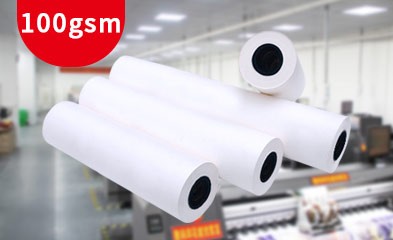
Paper is selected for its role in transfer, not to change CMYK ink into a fluorescent colorant. A heavier sheet likewise does not change the effect required by the ink order. Keep the sample tied to the paper, ink and fabric actually being considered, then decide whether its transferred CMYK appearance meets the accepted target.
An accepted CMYK target makes the ink inquiry specific.
Once ordinary process color is accepted, the inquiry can identify a supported supply option instead of asking for an undefined neon effect. A DX4, DX5 or DX7 buyer can discuss 1513 within its stated scope. An I3200 or Kyocera buyer needs the corresponding configuration discussion. In either case, the printer details and accepted physical target connect the technical choice to the ink being purchased; mandatory fluorescence remains outside that CMYK substitution.
Conclusión
We can pursue the CMYK order once its ink fits the actual printer configuration and the buyer has accepted the transferred process color. Send the printer and printhead model, head count and current ink with the accepted physical color target, intended fabric and viewing light. Include whether true fluorescence is mandatory, so the discussion stays with the CMYK supply appropriate to the order.
Preguntas frecuentes
Q1: Can sublimation print neon colors using standard CMYK ink?
A1: Some bright, neon-like shades can be reproduced within the system’s gamut. Have the transferred color approved before using it as the specification for the order. Changing CMYK saturation cannot provide the chemistry for true fluorescence; that requires suitable fluorescent inks running in a compatible system.
Q2: Can 1513 ink specified for DX5 also be used with I3200?
A2: Our 1513 head scope covers Epson DX4, DX5 and DX7 printheads. It gives no approval for I3200; that configuration has to be treated as a separate ink choice. We can discuss it once you provide the printer details, head count and current ink.
Q3: Should an order requiring fluorescence use high-density ink?
A3: High-density black addresses transferred black strength within its supported configuration. It does not supply fluorescent chemistry. Establish whether the customer accepts ordinary process color before making that CMYK ink inquiry.


