


Bán nóng
Ứng dụng
Phone:+86-15215969856 E-Mail: 396838165@qq.com
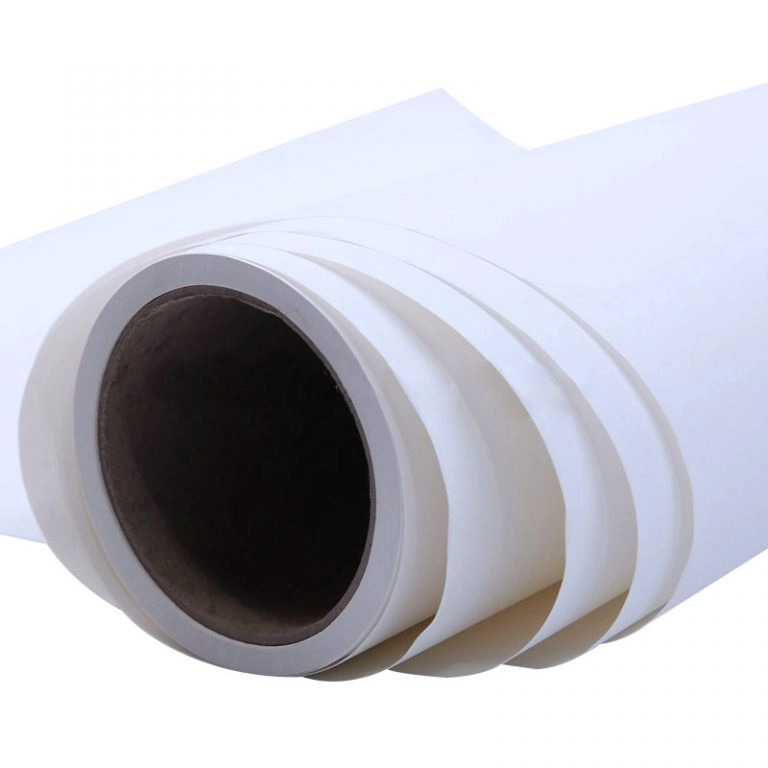
Sublimation printing is now an essential technique used for garment production, home textiles, sports wear, advertising banners, and other branded products. With faster printing speeds and expanding application scenarios, giấy thăng hoa is not just a material used for printing but has now become an essential element that plays a critical role in terms of color accuracy, transfer efficiency, production stability, and operational cost.
Various types of sublimation paper have been specifically developed to overcome different production difficulties, including ink drying speed, fabric movement during transfer, color release efficiency, and heavy ink loads. Choosing the proper paper, therefore, is a technical decision instead of an ordinary purchase. The article introduces the main types of sublimation paper, outlines their structural properties, and demonstrates their practical roles in modern production.
Why Do Different Sublimation Paper Types Matter in Production?
Before reviewing specific categories, understanding the tangible effects of paper choice on output quality and operational flow is valuable.
How Does Paper Structure Affect Ink Transfer?
The construction of sublimation paper governs the sequence of ink reception, temporary retention, and eventual release throughout thermal processing. Surface coating composition manages ink uptake and solidification characteristics, while base substrate thickness determines resistance against dimensional changes under elevated temperature and applied force. Uneven ink absorption or erratic release patterns frequently produce unwanted effects, including shadowing artifacts, softened contour definition, or partial color bonding.
Materials poorly suited to either printer characteristics or textile composition commonly underlie quality problems that operators incorrectly attribute to ink systems or pressing equipment.
Why Does Production Speed Depend on Paper Type?
Elevated printing velocities shorten available drying periods considerably. Papers engineered for lower output rates risk ink displacement or unwanted transfer when deployed on accelerated machines. In contrast, formulations promoting quick solidification enable seamless, continuous roll processing without workflow interruptions. Appropriate paper specification, therefore, decreases idle periods, curtails material losses, and helps sustain a steady manufacturing cadence.
What Are the Main Types of Sublimation Paper Available?
Sublimation paper has developed into several specialized groups, each fine-tuned to address particular working environments.
What Is Standard Sublimation Paper Used For?
Standard sublimation paper provides equilibrated performance regarding ink acceptance and subsequent detachment. This variety finds regular application in routine textile decoration tasks featuring moderate processing speeds and stable fabric positioning. It suits everyday clothing items, advertising textiles, and ornamental products where extreme ink saturation levels or exceptionally rapid throughput remain unnecessary.
When Should Fast-Drying Sublimation Paper Be Used?
Fast-drying sublimation paper receives design emphasis for accelerated printing systems and large-scale output requirements. Advanced surface treatments permit rapid ink immobilization following deposition, thereby eliminating smudge risks before heat application. Such papers are indispensable in extensive textile manufacturing facilities and broad-format operations that demand uninterrupted high-volume production cycles.
Why Is Tacky Sublimation Paper Necessary for Textiles?
Tacky sublimation paper incorporates a gentle adhesive coating that activates during thermal exposure. This temporary bonding capability secures fabric placement throughout the pressing phase, thereby counteracting positional drift capable of generating ghost images or duplicated outlines. Elastic substrates, performance garments, and stretchable compositions particularly benefit from this stabilization feature during transfer procedures.
What Makes Hybrid Sublimation Paper Different?
Hybrid sublimation paper integrates advantageous traits from multiple coating technologies, including accelerated drying and superior release efficiency. Production environments characterized by diverse substrate varieties and fluctuating printer parameters gain particular advantages from this multi-purpose construction. The resulting adaptability is especially useful when frequent workflow variations occur without convenient opportunities for material substitution.
When Is High-Release Sublimation Paper Preferred?
High-release sublimation paper achieves exceptional ink detachment performance, thereby reducing leftover ink retention on the carrier surface following pressing. Applications requiring intense hue saturation, rich shadow tones, and exact chromatic matching frequently favor this category, particularly in visually demanding graphic layouts.
How Does Manufacturer Capability Influence Paper Consistency?
Beyond chemical composition alone, manufacturing precision and systematic quality oversight determine actual material dependability.
How Do Integrated Production Systems Improve Stability?
In the field of sublimation paper manufacturing, Changfa kỹ thuật số maintains comprehensive vertical integration covering base paper production, coating, slitting, and international distribution networks. With over fifteen years of industry experience, four dedicated coating production lines, advanced imported coating machinery, and monthly output measured in thousands of tons, we prioritize stable ink release, consistent coating behavior, and reliable roll quality.
Our internal oversight from initial substrate creation through final rolled product delivery provides advantages to professional decoration operations that require repeatable outcomes, predictable repeatable results, predictable performance, and high throughput across long production runs, and high productivity during long production runs.
Which Paper Types Perform Best for Different Applications?
Paper specification should align with substrate properties, printer speed, and ink loads rather than be based on arbitrary preferences.
Which Paper Fits Lightweight Textile Production?
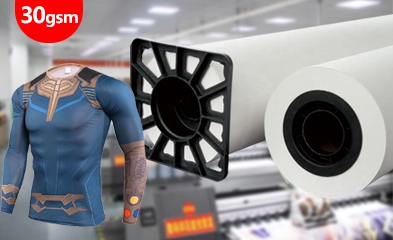
For lightweight fabrics and fast garment production, Giấy truyền nhiệt thăng hoa không dính 30 gsm delivers rapid ink solidification and efficient ink transfer while lowering material consumption. Lower basis weight supports high-speed printing and is particularly advantageous in high-volume textile facilities where efficiency and cost control are priorities.
Which Paper Supports Heavy Ink Loads and Industrial Printing?
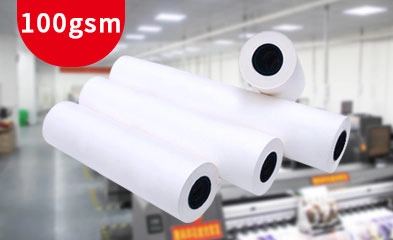
In applications involving high ink density or wide-format printers, Giấy thăng hoa khô nhanh 100 gsm maintains structural stability and controlled ink drying performance under demanding conditions. The heavier base paper resists thermal deformation, thereby promoting reliable transfer consistency throughout long-term production campaigns and large-scale manufacturing activities.
How Can Paper Selection Reduce Printing Defects?
Numerous sublimation irregularities trace directly to mismatched paper characteristics instead of mechanical equipment shortcomings.
What Problems Occur with Incorrect Paper Selection?
Papers exhibiting delayed solidification frequently produce ink displacement phenomena, while inadequate release capability often results in muted tonal values or incomplete chromatic bonding. Lightweight substrates paired with substantial ink volumes sometimes develop wrinkling or dimensional instability during pressing, thereby compromising image registration accuracy and contour precision.
How Can Proper Paper Improve Production Yield?
Thoughtfully matched paper stabilizes ink handling characteristics, enhances chromatic precision, and decreases rejection frequency. Accelerated drying performance reduces intervals between printing and pressing stages, while uniform release behavior supports dependable results across successive production batches. Accumulated benefits over extended periods manifest as elevated output efficiency and diminished operational expenditures.
How Should You Choose Sublimation Paper for Your Workflow?
Material decisions require careful correspondence with actual technical parameters rather than reliance upon promotional claims.
Which Factors Should Be Evaluated Before Purchase?
Critical assessment criteria encompass equipment velocity ratings, deposited ink quantities, substrate behavioral properties, intended thermal application levels, and anticipated production volumes. Formulations featuring reduced weight align effectively with velocity-oriented processes, while heavier fast-drying variants accommodate elevated ink saturation requirements. Elastic compositions derive particular benefit from tacky alternatives, while diversified manufacturing environments often favor hybrid solutions.
Kết luận
Sublimation paper plays the role of an essential operational component rather than being merely a freely available accessory. Various types, including regular, rapid-drying, tacky, hybrid, and high-release sublimation papers, are available to overcome specific production challenges. Careful selection of the best-suited sublimation paper type ensures smooth operation, accurate color reproduction, and cost-effectiveness.
When paper attributes are exactly aligned with the actual printing conditions, sublimation technology can generate uniform, high-standard results across varied application scenarios while reducing unnecessary experimentation phases.
Câu hỏi thường gặpS
Q: Which sublimation paper type is best for sportswear?
A: Tacky sublimation paper generally receives preference in sportswear production because it effectively counteracts fabric displacement throughout thermal transfer procedures.
Q: Does heavier sublimation paper always produce better results?
A: No. Paper weight should match ink load and printer speed rather than being selected by thickness alone.
Q: Can one sublimation paper handle all applications?
A: Most manufacturing facilities achieve superior performance through purposeful selection of paper categories according to substrate response patterns, processing velocity, and desired chromatic outcomes instead of depending upon a solitary universal material.


