


Choosing the Proper Printing Method: Heat Transfer Paper vs. Sublimation Printing
HOT SALE
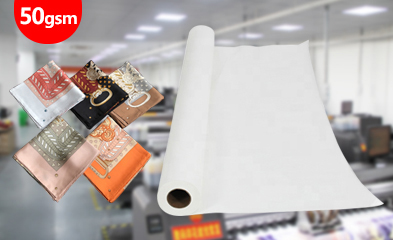
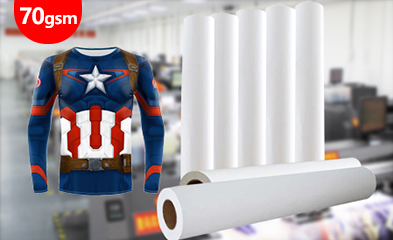
APPLICATION
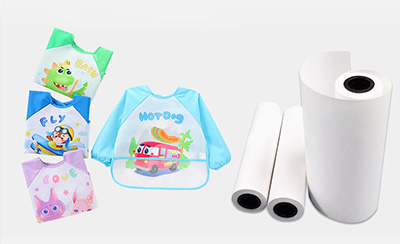
Phone:+86-15215969856 E-Mail: 396838165@qq.com
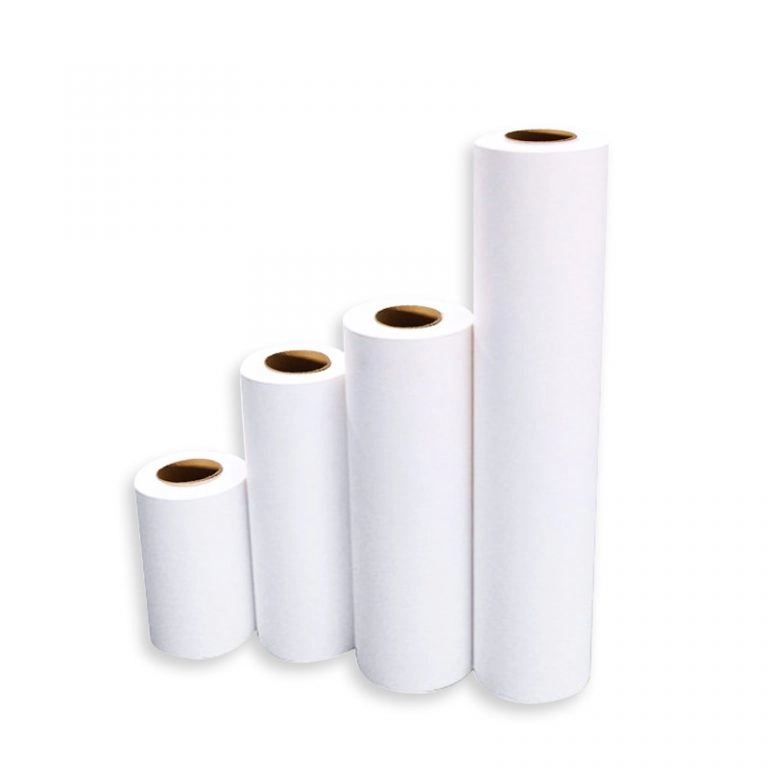
Selecting a printing method is not a stylistic preference, but a production-system decision that affects durability, failure rate, unit cost, and how much control you retain over quality at scale. Heat transfer paper and sublimation printing often appear interchangeable on the surface, but they rely on different material mechanisms and perform very differently once orders increase, fabrics diversify, and customer expectations tighten.
If choosing the wrong method, problems appear slowly, such as inconsistent hand feel, fading after washing, unstable color batches, or rising rework rates, thus reducing margins. This article examines both methods from a technical and operational perspective so you can match the process to your actual production model.
What fundamentally distinguishes heat transfer paper from sublimation printing at the material level?
At first glance, both methods rely on heat to move color from paper to fabric, but the similarity stops there.
How surface bonding and polymer diffusion define durability and hand feel
Heat transfer paper places pigments and binders on top of the fabric. During pressing, the coating softens and bonds mechanically to the fiber surface, which means the color layer remains external, much like a thin film.
Sublimation printing behaves differently. Disperse dyes enter a vapor phase under heat and migrate into polyester polymer chains. When the fabric cools, the polymer contracts and traps the dye molecules internally.
This distinction determines performance. Surface layers can crack, peel, or stiffen the fabric, but embedded dyes cannot detach without destroying the fiber itself. As a result, sublimated textiles retain softness, breathability, and flexibility, while surface-coated fabrics trade comfort for coverage.
In short, one method adds material to fabric, while the other modifies the fiber itself.
Which applications naturally favor heat transfer paper instead of sublimation printing?
Material physics sets boundaries, but production reality decides adoption.
Why dark fabrics, cotton, and small batches favor surface transfer
Heat transfer paper works on cotton, blends, and dark fabrics because opacity comes from the ink layer itself. Sublimation dyes are transparent and rely on reflected light, which makes them unsuitable for dark substrates.
Besides, the method of heat transfer gains flexibility for textured or coated materials that resist dye diffusion. For small batches, promotional items, or short product cycles, surface transfer avoids the need for polyester-only sourcing and dedicated sublimation ink setups.
The limit is longevity. If the product lifecycle is short or the garment is not expected to endure heavy washing, surface transfer can be rational. However, when durability is critical, its limitations become costly.
When does sublimation printing become the more rational production choice?
Once you shift to polyester-based textiles, the balance changes.
Why polyester, roll production, and durability favor sublimation
Sublimation excels on 100 percent polyester and high-polyester blends. Sportswear, flags, curtains, banners, and performance garments benefit from dye-embedded coloration that does not obstruct airflow or stretch recovery.
In roll-to-roll production, sublimation also integrates cleanly with continuous calendars and wide-format presses. Rework rates drop when color stability depends more on polymer chemistry than on operator technique.
If your orders emphasize repeatability, long service life, and tactile quality, sublimation reduces hidden costs that surface-based processes accumulate over time.
How does ultra-light sublimation paper influence efficiency in high-speed production?
Process stability depends heavily on how paper releases ink and moisture.
How ultra-light paper improves speed and material efficiency
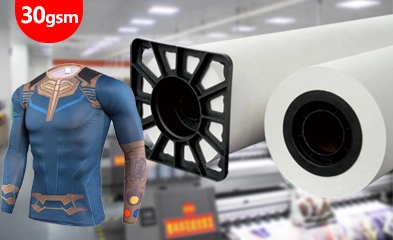
Ultra-light papers reduce thermal mass and allow faster solvent evaporation. This shortens dryer dwell time and improves throughput on high-speed printers when ink limits are well-tuned.
A typical example is 30 gsm sublimation heat transfer paper, designed for rapid drying and low paper consumption in mature production environments. Its low weight lowers transport cost, reduces storage volume, and allows tighter roll diameters for continuous feeding.
The price is tolerance. Low grammage leaves little margin for excessive ink density or unstable humidity. In controlled factories, it supports aggressive production targets, while it can amplify defects in fluctuating conditions.
Why does medium-light sublimation paper offer better process tolerance for most production environments?
Most facilities operate in variable climates and mixed order profiles.
Why higher coating capacity improves process stability
Medium-light papers have a thicker coating and greater base strength, which can buffer ink load variation and reduce deformation during long press cycles.
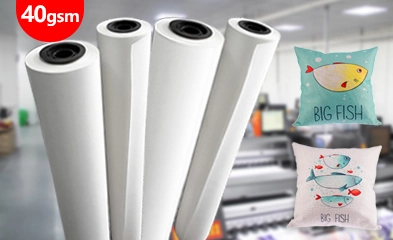
40 gsm sublimation transfer paper is often used as a balance point between efficiency and stability. It accepts higher ink volumes, resists curling under humidity swings, and maintains registration across wide calendars. For many plants, this class of paper lowers operator dependency and shrinks defect variance without sacrificing much speed.
How do cost structure and failure rate differ between the two methods in real operations?
Equipment price rarely reflects the true cost.
How waste, rework, and labor shape real production costs
Heat transfer setups cost less to enter, but the surface coatings generate higher scrap when alignment slips or pressure varies. Color inconsistency leads to batch rejection, and labor hours rise as operators adjust parameters manually.
Sublimation requires a higher initial investment in printers, inks, and calendars. However, once the parameters are stable, the scrap rate is significantly reduced. Because the dye becomes part of the fabric, the incidence of appearance defects is even lower in mass production.
Over time, the decisive factor is not the consumable price, but the cost that you need to pay for how many reprints, refunds, or discounts you need to process.
How should you decide which method fits your production model rather than chasing trends?
No method dominates every scenario, so it is important to choose a method that is suitable for you.
How fabric type, order scale, and quality goals guide your decision
The correct choice aligns technical behavior with your order structure and brand promise. The following factors can be taken into account:
Fabric mix: cotton or dark colors favor surface transfer; polyester favors sublimation
Batch size: small runs tolerate surface methods; large runs reward sublimation stability
Durability needs: frequent washing demands embedded dye
Customer sensitivity: premium brands penalize stiffness and fading
Process maturity: sublimation benefits structured environments
Why is Changfa Digital vital for stable large-scale sublimation paper production?
In industrial sublimation workflows, consumable engineering matters as much as printers and heat presses.
Changfa Digital is a manufacturer that focuses on sublimation paper and digital printing services with more than 15 years of specialization. Our company operates a full in-house production, from base paper processing to coating and precision slitting, and has the capacity for global shipping at large scale. Our facilities include four coating lines, four slitting workshops, and ten slitting machines for multi-core roll formats, supported by a German-imported advanced coating line used for daily production.
Monthly output reaches about 3,000 tons, with exports of roughly 120 containers worldwide. Product ranges cover 29–100 gsm grades and wide-format rolls, and services cover OEM/ODM customization and 24-hour technical support available for production users.
FAQs
Q1: Can heat transfer paper replace sublimation printing for polyester fabrics?
A: It can functionally apply color, but durability, breathability, and hand feel differ significantly. For long-term use on polyester, sublimation remains structurally superior.
Q2: Is lighter sublimation paper always better for production efficiency?
A: No. Ultra-light paper increases speed but reduces tolerance. Medium-light grades often deliver lower defect rates in real factory conditions.
Q3: Which method supports long-term business growth more effectively?
A: The method aligned with your fabric base, order scale, and quality expectations will scale better. There is no universal best process—only a better system matching.


