


Phone:+86-15215969856 E-Mail: 396838165@qq.com
Dye sublimation printing stands out as a leading method for decorating polyester textiles because of its lasting quality, deep color infusion, and strong resistance to washing. However, the technique shows noticeable differences when applied to dark-colored materials. Production crews frequently observe diminished color strength, reduced contrast levels, or loss of fine details during transfers onto deeply shaded substrates. Reliable outcomes, therefore, demand careful coordination among transfer paper characteristics, ink performance, printer adjustments, and heat press settings instead of depending on single isolated changes.
This article presents feasible strategies to enhance print quality on dark fabrics while preserving overall production speed and effectiveness.
Why Does Dye Sublimation Perform Differently on Dark Fabrics?
Understanding the fundamental reasons for varied performance becomes essential before modifying equipment or supplies.
Why do colors lose brightness on dark fabric?
Sublimation dyes possess transparent properties by nature. Their appearance relies upon light bouncing back from the fabric surface once the dye molecules penetrate polyester fibers. Light or white textiles reflect substantial amounts of light, allowing colors to display vivid intensity, while darker textiles absorb considerable light quantities, causing transferred colors to look subdued or less prominent.
Even a successful technical dye movement produces altered visual effects because reflection decreases significantly.
Can ink density alone solve this limitation?
Raising ink volume might seem like a straightforward fix, but overly heavy application frequently leads to dye bleeding, unclear details, and uneven transfers. Too much saturation often blurs sharpness and extends drying periods, thereby creating workflow disruptions. The overall optimization across paper selection, ink application, and pressing conditions generally yields more satisfactory outcomes than simply boosting ink coverage.
How Can Paper Selection Improve Transfer Efficiency?
Transfer paper significantly plays a critical role in how effectively dye migrates to the fabric surface and how precisely patterns hold their shape after pressing.
Why is fast ink release critical on dark fabrics?
Coatings designed for rapid ink release enable greater dye quantities to enter the fabric during the pressing stage. Enhanced dye movement raises achievable color strength, partially offsetting the light absorption typical of dark fibers. Quick release additionally minimizes residual ink left behind, thereby promoting greater uniformity across multiple prints.
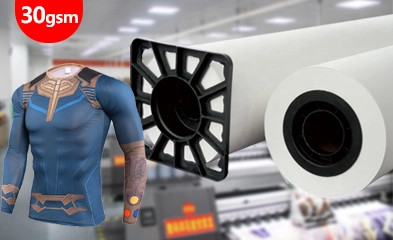
A practical lightweight option frequently chosen for fast-paced operations is 30 gsm 승화 열전달 종이, which facilitates swift ink delivery while preserving pattern stability throughout extended continuous printing runs.
Which paper weight works better for deep-color substrates?
Lighter papers generally allow quicker dye transfer, while heavier varieties provide improved ink positioning control. Selection between these options depends upon the required production pace, printer specifications, and fabric characteristics. Thinner materials often respond favorably to lighter papers, while thicker textiles sometimes benefit from heavier papers that regulate dye delivery more evenly.
How Do Ink Formulation and Printer Settings Influence Results?
Ink composition combined with printer calibration markedly affects color behavior on dark substrates.
Should ink density be increased for darker fabrics?
Slight to moderate increases sometimes enhance color visibility without major drawbacks, but excessive increases commonly compromise detail accuracy. Appropriate color management profiles help sustain equilibrium between richness and definition. Carefully measured modifications produce dependable results while avoiding excessive saturation.
How does print resolution affect transfer sharpness?
Higher resolution settings contribute to finer details and crisper edge definition. However, overlapping print passes require strict regulation to prevent unnecessary ink buildup. Excessive layering tends to soften boundaries and generate inconsistent transfer patterns.
What Role Does Heat Press Control Play in Color Visibility?
The heat pressing stage largely governs how thoroughly dyes integrate into polyester fibers.
Can higher temperature improve color performance?
High temperatures accelerate dye diffusion and potentially deepen penetration into fibers. Excessive heat application, however, risks distorting fabric structure or shifting tonal values. Suitable temperature ranges should correspond to specific fabric composition and ink type rather than adhering to universal fixed values.
How does pressure influence transfer uniformity?
Uniform pressure application ensures consistent dye distribution across the entire contact area. In contrast, irregular pressure frequently creates patchy zones, which become especially apparent on dark fabrics where contrast already remains limited. Therefore, regular calibration of the heat press equipment holds primary importance for achieving repeatable uniformity.
Which Paper Options Work Better for Thick or Plush Fabrics?
Thicker materials like blankets or plush surfaces present extra difficulties because of their irregular textures.
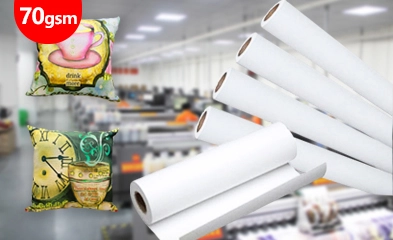
70 gsm 빠른 건조 승화 종이 provides superior size stability and regulated ink release, thereby supporting consistent color depth and pattern clarity when transferring onto heavier substrates where dye absorption varies across different surface areas.
Why do thicker fabrics need different paper behavior?
Fabrics featuring raised pile or textured surfaces absorb dye at uneven rates. Papers designed for gradual ink release help sustain steady penetration levels and avoid mottled appearances, ensuring stable transfer quality in both elevated and smooth sections.
Who Supports Sublimation Production with Reliable Materials?
Stable manufacturing outcomes frequently depend upon dependable material supply chains and consistent production oversight.
Changfa 디지털 is a company specializing in 승화 종이 along with digital printing solutions and possessing more than fifteen years of manufacturing expertise. Equipped with several coating lines and slitting facilities, we manage the entire process from raw base paper through coating application to finished roll preparation, delivering products worldwide. Our substantial production capacity, combined with advanced coating techniques, enables uninterrupted support for textile printing operations that require predictable transfer behavior and steady paper performance. We focus on coating uniformity, compatibility with rapid digital printers, and practical efficiency suited to extended production runs in textile environments rather than sheer volume alone.
How Can Workflow Adjustments Improve Dark Fabric Printing?
Material choices represent only part of the equation, and operational practices also significantly affect final quality.
Should fabric pretreatment be considered?
Surface moisture or contaminants hinder proper dye adhesion and migration. Adequate preheating or thorough drying promotes even results, thus reducing unexpected variations in transfer zones.
How important is environmental control?
Ambient humidity influences ink drying rates and paper stability. Stable storage environments preserve coating effectiveness and prevent curling or moisture uptake that might compromise transfer reliability.
What Final Checks Ensure Consistent Results?
Stable production emerges more often from systematic process verification than from equipment replacement.
Have transfer parameters been tested across fabric batches?
Various polyester compositions respond differently under thermal conditions. It is recommended to undergo the preliminary testing of sample batches to confirm the stability of parameters before committing to full-scale runs.
Is paper storage affecting performance?
Long-term exposure to humid conditions degrades coating properties over time. Sealed storage under regulated humidity and temperature levels preserves original performance characteristics.
FAQ는s
Q: Why does sublimation printing struggle on dark fabrics?
A: Sublimation dyes remain transparent and depend upon reflected light for visibility, but dark fabrics absorb much of that light, thereby diminishing perceived color strength.
Q: Can higher ink usage alone improve print results?
A: Excessive ink application commonly reduces detail definition and leads to uneven transfers; comprehensive process management delivers superior outcomes.
Q: What is the simplest improvement step for dark fabric sublimation?
A: Selecting appropriate transfer paper combined with fine-tuned heat press settings generally brings the most noticeable quality gains.


