


APPLICATION
Phone:+86-15215969856 E-Mail: 396838165@qq.com
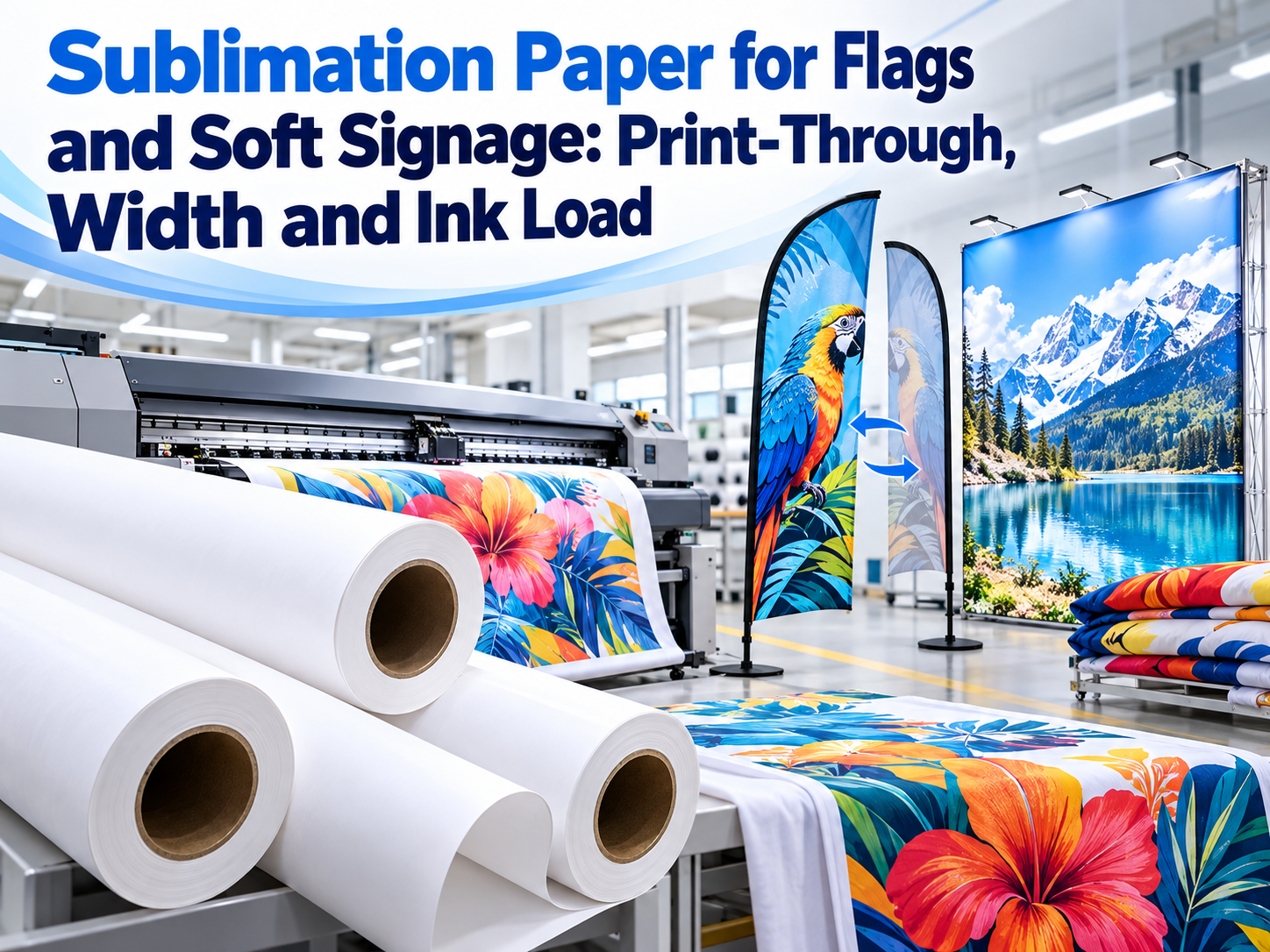
A flag is not judged on the printer table. It is judged hanging, from across the street, where the image has to read through a single layer of fabric. A lightbox panel is judged with the lamps on, when a black that looked solid by daylight turns grey. A backdrop is judged as one picture across its panels, and a banner run is judged at metre 800 against metre 1. Each of those verdicts arrives after the job has left the calender, and none of them can still be corrected there.
What decided them was settled earlier, in four conditions the paper shares: how far the dye prints through the fabric, how much ink the coating holds before the image blooms or the sheet cockles, whether the roll width covers the finished size or forces a seam, and how evenly the calender pass drives the dye across the full width. The Changfa Digital sublimation paper range runs from 29 gsm to 100 gsm and is slit in-house to widths from 61 cm to 320 cm, and its grades are not interchangeable across those four conditions. The four job types are settled by different ones of these conditions: a single-sided flag by print-through, a backlit panel by ink load, a wide backdrop by width, and a long banner run by the evenness of the calender pass across the full length.
Section 1: What Sets the Print-Through on a Single-Sided Flag?
Ink Load, Fabric Openness and the Calender Pass Set It Together
A flag has no second layer to hide behind: the dye must colour the face and keep travelling through the fibre bed to draw the reverse image. Ink load sets the dye available to travel. The fabric sets how much can pass — knitted flag polyester is open, and its openness fixes the share reaching the back. The calender pass sets how deep the dye is driven: temperature, dwell and blanket pressure, at a reference condition of 225 °C for 20 seconds on our papers. Shorten the dwell for speed, and print-through pays.
Past the Fabric’s Limit, More Ink Blooms at the Edge Instead of Deepening the Reverse
Every fabric has a load where the reverse stops improving. Above it the fibres are saturated, and the extra dye spreads sideways on the face — fine lines fatten, edges bloom, the reverse stays put. The test is a step wedge on the production fabric, read from the back: raise the load until the reverse stops gaining, and that step is the fabric’s flag load. The printer’s maximum is not.
Outdoor Fading Is Decided at the Calender, Weeks Before It Shows
Dye that never diffused fully into the fibre sits near the surface, and sunlight removes it first — the flag fails within weeks on the pole, not on delivery day. Where calender energy falls off — a cooler edge, a tired blanket — diffusion runs shallower in lanes, and the flag fades in lanes matching the calender, not the artwork. Even energy across the width, the full dwell and a specified lightfastness grade are the durability controls.
Section 2: Why Does a Backlit Panel Wash Out When the Lamps Come On?
Black Fails First Because It Carries the Highest Density in the Image
On the table a print is judged by reflected light; in a lightbox, by the light it lets through, and every gap in ink density is a leak. Black carries the most ink, so a shortfall shows there first: flat black turns grey, or shifts brown where one channel of its four-colour build was limited harder than the others. The panel was printed to satisfy reflected light; backlit work is a transmitted-light specification.
Ink Limits Come Down in Order: Light Inks and Yellow First, Black Last
Backlit density is built at the RIP, in ink limits set for the actual fabric — and the total comes down in an order. Light inks and yellow come down first: mostly solvent, they add least to the density a lamp must be stopped by. Cyan and magenta follow; black comes last and least, being the hardest area to hold. Saturation is raised inside that limit, never past it.
A Backlit Proof Counts Only When It Is Lit, and on the Production Fabric
An unlit proof approves a different product. The proof that settles the job is the production fabric, printed at production limits and viewed lit — in its own box, or against a source of the same brightness — with the blacks judged there. A proof on substitute fabric settles nothing: its limits belong to a different fibre bed, and the panel is re-limited on the real cloth.
The 100gsm Fast Dry Sublimation Paper Roll Holds Heavy Ink and Stays Flat
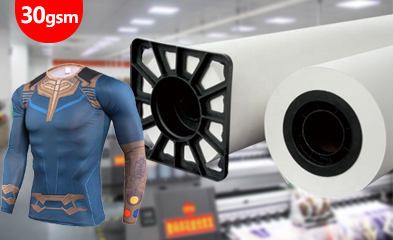
On backlit work we run that density on our 100gsm Fast Dry Sublimation Paper Roll. Its coating holds rich ink loads without bleeding, and its transfer rate is above 98%. Its applications include soft signage and exhibition graphics; widths from 91.4 cm to 183 cm cover most lightbox panels in one piece.
Section 3: What Makes a Wide Backdrop Fail as a Single Picture?
Banding Shows First on Flat Colour, and One Lane Condemns the Whole Panel
A backdrop is metres of flat colour read as one surface; banding stands open on it. The sources separate by pattern: a lane at the head’s pitch points at a nozzle no longer firing clean; bands at the pass pitch, at feed calibration; a band growing with ink load, at the paper cockling toward the head. Check in that order — nozzle, feed, then flatness and load.
The Roll Width Decides the Panel Count Before Printing Starts
Finished size, plus hems and wrap, fixes the panel count before anything prints; the roll width should be chosen for the panel, not the printer’s maximum throat, and seam placement belongs in low-detail areas, not across faces or brand blocks. Our widths are slit to order between 61 cm and 320 cm, so panel width is a buyer specification — including the non-standard width that deletes a seam outright.
Panels From One Roll and One Batch Match at the Seam
At a seam the eye forgives no small density difference between panels. Coating weight varies slightly from lot to lot; two lots that each pass alone can draw a line at the join under show lighting. The control is material discipline — one roll per job where length allows, one batch in consecutive metres where it does not — verified by a seam pair printed and hung together before the run commits.
The 90gsm Fast Dry Sublimation Paper Roll Stays Flat Under Heavy Coverage
Backdrop work is where we run our 90gsm Fast Dry Sublimation Paper Roll. Its coating grips ink and the sheet does not buckle under heavy colour blocks — the flatness the banding checks depend on. It is a grade for larger textile panels, and its widths run 61 cm to 210 cm, so common backdrop heights print as one piece.
Section 4: What Keeps Metre 800 the Same Colour as Metre 1?
A Web Rewound Before It Is Dry Marks Its Own Face
A long run spends days as its own storage: rewound while the ink film holds moisture, one wrap’s face prints faintly onto the next wrap’s back — set-off — and full-roll pressure can block the wraps together. Fast-dry coatings shorten the wait, not the risk. The web must be dry through, not dry to a fingertip, before the roll is closed.
Storage Humidity and a Cold Roll on the Printer Move the Colour
Paper equilibrates with its room: a roll from a damp store and one kept beside the printer are one product in two moisture states, transferring differently. Colour drift blamed on an ink batch starts at a roll change — colder, damper, first metres off colour until material and room agree. Store wrapped, acclimatise cold rolls in the print room, and ticket the roll and batch.
Protective Tissue Guards the Blanket and the Face on Wide Calender Runs
Whatever passes the nip can reach the blanket — and what reaches the blanket returns as a ghost on the next job. Protective tissue runs with the paper and fabric and takes that strike-through instead. Ours is a 30 gsm tissue in widths from 160 cm to 182 cm, sized for wide calender work. A clean blanket transfers evenly: the tissue is part of why metre 800 matches metre 1.
The 50gsm Factory Supply High Quality Jumbo Roll Sublimation Paper Is Wound From 300 to 3000 Metres for Runs Like This
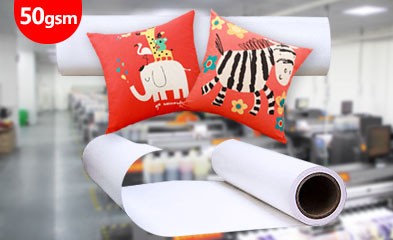
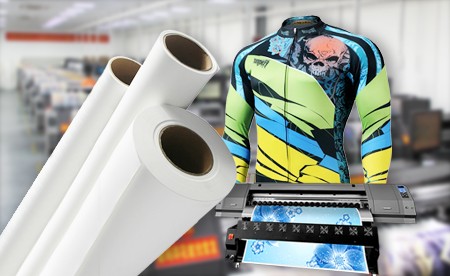
Consistency is easiest when nothing changes mid-run — what our 50gsm Factory Supply High Quality Jumbo Roll Sublimation Paper is wound for: 300 m to 3000 m in six widths from 61 cm to 183 cm, with a stable transfer rate across the length. One roll means no roll change, no second acclimatisation and no batch boundary — the three events that most often break consistency.
Conclusion
A flag, a lightbox panel, a backdrop and a banner run fail in four different places: the reverse side, the lit black, the seam and the last metre. All four failures were loaded into the job by the same four conditions — print-through, ink load, width and the calender pass — and none of them is repaired by one setting at the machine. Each is settled before the run, by matching the paper to the job: the coating weight that holds the ink the image needs, the width that covers the finished size or places the seam where it will not be read, and the roll form that keeps the first metre and the last metre under the same conditions.
Changfa Digital supplies those grades from one range, 29 gsm to 100 gsm, slit to the ordered width on 2 inch and 3 inch cores. Send the job type, the fabric, the finished width and the metres one run needs, the printer, printhead and ink in use, and a photograph of the defect on the last failed run, and the grade, the width and the ink load can be specified against that job instead of against a catalogue page.
FAQs
Q1: Can a single layer of transfer paper produce a true double-sided flag?
A1: No. On a single layer, the reverse image is show-through: across the flag fabrics in trade use it reaches roughly 50 to 75 per cent of the front image, and no ink load closes the rest, because past the fabric’s limit the extra ink blooms at the edges instead of deepening the reverse. A flag that must read the same from both sides is built differently, with a blockout liner or two printed layers sewn back to back.
Q2: Why does black print solid on the table and grey in the lightbox?
A2: On the table the print is seen by reflected light; in the box it is seen by light passing through it, and any gap in ink density lets that light through. Black shows it first because a solid black carries the highest density in the image. The correction is made in the ink limits set for that fabric: reduce the light inks and yellow first, then cyan and magenta, and reduce black last — then proof the panel lit, not on the table.
Q3: Why do bands appear in the middle of a long run when the first metres were clean?
A3: Banding that develops mid-run is rarely the file. Check the head condition as the run has heated and loaded, the flatness of the paper under a sustained heavy ink load, and whether the printed web is dry before it is rewound onto itself. A lane that repeats at the same width points at the paper path and the head; a band that wanders points at feed and tension. The first metres were printed before those conditions built up.


