


HOT SALE
APPLICATION

Phone:+86-15215969856 E-Mail: 396838165@qq.com
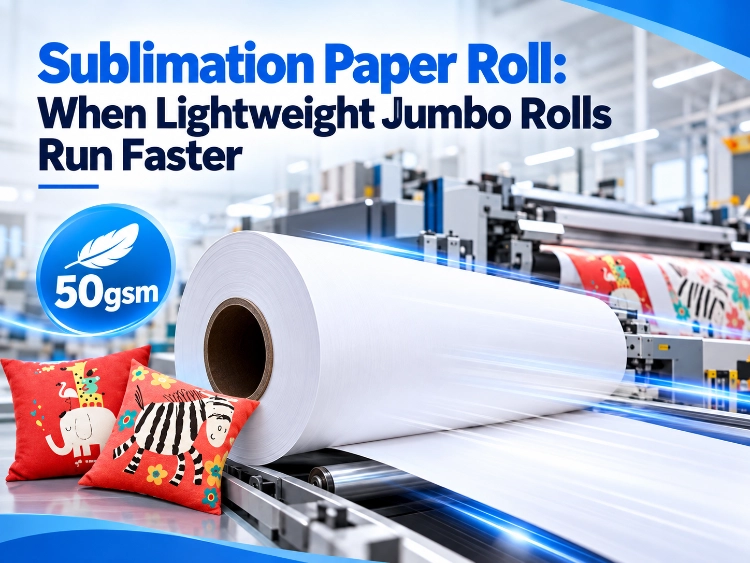
Night shift, two printers, one operator. That is how a sportswear shop we supply runs it, and on 300 m rolls the man spent half his night doing roll work instead of print work. Hang the new roll. Rethread. Print a test strip, press it, hold it against the last panel, then finally let the job go again. Three times a night, sometimes four.
Nobody buys a lightweight jumbo roll sublimation paper because the paper is thin. They buy the hours back. A 30 or 35gsm roll carries 1,000 m, and the stops mostly disappear. What does not disappear is the ink question, because a thin coating fills up fast, and that — not the metre count — is where these rolls earn or lose their place on a line.
A 1,000 m roll changes the shift, not just the paper bill
The speed is in the stops you never make
Start with the maths, because it is not close. A line fed on 300 m rolls wants a fresh roll about halfway through every shift, sooner when the designs run long. Feed it 1,000 m rolls instead and the stop happens once; the shops we supply that run 3,000 m lengths sometimes load on Monday morning and forget the shaft until Tuesday. None of this asks for a bigger machine, either. A thousand metres of 35gsm winds up roughly 26.5 cm across — it hangs on the same shaft, clears the same guards, and after the first hour nobody on the floor remembers it is there.
Ten minutes is what the changeover shows on paper. The real cost sits downstream of it. The calender behind the printer has a rhythm of its own and a long memory for temperature. Feed it in bursts — nothing for twenty minutes while a roll changes, then a flood — and its transfer temperature drifts with the workload, which shows up later as panels that do not quite match each other. A long roll keeps the flow boringly even from load to load, and boring is exactly what a calender wants. Operators notice this before managers do. The roll that makes those long runs possible starts as a coated mother roll at the mill and is slit to the ordered width — jumbo roll to short roll conversion is a discipline of its own, and it decides how clean the edges of your 1,000 m will run.
A long roll only pays if the back of the line can take it
Roll-to-roll transfer is the clean case: printed roll in, fabric roll out, both a thousand metres long. Piece work is different. Plenty of shops cut panels by hand at the back, and for them the queue just moves — less waiting at the printer, more waiting at the cutting table, same shirts at the end of the day. Roll length should be sized against the slowest station in the building. The printer is rarely it.
Width is the other trap. For 30, 31 and 35gsm we keep exactly one width on the shelf at Changfa Digital: 162 cm. Widths between 132 and 190 cm beyond that are slit to order here, in our own slitting workshops, and leave on 2 inch or 3 inch cores depending on the machine they are feeding. None of that is a problem when it is agreed up front. It becomes one when the first time anyone mentions width is after the pallet is already sitting in the buyer’s yard. The full width and length table, grade by grade, sits in our sublimation paper sizes guide for anyone speccing a line from scratch.
The ceiling is in the rating table
Two stars for ink volume means two stars
Open the spec sheet for any of the light grades — 30, 31, 35, 40gsm, the row barely changes. Transfer rate two stars. Transfer effect four. Maximum ink volume two stars. Drying four. Runnability three. Most buyers read the four-star lines and stop. The two-star line is the one that runs their factory.
A thin coating holds a thin film of ink. Physics stops there. Give a 35gsm roll a black-heavy jersey and a generous profile and you can watch the rest happen: the surface stays wet after printing, the sheet cockles as it dries — one lane dry, the next still damp — and at the press the big dark blocks come out pale around the edges, because the ink was sitting on the coating rather than in it. The roll gets blamed. The roll was innocent; the job sheet was written for heavier paper.
Concentrated ink is the partner thin paper wants
The fix has no glamour in it at all. Use a dense ink, and open the RIP and set the ink limit for this grade by hand, instead of leaving the 60gsm profile that is still saved in the machine from the last job. A high-concentration ink carries its colour in less water, which is what a two-star coating needs: the shade builds without flooding the surface, and at the press the ink lets go cleanly rather than smearing. Shops that skip the profile work usually phone us within a day. Shops that do it stop phoning.
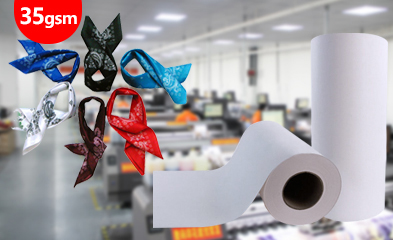
The 35gsm sublimation transfer paper spends its life on scarves, fashion panels and sportswear graphics — strong colour, controlled volume — and it presses at 225°C for 20 seconds, same as every other grade we sell. Nothing exotic. The discipline is all in the ink limit.
Dark work belongs to the 50gsm roll
At 50gsm the ink score steps up to three stars and the transfer rate runs 95% to 98% in normal production. Deep team-kit backgrounds, big navy blocks, the designs where a light roll forces you to back the colour off — that is 50gsm work, and it still ships as a jumbo roll from 300 to 3,000 m, so the long-run habit survives. The bill for that is a slightly dearer square metre and a few more roll changes across a month. Worth every cent on a run of navy kits; pure waste on a pastel fashion order. That is why both grades stay in the range, and why we ask about the work before we quote the paper.
Before you switch, check the roll against your line
Width, core, and a sealed bag
Three checks, five minutes, most of the arguments avoided. Width first: the paper has to follow the printer’s working width and the fabric coming off the roll, and on the light grades the shelf answer is 162 cm, so get that confirmed while the quote is still being written. Core second: check whether your shafts take the 2 inch or the 3 inch core before the order is slit, because a pallet wound on the wrong one cannot be mounted, full stop, and it happens more often than anyone admits. Storage third: light paper drinks damp air faster than heavy paper does, so our rolls travel sealed and should stay sealed in a dry room, 40 to 50% humidity, until loading day. A 35gsm roll left open through one wet week will wave at the edges on the calender, and no setting on the machine will talk it out of that. The complete version of this checklist is the one we use when specifying a jumbo roll for production; the three checks above are simply the ones that bite first.
Conclusion
Light rolls run faster on long jobs with moderate coverage and concentrated ink: a thousand metres between stops, a calender that never goes hungry, colour that holds because the coating stayed inside its limit. They stop running faster on dark, wet-profile work, where the 50gsm roll takes over without giving up the jumbo format. If you want to know which side your own work falls on, send us the printer model, the working width, the ink in the machine and one typical design. Our reply will name a grade and a width and include a trial length slit for your machine, so the argument gets settled by your own press, on your own fabric, under your own lights.
FAQs
Q1: If we move from 300 m rolls to 1,000 m lightweight rolls, how often will we be changing rolls?
A1: About a third as often. A shop changing three times a shift usually lands at once a shift, and the bigger saving hides behind that number: one test strip instead of three, and a calender that stays at temperature instead of cycling with the stops.
Q2: Can a 35gsm roll print black-heavy team jerseys?
A2: It will print them, but deep solids sit right against the two-star ink ceiling, so there is no margin for a wet profile or a humid week. Shops with regular black-heavy work do better on the 50gsm roll — three stars for ink volume, 95% to 98% transfer — and keep the light rolls for the work they are good at.
Q3: Do lightweight rolls need different press settings?
A3: No. They press at 225°C for 20 seconds, the same condition as the rest of the range. The change happens earlier, at the RIP: set the ink limit for the light grade, ideally with a high-concentration ink, rather than reusing a heavier grade’s profile.


