


HOT SALE
APPLICATION

Phone:+86-15215969856 E-Mail: 396838165@qq.com
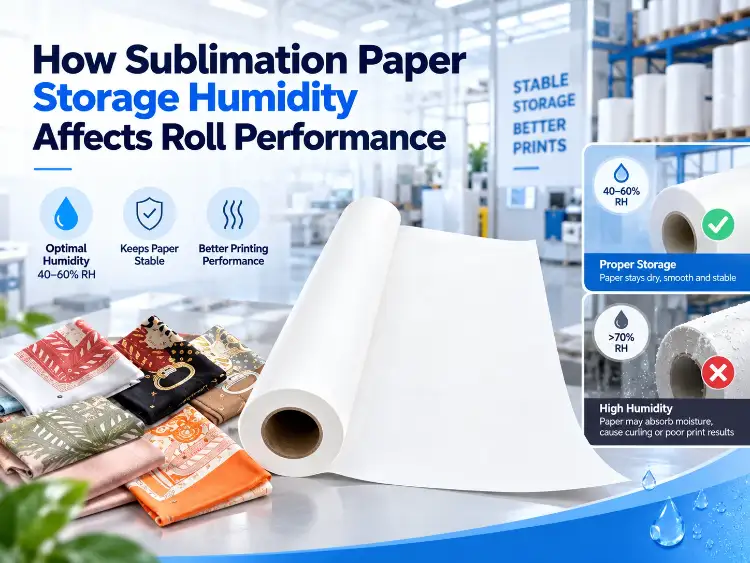
Paper is easy to treat as an inert consumable until a stored roll starts behaving differently. Sublimation paper storage humidity can change the base sheet, the coating, and the way the roll unwinds. The shift may appear as a raised edge, a wave through the web, uneven ink holdout, or a release mark that was absent from the approved sample.
The useful question is not whether one warehouse percentage is perfect. A practical storage plan controls the conditions that change between receiving, active production, and the next use of a partly consumed roll.
Moisture Changes the Paper Before It Reaches the Printer
Coating, Base Paper, and Uneven Expansion
Transfer paper combines a paper base with a coating designed to receive ink and release dye. The two layers do not respond to moisture at an identical rate. When the base sheet expands or contracts while the coating remains stable, curl and dimensional unevenness appear. When moisture sits at the surface, ink holdout and drying can change.
A visible defect is not required for the roll to perform differently. A small edge lift can create wrinkles as the paper crosses the feed path. A slight surface change can alter transfer at the highest ink loads while lighter images still look acceptable.
Why Results Drift Between Print Runs
Storage exposure depends on time. A roll used within hours of opening has a different history from one that remains partly used for weeks. Seasonal weather, overnight cooling, and a closed warehouse without air movement all change the local condition around the roll.
The record that matters links exposure to output: opening date, storage zone, obvious room conditions, remaining length, and the print or transfer result at restart. That history separates a paper problem from a printer adjustment.
A Storage Area Can Look Dry and Still Cause Problems
Temperature Shifts and Condensation
A large temperature change can cause condensation even when the room does not feel wet. A roll moved from a cold vehicle into a warm print floor may collect moisture on the packaging or exposed surface. Allow sealed rolls to reach room condition before opening them when that temperature difference is obvious.
Avoid exterior walls, leaking pipes, drying equipment, and areas directly under heating or cooling vents. Local conditions can differ from the room sensor. Use more than one reading when a recurring defect appears in the same storage position.
Dust, Sunlight, and Direct Airflow
Dust on the exposed edge can move into the coating as the roll unwinds. Sunlight heats one side of the package and creates uneven expansion. A strong fan or open door can dry the outer layers faster than the core. None of these conditions guarantees a defect, but each adds variation to a product that needs a stable surface.
Keep sealed rolls wrapped until use. Store active stock away from cutting, sanding, and fabric-handling areas where particles remain in the air.
Handling Sealed, Active, and Partly Used Rolls
Support the Roll Without Damaging the Core
Store heavy rolls horizontally on a clean rack or pallet that supports the full length. A narrow contact point can deform the wrap or damage the core. Keeping the package off a damp floor reduces exposure and makes inspection easier.
The 50gsm jumbo paper roll is one production format with handling needs defined by its diameter, weight, and packaging. Use a support method that matches the actual roll rather than copying a shelf design from a smaller format.
Rewrap and Return Partly Used Rolls
A partly used roll has more exposed surface than a sealed package. Rewrap it, close the wrap, and return it to a stable storage position. Avoid leaving it on the printer through a long shutdown or beside an open door. If the roll remains in the print room, protect it from dust and direct airflow.
Keep the roll orientation consistent where possible. The same support and handling method makes edge damage or winding drift easier to notice.
Label the Date, Grade, and Remaining Length
Attach a label that states the opening date, paper grade, roll width, core, remaining length, and storage location. A 100gsm sublimation paper roll can have a different handling profile from a lighter product, so the record needs the exact format rather than only “sublimation paper.”
The label also gives the next operator a reason to inspect the roll before production. Unlabeled stock often receives the longest exposure because no one knows when it was opened.
Restart Tests That Reveal Storage Damage
Inspect Curl, Edge Shape, and Winding
Unwind several meters before loading a full production run. Check edge curl, waves, dents, wrinkles, coating marks, and winding pressure. Compare the appearance with the beginning of the roll or with a sealed reference from the same grade.
Damage limited to the outer wrap may be removed as waste. Damage that returns farther into the roll, or an edge shape that changes under tension, needs a quality decision before the customer order begins.
Print and Transfer a Known Reference Image
Use a short chart with fine lines, solid blocks, gradients, and a known color target. Print and transfer it with the approved fabric and settings. Compare the result with a recent good sample from the same paper grade. A sublimation paper range can help the buyer compare formats, but the actual result shows whether storage changed the material.
If a stored roll fails while a newly opened roll passes, preserve both samples and the storage record. That comparison is more useful than changing several printer settings at once.
Build a Storage Routine the Team Can Repeat
Use Incoming, Active, and Reserve Zones
Incoming rolls remain wrapped until they reach room condition. Active rolls stay in the cleanest and most stable part of the print area. Reserve stock remains closed and rotates in order. This simple separation prevents a new delivery from being opened while older material remains at the back of the rack.
For a 40gsm sublimation transfer paper order, record the paper grade, width, core, packaging, and storage instructions at receiving. The product center provides the current paper, ink, and machine categories when a format change is under review. A lighter or heavier roll may need a different support or handling method even when both arrive in similar packaging.
Link Storage Records to Print Quality
When a defect appears, record how long the roll stayed idle, where it was stored, and which roll or batch was used. If a fast dry sublimation paper performs well after one week but changes after a humid month, the exposure history becomes part of the investigation. If one roll fails in every location, inspect the material and packaging.
The record does not need to be complex. A date, roll ID, storage zone, room reading, and restart result are enough to build a pattern that the production team can act on.
Conclusion
Sublimation paper storage humidity matters because moisture changes paper dimensions, coating behavior, curl, ink holdout, and transfer release. Stable storage, correct support, wrapped partly used rolls, and a known restart test reduce the chance that a production problem begins before the paper reaches the printer.
Send the paper grade, roll width and core, packaging, storage method, time between runs, printer model, ink series, fabric, and defect that appears after storage to Changfa Digital. Those details make it possible to compare the handling conditions with the applicable paper format.
FAQs
Q1: What happens when sublimation paper takes on moisture?
A1: The base paper and coating can respond at different rates. That may cause curl, waves, dimensional change, uneven ink holdout, or inconsistent transfer release.
Q2: Can a partly used roll remain on the printer?
A2: It can remain in a stable print room when protected from dust, heat, and direct airflow. Rewrap the roll and record its opening date, grade, and remaining length.
Q3: How should a stored roll return to production?
A3: Unwind several meters, inspect for curl and edge damage, then run a short print and transfer test against a known-good sample from the same paper grade.


